

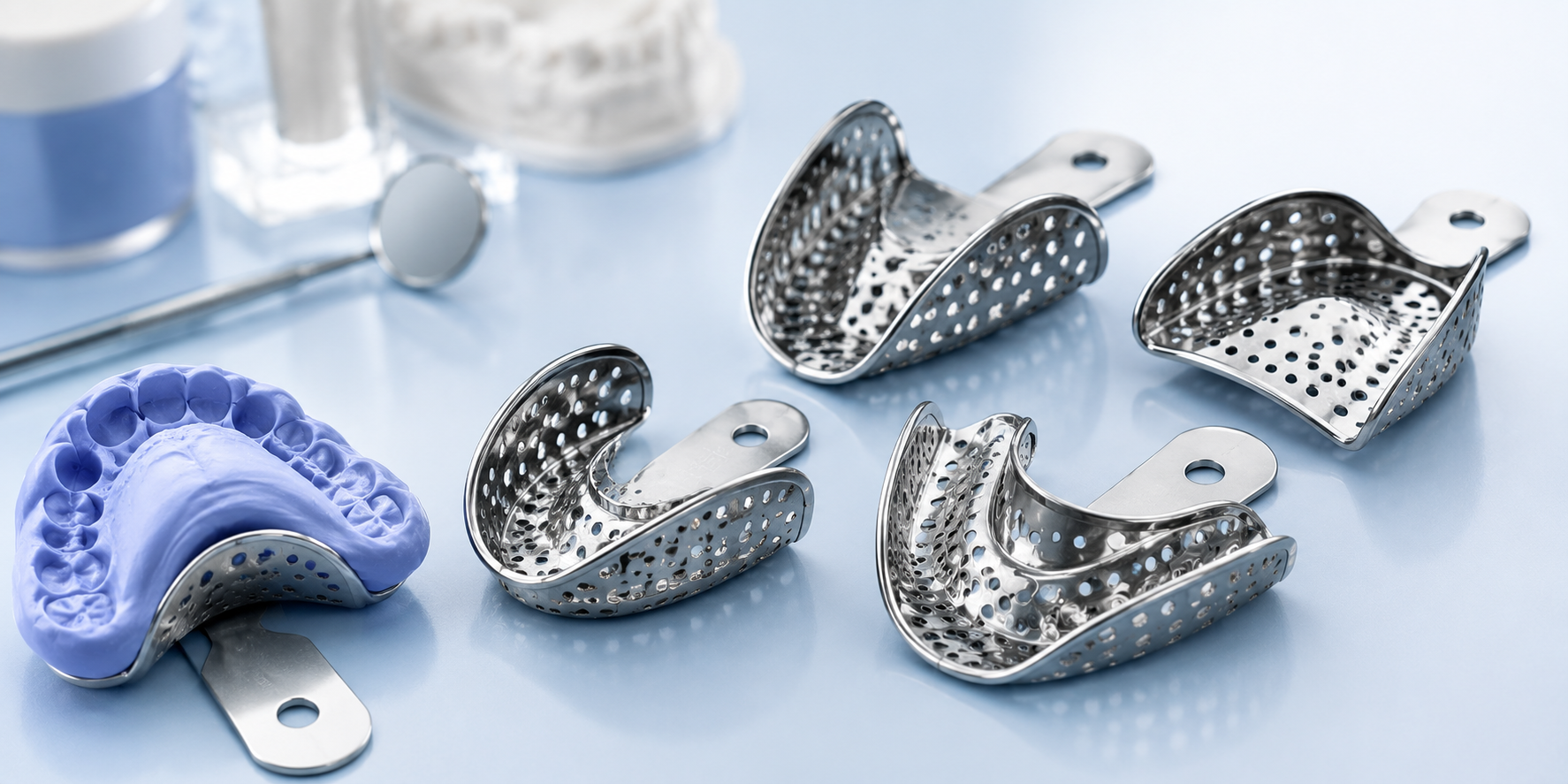
The dental impression tray is one of the most foundational tools in clinical dentistry used in almost every restorative workflow, yet rarely explained in enough technical depth for the labs and clinicians who rely on it daily. Getting the tray selection right determines whether the impression accurately captures the patient's anatomy, whether the material seats and releases cleanly, and whether the resulting cast or digital model has the precision the restoration requires.
This guide covers everything dental professionals and lab technicians need to know: how impression trays work, the three main tray types, how to match the tray to the procedure, what materials modern labs use for CAD/CAM-milled custom trays, and how impression workflow connects to the broader zirconia dental blanks and restoration production chain.
How Dental Impression Trays Work?
A dental impression tray is a rigid or semi-rigid carrier used to hold impression material in contact with the teeth and surrounding oral tissues long enough for the material to set. The result is a negative imprint of the patient's oral anatomy teeth, gingiva, palate, and ridges which is then used to produce a positive stone or digital model for restoration fabrication.
The tray serves three mechanical functions simultaneously. It must confine the impression material so it flows uniformly around all anatomical surfaces. It must hold the material dimensionally stable during setting so the impression does not distort. And it must release cleanly from the set material without tearing or deforming the impression at the margins the region most critical for restoration accuracy.
Every choice made at the tray selection stage affects all three of these functions. Size, shape, material, perforation pattern, and whether the tray is stock or custom-fitted all determine how well the impression captures the preparation margin and therefore how well the final restoration fits.
The Three Main Types of Dental Impression Trays
Stock Trays
Stock trays are pre-fabricated in standardized sizes and sold ready to use. They are the most widely used impression tray format in general dental practice available in small, medium, large, and extra-large arch sizes for both maxillary and mandibular arches, and manufactured in stainless steel, chrome-plated metal, rigid plastic, or acrylic.
Metal stock trays are the most dimensionally stable and reusable after sterilization. Plastic and acrylic stock trays are typically single-use, though some rigid plastic formats are rated for autoclave sterilization. Perforated stock trays provide mechanical retention for alginate and polyvinyl siloxane impression materials through the tray wall, which improves the tray-to-material bond during removal.
The limitation of stock trays is fit. A tray that does not conform closely to the patient's arch leaves excess impression material, which increases the risk of dimensional distortion during setting and removal. For full-arch cases where every margin must be captured accurately crown preparations, bridge preparations, full-arch fixed prosthetics stock trays are frequently insufficient for the precision the lab requires.
Disposable Plastic Trays
Disposable trays are single-use plastic stock trays designed primarily for infection control efficiency. They eliminate the sterilization cycle required for metal stock trays, reduce cross-contamination risk between patients, and lower the per-impression processing time. In high-volume general practices where full-arch accuracy is secondary to speed and throughput routine alginate study models, orthodontic records, whitening tray fabrication disposable trays are a practical default.
They are not appropriate for crown and bridge impressions, implant-level impressions, or any case where marginal accuracy determines restoration fit. The dimensional stability of disposable plastic is lower than metal stock trays, and the fit is no more precise than standard stock formats.
Custom Impression Trays
Custom trays are fabricated from the patient's own diagnostic model, providing a tray that conforms precisely to the individual arch anatomy. The uniform 2–4 mm spacing between the tray and the tissues achieved through custom spacer wax during fabrication — ensures even impression material thickness throughout the impression. Even material thickness is the single most important factor in dimensional accuracy for polyvinyl siloxane and polyether impressions.
Custom trays are the clinical standard for:
- Crown and bridge final impressions
- Full-arch fixed implant impressions
- Complete denture final impressions
- Implant-level open-tray and closed-tray impressions
- Any case where marginal fit tolerance is less than 50 microns
The material used to fabricate the custom tray directly affects its rigidity, accuracy, and clinical performance. This is where CAD/CAM resin technology has significantly upgraded the custom tray workflow for modern dental labs.
CAD/CAM Custom Tray Materials: What Labs Are Using Now
The traditional method for custom tray fabrication hand-adapting light-cure or heat-activated acrylic over a spacer-waxed model has been largely displaced in modern labs by CAD/CAM-milled custom trays. Digitally designed and milled trays offer superior dimensional accuracy, consistent wall thickness, and reproducible geometry compared to manually formed trays, where thickness variation is operator-dependent.
The material choice for CAD/CAM custom trays is purpose-formulated dental impression tray resin Whip Mix VeriTray is a widely used example, engineered specifically for the mechanical demands of impression tray applications. Tray resin must be rigid enough to resist deformation under impression material seating pressure and removal force, biocompatible for oral use, and machinable to a smooth surface that seats cleanly against impression material adhesives.
VeriTray is formulated to meet these requirements from a CAD/CAM milling workflow available in standard 98 mm disc format, compatible with open-system mills, and producing trays that maintain dimensional stability through the full impression cycle from seating to removal.
For labs running Keystone's resin product range, the key tray resin is an equivalent format purpose-built for custom impression tray production in a digital workflow, with the material properties optimized for tray rigidity, polished edge finish, and impression material adhesion compatibility.
Both formats represent a significant upgrade over hand-formed acrylic: the digital workflow produces a tray with consistent geometry that the dentist can trust for critical final impressions, rather than compensating for uneven wall thickness during material application.
Comparing custom tray material formats:
| Property | CAD/CAM Tray Resin | Traditional Light-Cure Acrylic | Vacuum-Formed Thermoplastic |
|---|---|---|---|
| Dimensional accuracy | High digitally controlled | Moderate operator-dependent | Low thickness varies |
| Wall thickness consistency | Uniform throughout | Variable | Variable |
| Rigidity | High | Moderate to high | Low to moderate |
| Surface finish | Smooth mill-finished | Rough requires trimming | Smooth |
| Workflow integration | CAD/CAM native | Manual | Manual |
| Production time | Fast milled to design | Slow multi-step bench | Fast but limited accuracy |
Impression Tray Materials: Matching the Material to the Procedure
The tray material and the impression material must be selected together different impression materials require different tray characteristics for optimal performance.
Alginate
The most forgiving impression material and works with stock trays, perforated or solid. Its dimensional stability is limited it dehydrates and distorts within minutes of removal so the impression must be poured immediately regardless of tray format. Alginate is appropriate for study models, orthodontic records, and whitening tray fabrication. It is not appropriate for crown and bridge final impressions.
Polyvinyl Siloxane (PVS)
The standard material for crown, bridge, and implant final impressions in most practices. PVS requires a clean, dry field and good tray retention either perforations or tray adhesive. Custom trays with uniform 2–4 mm spacing are strongly preferred for PVS final impressions because the dimensional accuracy of the set impression is directly related to the uniformity of material thickness.
Polyether
An alternative to PVS for final impressions, offering higher rigidity in the set state and excellent marginal detail reproduction. Polyether is moisture-tolerant during setting but hydrophilic after setting store polyether impressions away from humidity. Like PVS, polyether performs best in a custom tray with even material thickness.
Zinc Oxide Eugenol (ZOE)
Paste is used for final impressions in edentulous cases specifically for complete denture final impressions where mucosal detail is the priority rather than tooth preparation margin capture. ZOE requires a custom tray fitted closely to the edentulous arch.
How Impression Accuracy Connects to the Downstream Restoration Workflow?
The impression tray and material are the first step in a production chain that ends with the final restoration seating on the prepared tooth. Every dimensional error introduced at the impression stage compounds through the subsequent workflow: model pouring, die trimming, CAD scanning, design, milling, and sintering.
For labs producing restorations from zirconia blocks dental Aidite multilayer zirconia, Upcera, or other precision-milled formats an inaccurate impression is the upstream cause of a poorly fitting crown, regardless of how precisely the disc was milled. A 50-micron impression error at the margin translates directly into a 50-micron fit error at delivery, which may require adjustment, remakes, or cementation compensation.
This is why the custom tray format is the correct clinical standard for final impressions in crown and bridge cases. The lab cannot recover accuracy that was not captured in the impression. Asking a lab to mill a precisely fitting crown from an inaccurate impression is asking the milling machine to correct a problem the tray was supposed to prevent.
What ZirconiaGuys Stocks for Impression Tray Workflows?
As a zirconia materials distributor usa serving dental labs across the country, ZirconiaGuys stocks more than dental zirconia discs Upcera esthetic and functional zirconia alongside impression tray resins, surgical guide resins, model resins, and the full range of CAD/CAM production materials labs need to run complete digital workflows.
For labs building or rationalizing their CAD/CAM resin inventory alongside zirconia:
- Impression tray production: Whip Mix VeriTray and Keystone Key Tray Resin both purpose-formulated, open-system compatible, US-stocked.
- Surgical guide production: Whip Mix VeriGuide Clear biocompatible, transparent, designed for implant surgical guide applications.
- Study and diagnostic models: Whip Mix VeriModel range grey, ivory, golden brown, and ortho white formats for different model-reading applications.
- Splint and night guard production: Whip Mix VeriSplint Clear and Keystone KeySplint Hard and Soft formats.
The full range is available from US inventory with same-day or next-day shipping. As covered in our Role of Dental PMMA in Temporary and Long-Term Restorations guide, the digital workflow depends on the right material being available at every production stage not just at the zirconia milling step.
For labs evaluating zirconia blank alongside impression tray and resin products, ZirconiaGuys provides consolidated supply from US inventory reducing the multi-vendor overhead that most full-service labs manage today.
Dental impression trays are not a commodity item in the restoration production chain they are the first precision decision that determines whether every downstream step delivers the clinical accuracy the patient and dentist expect. Understanding the tray types, matching the material to the procedure, and using the right zirconia blocks and CAD/CAM resin materials throughout the workflow is what separates labs that consistently hit marginal accuracy from labs that spend time adjusting and remaking restorations that didn't have to fail.
ZirconiaGuys stocks the full range of impression tray resins, CAD/CAM zirconia blank formats, and dental production materials from US inventory all from a single supplier built specifically for dental lab workflows.


