

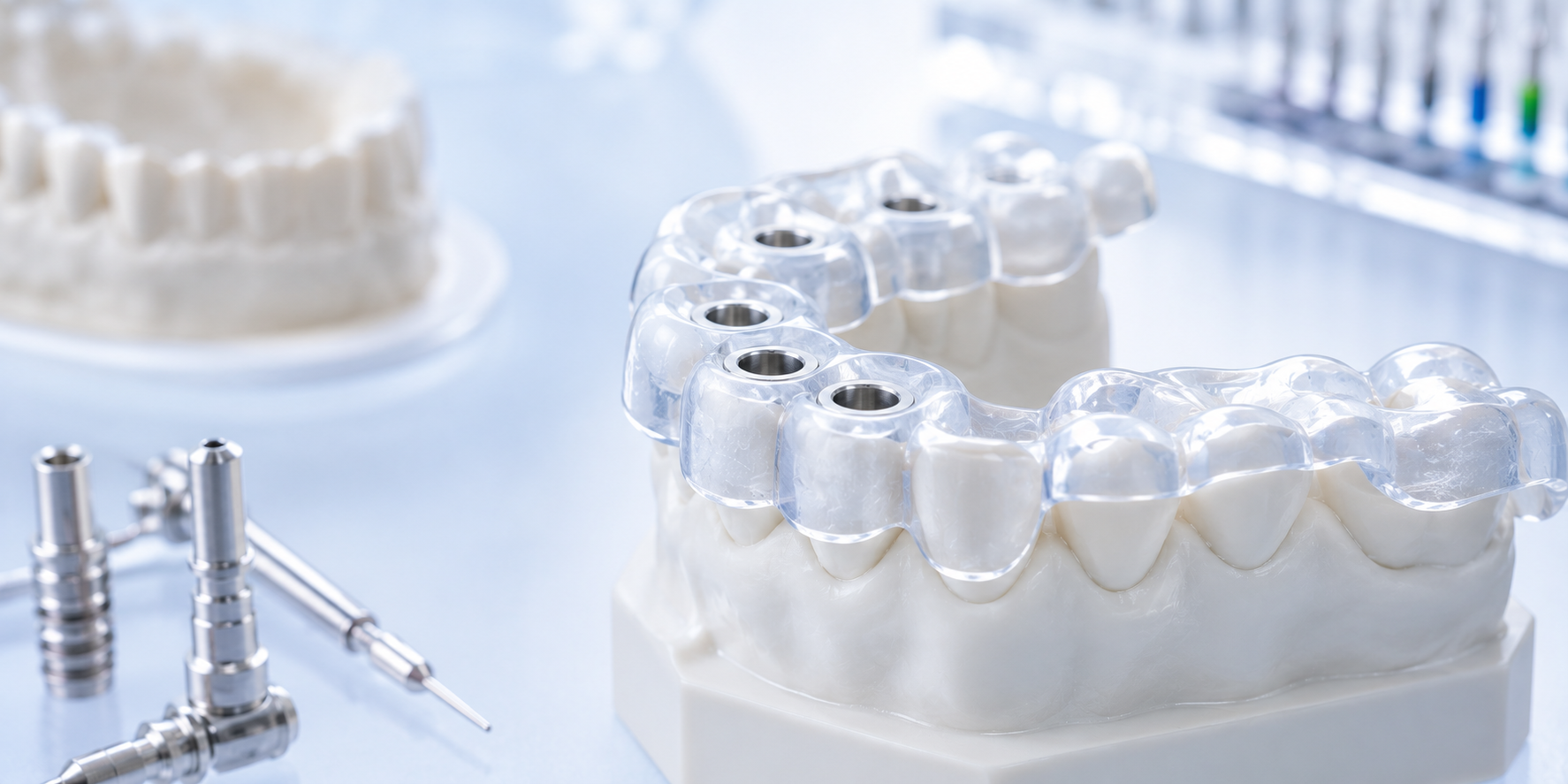
Dental workflows have changed dramatically over the past decade. Chairside milling, digital impressions, and CAD/CAM production have replaced most manual fabrication steps and the materials used in those workflows have evolved alongside the technology. PMMA has been part of dentistry since the 1940s, but the material available to labs and dentists today bears little practical resemblance to the bench-mixed acrylic of earlier generations. Modern pre-polymerized PMMA discs are precision-engineered for digital milling, with consistent mechanical properties, controlled residual monomer, and formulations matched to specific clinical applications.
Understanding what separates high-quality PMMA from generic acrylic, where it fits in the full material hierarchy, and how to choose the right formulation for each application is practical knowledge that directly affects clinical outcomes and lab efficiency. This guide covers all of it.
What Is Dental PMMA and How Is It Made?
PMMA stands for polymethyl methacrylate a thermoplastic acrylic polymer that has been used in dental applications for over seventy years. In modern dental labs, PMMA refers specifically to pre-polymerized CAD/CAM discs manufactured under controlled industrial conditions, not to the hand-mixed powder-and-liquid acrylic still used in some traditional workflows.
The difference between bench-mixed acrylic and industrial pre-polymerized PMMA is significant. Traditional acrylic is mixed from monomer liquid and polymer powder at the bench and cured at atmospheric pressure in a water bath or flask. This process traps residual monomer at levels of 3–5% or higher a known irritant that causes tissue sensitivity in susceptible patients. The packing and curing process also introduces porosity and dimensional variability that affects fit accuracy.
CAD/CAM pmma dental material discs are polymerized under high pressure typically 50 to 200 bar and elevated temperature in industrial autoclaves. This industrial process produces a denser, more homogeneous polymer with residual monomer below 0.5%, near-zero internal porosity, and consistent dimensional properties that enable accurate digital milling. The result is a safer, more machinable, and more predictable material than anything bench mixing can produce.
Why Dentists and Dental Labs Prefer PMMA Today?
The preference for PMMA in modern dental workflows is not about sentiment for a traditional material it is about specific performance characteristics that no other material class delivers at PMMA's price point and workflow compatibility.
Machinability in CAD/CAM systems.
PMMA mills cleanly and quickly in all major open-system dental milling machines. Its softness relative to ceramics and zirconia blocks dental formats means faster milling cycles, lower bur wear, and fewer milling errors. A single PMMA disc produces multiple restorations per milling session at a fraction of the time required for ceramic milling.
Repairability and adjustability.
Unlike dental zirconia discs and ceramic restorations that cannot be added to or structurally repaired, PMMA restorations can be adjusted at the chairside with standard acrylic instruments, extended with cold-cure acrylic, and relined without fabricating a new restoration from scratch. In provisional and removable applications, this adjustability is a core clinical advantage.
Biocompatibility.
Pre-polymerized PMMA meeting ISO 20795-1 requirements is biocompatible for both short-term provisional and long-term removable applications. The low residual monomer of industrial pre-polymerized discs is well below the threshold associated with tissue sensitivity, making it appropriate for direct tissue contact in denture base applications.
Cost efficiency.
The per-case material cost of PMMA is significantly lower than ceramics or zirconia blank formats. For temporaries and removable applications where the restoration will be replaced or modified, the economics of PMMA are clearly superior. Labs that calculate total case cost including finishing labor, not just disc acquisition find that quality pre-polymerized PMMA consistently delivers the lowest total cost per provisional unit.
For labs sourcing quality pmma dental material from a reliable US supplier, ZirconiaGuys stocks the full Aidite PMMA range denture base, multilayer, and clear formulations from domestic inventory with no international lead times.
PMMA for Denture Bases: The Long-Term Application
The highest-demand long-term application for PMMA in dental labs is the denture base. Full and partial removable dentures require a base material that sits in direct contact with oral mucosa for extended daily wear sometimes all day, every day for years. The material requirements for this application are stricter than for any temporary restoration: low residual monomer, excellent polishability, dimensional stability over time, and gingival shade accuracy that maintains its appearance across years of use.
Pre-polymerized CAD/CAM PMMA meets all four requirements in a way that conventional bench-mixed acrylic cannot consistently deliver. The industrial polymerization process ensures residual monomer stays well within ISO biocompatibility limits. The dense polymer matrix polishes to a high gloss quickly reducing bench finishing time per unit and maintains its surface quality under the abrasion of daily oral use significantly better than porous, bench-cured alternatives.
Shade stability is the other critical factor. A denture base that yellows, grays, or shifts shade within the first year of wear creates patient dissatisfaction and requires remake. High-quality pre-polymerized PMMA uses colorfast pigmentation that maintains gingival shade fidelity across the clinical lifespan of the restoration.
The aidite denture base pmma disc is the benchmark product in this category for US dental labs formulated specifically for full and partial denture base production with documented biocompatibility, consistent batch-to-batch shade, and polishing behavior that reduces finishing time compared to generic alternatives.
PMMA for Temporary Crowns and Bridges: The Provisional Application
The highest-volume PMMA application in most dental labs is the temporary crown and bridge provisional. Single-unit and multi-unit temporary restorations are produced at high volume protecting prepared teeth, previewing final esthetic outcomes, and maintaining occlusal relationships during the treatment period between preparation and final restoration delivery.
PMMA provisionals are produced in two primary formats for this application: single-shade discs for posterior cases where shade matching is secondary to fit accuracy, and multilayer gradient discs for anterior cases where the temporary must credibly match natural tooth appearance to allow the patient to evaluate the proposed esthetic outcome.
The aidite pmma multilayer disc format delivers a dentine-to-incisal gradient within a single blank the same gradient architecture concept used in multilayer zirconia dental blanks, applied to PMMA for provisional restorations. Labs that handle high-volume anterior cases use multilayer PMMA to produce temporaries that require minimal post-milling staining, reducing finishing time on every anterior provisional case.
For long-term provisionals worn for three to twelve months during complex treatments full-mouth rehabilitations, implant osseointegration phases, or large-scale esthetic cases high-quality pre-polymerized PMMA is essential. Low-quality PMMA with high internal porosity absorbs staining agents and accumulates biofilm over extended wear, leading to surface degradation and patient complaints well before the treatment timeline requires remake.
PMMA Formulation Types: Matching the Disc to the Application
Not all PMMA discs are the same product. PMMA is a material class with distinct formulations engineered for distinct clinical applications. The most common mistake labs make with PMMA is treating all discs as interchangeable using denture base formulations for crown and bridge applications, or vice versa.
Sourcing from a multilayer pmma disc range that covers all three primary formulations gives labs the flexibility to match material to application correctly on every case.
- Denture base PMMA — Pigmented with gingival tissue shades. Optimized for tissue contact, biocompatibility, and polishability. Not appropriate for crown and bridge provisionals where tooth-like translucency is required. Available in standard pink, medium reddish-pink, and darker reddish-brown shades to cover the gingival tone range of different patient demographics.
- Multilayer PMMA — Manufactured with a shade gradient from the cervical end to the incisal end of the disc. Produces tooth-like optical gradation in temporary crowns without post-milling staining in standard A-shade cases. The correct default format for anterior provisional production in any lab running a digital workflow.
- Clear/transparent PMMA — Formulated for maximum optical clarity. Used for occlusal splints, night guards, orthodontic retainers, and clear appliances. Not appropriate for crown and bridge or denture applications where shade accuracy is needed.
| PMMA Format | Primary Application | Key Property | Wrong Use Case |
|---|---|---|---|
| Denture base | Full and partial dentures | Gingival shade accuracy | Crown and bridge provisionals |
| Multilayer tooth-shade | Temporary crowns and bridges | Dentine-to-incisal gradient | Denture bases |
| Clear / transparent | Splints, retainers, clear appliances | Optical clarity | Any shade-sensitive application |
PMMA vs. Zirconia: Understanding the Correct Hierarchy
The most important material relationship in a modern dental lab is between PMMA and zirconia not because they compete for the same applications, but because they form a sequential production pair in most complex treatment cases.
Zirconia blocks and PMMA discs serve completely different clinical functions. PMMA handles every temporary and removable application: provisionals, denture bases, splints, and clear appliances. Zirconia blank formats handle every permanent fixed application: crowns, bridges, and implant-supported restorations. The material hierarchy is clear PMMA is the temporary phase, zirconia is the permanent phase, and they work together rather than against each other in any well-organized lab workflow.
| Property | PMMA | Dental Zirconia |
|---|---|---|
| Flexural strength | 80–120 MPa | 500–1200+ MPa (grade dependent) |
| Repairability | Excellent | Not repairable |
| Wear resistance | Moderate | Excellent |
| Cost per disc | Low | Moderate to high |
| Primary application | Temporaries, dentures, splints | Permanent crowns and bridges |
| CAD/CAM machinability | Fast, low bur wear | Slower, higher bur wear |
Labs that stock both PMMA and zirconia and use each in its correct application are more efficient and produce better outcomes than labs that try to stretch one material beyond its clinical mandate. As a zirconia materials distributor usa, ZirconiaGuys stocks the full range alongside Aidite PMMA, enabling labs to consolidate their CAD/CAM material supply from a single US inventory source.
Common PMMA Mistakes and How to Avoid Them
Using the wrong formulation.
Denture base PMMA in crown and bridge applications produces opaque, tissue-toned temporaries that look nothing like natural teeth. Match the formulation to the application every time tooth shade for crowns, gingival shade for dentures, clear for appliances.
Underestimating long-term provisional requirements.
Standard PMMA is designed for weeks. Extended wear provisionals of three months or more require high-quality pre-polymerized discs with documented low porosity. Low-grade PMMA degrades visibly within the first few months of extended wear.
Treating PMMA as a substitute for permanent zirconia restorations.
PMMA at 80–120 MPa flexural strength will wear, stain, and structurally degrade over the years of service life that zirconia is designed to handle. It is a temporary material, and using it as a permanent restoration creates patient outcomes that reflect that compromise.
Dental PMMA is not a legacy material waiting to be replaced it is a precision-engineered material class that fills an irreplaceable role in the modern CAD/CAM workflow. Temporaries, denture bases, splints, and clear appliances all depend on PMMA, and they all depend on getting the formulation right. The labs that produce consistent clinical outcomes with PMMA are the ones that stock the correct formulations, source from suppliers with documented batch consistency, and understand where PMMA ends and dental zirconia discs begin.


