

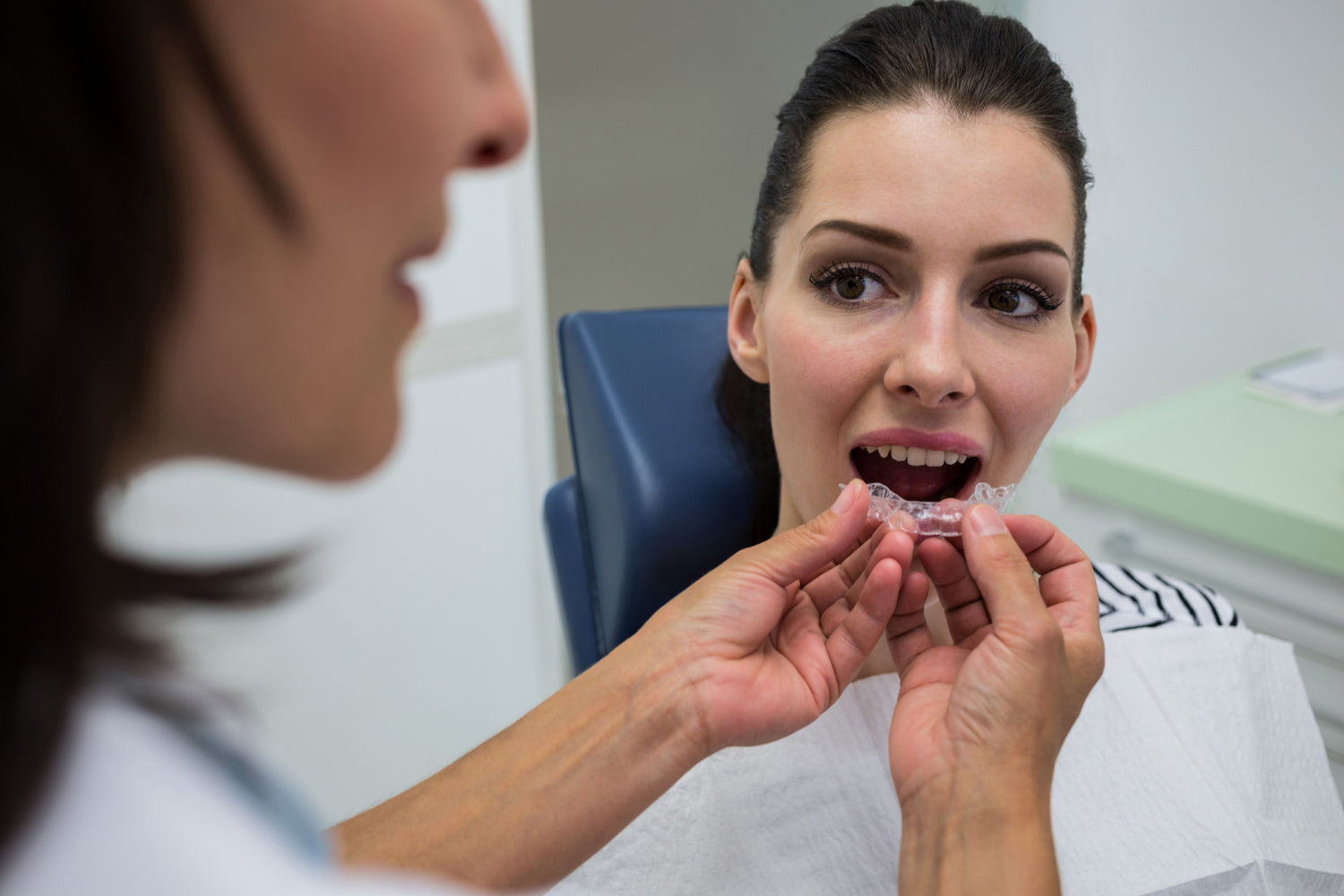
A temporary restoration has a specific job: protect the prepared tooth or implant site, maintain occlusion, preserve aesthetics, and condition the soft tissue emergence profile all while the permanent restoration is being fabricated or while an implant integrates with bone. It's a functional role that can span a few days or several months, and the material it's made from needs to be appropriate to that role.
High-strength PMMA blocks have become the standard for milled temporary restorations in digital dental labs because they serve that role better than the alternatives not because they're the strongest material available, but because their combination of properties fits the clinical requirement precisely. This guide explains why, with the technical context that sourcing and clinical decisions need to be grounded in. For labs specifying PMMA teeth and temporary restorations alongside dental zirconia permanent cases, the distinction between what PMMA does and what zirconia does is the most important framework to understand.
What "high-strength" means for PMMA blocks and what it doesn't?
The term "high-strength" in PMMA blocks refers to the improvement in mechanical properties achieved by milling from industrially pre-polymerised blanks rather than processing conventional powder-liquid acrylic. It does not mean the material approaches the strength of ceramic or zirconia and understanding that distinction prevents misspecification.
Industrial-grade milled PMMA blocks achieve flexural strength of 80–120 MPa, with lower variance and better consistency than conventionally processed acrylic. That strength range is adequate for:
- Temporary crowns and bridges worn days to weeks while a permanent restoration is fabricated
- Implant temporaries worn during osseointegration (3–6 months)
- Long-term provisionals in complex full-mouth rehabilitation cases
- Diagnostic wax-up equivalents for patient evaluation
It is not adequate for permanent posterior crowns, bruxism patients under heavy parafunctional load, or any case where the restoration is expected to function permanently without replacement. For those cases, dental zirconia in zirconia blocks or dental zirconia discs is the correct specification. The two materials are complementary, not interchangeable.
Why milled PMMA blocks outperform conventional acrylic for temporaries?
Most labs running digital workflows have already made the switch from conventional acrylic temporaries to milled PMMA, but it's worth being explicit about why particularly for labs evaluating the transition.
Residual monomer is substantially lower. Conventional powder-liquid acrylic retains residual methyl methacrylate monomer from incomplete polymerisation. Residual monomer leaches into the oral environment and is the primary cause of tissue sensitivity reactions associated with acrylic temporaries. Industrial PMMA blocks are fully polymerised before machining the monomer has already reacted, and there is essentially none left to leach. For implant temporaries placed adjacent to healing tissue, this is a meaningful clinical advantage.
Porosity is significantly reduced. Conventionally processed acrylic develops microporosity during the polymerisation and curing process. This porosity provides sites for bacterial colonisation and stain absorption. Milled PMMA from dense industrial blanks has a non-porous, smooth surface that resists both directly relevant for temporaries placed adjacent to soft tissue during a healing period where microbial load management matters.
Dimensional accuracy is better. Conventional acrylic processing introduces polymerisation shrinkage that complicates fit. The restoration has to be adjusted chairside to compensate. Milled PMMA is cut from a dimensionally stable blank to CAD specifications the restoration comes off the machine at the intended dimensions. Initial fit is better, chairside adjustment time is lower, and the tissue-conditioning profile of an implant temporary is more precisely maintained.
Mechanical consistency is higher. Conventional processing produces variation in polymerisation completeness across the restoration. Pre-polymerised PMMA blocks have homogeneous properties throughout the flexural strength measured at any point across the blank is consistent. That consistency translates to more predictable clinical performance over the service life of the temporary.
Why PMMA is chosen over zirconia for temporary restorations?
The question of why labs use PMMA instead of zirconia for temporaries has a simple answer: the clinical role of a temporary restoration doesn't require zirconia's properties, and zirconia's properties are actually disadvantageous for a temporary.
Adjustability. A sintered dental zirconia crown whether milled from zirconia blocks dental labs run for permanent work or from dental zirconia discs cannot be meaningfully adjusted chairside. It can be spot-ground to a limited degree, but the hardness that makes zirconia clinically valuable as a permanent material makes it impractical for a temporary that needs to be modified as tissue heals, as the patient's bite settles, or as the clinician refines the emergence profile of an implant case. PMMA trims and polishes with standard chairside instruments in minutes.
Cost proportionality. A permanent zirconia crown from a zirconia blank is designed for 10–15 years of clinical service. A temporary restoration is designed to be replaced after weeks or months. Specifying a permanent-grade dental zirconia material for a case that will be followed by a permanent restoration uses a high-cost material for a temporary purpose. PMMA at significantly lower cost per unit than any zirconia dental material is economically correct for the clinical role.
Shock absorption during healing. PMMA's lower stiffness compared to sintered zirconia dental blanks provides a degree of force dampening during the osseointegration period. While occlusal design is the primary protection for a healing implant, the material's compliance contributes to a more forgiving mechanical environment during the period of greatest vulnerability.
Turnaround speed. PMMA mills in a fraction of the time required for zirconia, with no sintering step. A temporary crown can be designed, milled, finished, and delivered in a single clinical session. Dental zirconia even with fast-fire sintering requires a furnace cycle of at least 90 minutes. For same-day temporary delivery, PMMA is the practical choice.
Clinical applications that require high-strength PMMA blocks specifically
Implant temporization during osseointegration
The clinical case for high-quality PMMA blocks is strongest in implant temporization. During the three-to-six-month osseointegration period, the temporary crown worn by the patient actively shapes the soft tissue emergence profile that the permanent crown will inherit. A poorly fitting or incorrectly contoured temporary creates a soft tissue environment that complicates the permanent restoration tissue that hasn't been correctly conditioned requires additional procedures to correct.
A milled PMMA temporary from a digital design file replicates the planned permanent restoration geometry precisely. The soft tissue emergence, interproximal contacts, and occlusal design established by the temporary are the same as what the permanent dental zirconia restoration will occupy. This eliminates one of the most common sources of difficulty at permanent crown delivery: a tissue environment that doesn't match the planned restoration because the temporary was made differently.
Full-mouth rehabilitation provisionals
Complex full-arch cases whether implant-supported or tooth-supported often require long-term provisionals while the occlusal scheme is verified and the patient adapts to the new vertical dimension. These provisionals can be worn for months. High-strength PMMA blocks provide the durability needed for extended provisional service, and the material can be repaired or modified in the lab if changes are needed during the verification period.
Anterior aesthetic provisionals
For anterior cases where the temporary will be worn in a visible position for weeks or months, single-shade PMMA looks flat next to natural teeth. Multilayer PMMA blocks address this by building a colour gradient into the blank itself the cervical is deeper and more saturated, the incisal lighter and more translucent. The result is an anterior temporary that satisfies patient expectations during the provisional period without requiring additional chairside characterisation work. The temporary crowns Aidite PMMA multilayer disc is designed for exactly this indication pre-shaded across standard VITA shades with a gradient built in, milling on standard open-system CAD/CAM platforms.
Denture try-ins and diagnostic bases
Before committing to a final milled denture base, many complete denture workflows include a diagnostic trial a full-contour PMMA try-in that allows the clinician and patient to verify aesthetics, occlusion, and phonetics in the mouth before the definitive prosthesis is processed. High-strength PMMA blocks produce these try-ins accurately from a digital design, and the same blank type used for the try-in can transition directly to the final denture base in the same workflow. The Aidite Denture Base PMMA covers this application a high-density milling disc formulated for denture base workflows with consistent gingival shade matching across batches.
Choosing the right PMMA block: key specifications to evaluate
Not all PMMA blocks in the dental lab materials market perform consistently. The specifications that matter most for clinical reliability are:
- Flexural strength. The meaningful range for a temporary restoration is 80–120 MPa. Within that range, variance across the blank is more important than the peak figure a block with consistent 90 MPa throughout is more clinically reliable than one with a peak of 120 MPa and significant variation. Ask for batch data, not just headline specs.
- Residual monomer content. For any PMMA in contact with oral tissue particularly implant temporaries adjacent to healing bone and mucosa residual monomer should be as low as possible. Industrial-grade pre-polymerised blanks from established manufacturers meet this requirement. Cheaper blanks may not disclose residual monomer data.
- Shade stability across batches. Pre-shaded PMMA should produce the same shade outcome after milling on batch 50 as it did on batch 1. Shade drift between deliveries forces labs to reverify every new shipment eliminating the efficiency benefit of pre-shaded material.
- CAD/CAM compatibility. PMMA blocks need to fit the milling system's chuck dimensions and match the cutting parameters for carbide tooling. All Aidite PMMA products are open-system compatible with major platforms including Roland, vhf, and Imes-icore the same platforms most labs already use for their dental zirconia discs and zirconia blocks dental workflows.
How PMMA blocks fit into the complete digital lab workflow?
In a complete digital dental lab, PMMA and dental zirconia operate in sequence: PMMA for temporaries and diagnostic work, zirconia dental blanks for the permanent restorations that follow. The two materials run on the same CAD/CAM equipment, from the same digital design files, requiring only a material and tooling change between temporary and permanent production runs.
Labs that have integrated this workflow report cleaner handoffs between provisional and permanent phases, fewer surprises at permanent crown delivery, and less chairside adjustment time overall. The PMMA temporary establishes and verifies the clinical parameters; the dental zirconia permanent restoration inherits an environment that's been correctly prepared.
Zirconia Guys stocks the complete Aidite PMMA range multilayer, denture base, and clear variants alongside Aidite and UPCERA dental zirconia in blocks and disc formats, covering the full digital workflow from provisional to permanent from a single dental lab material supplier. Get in touch with the team to discuss which PMMA formats and zirconia dental materials suit your milling system and case mix.


