

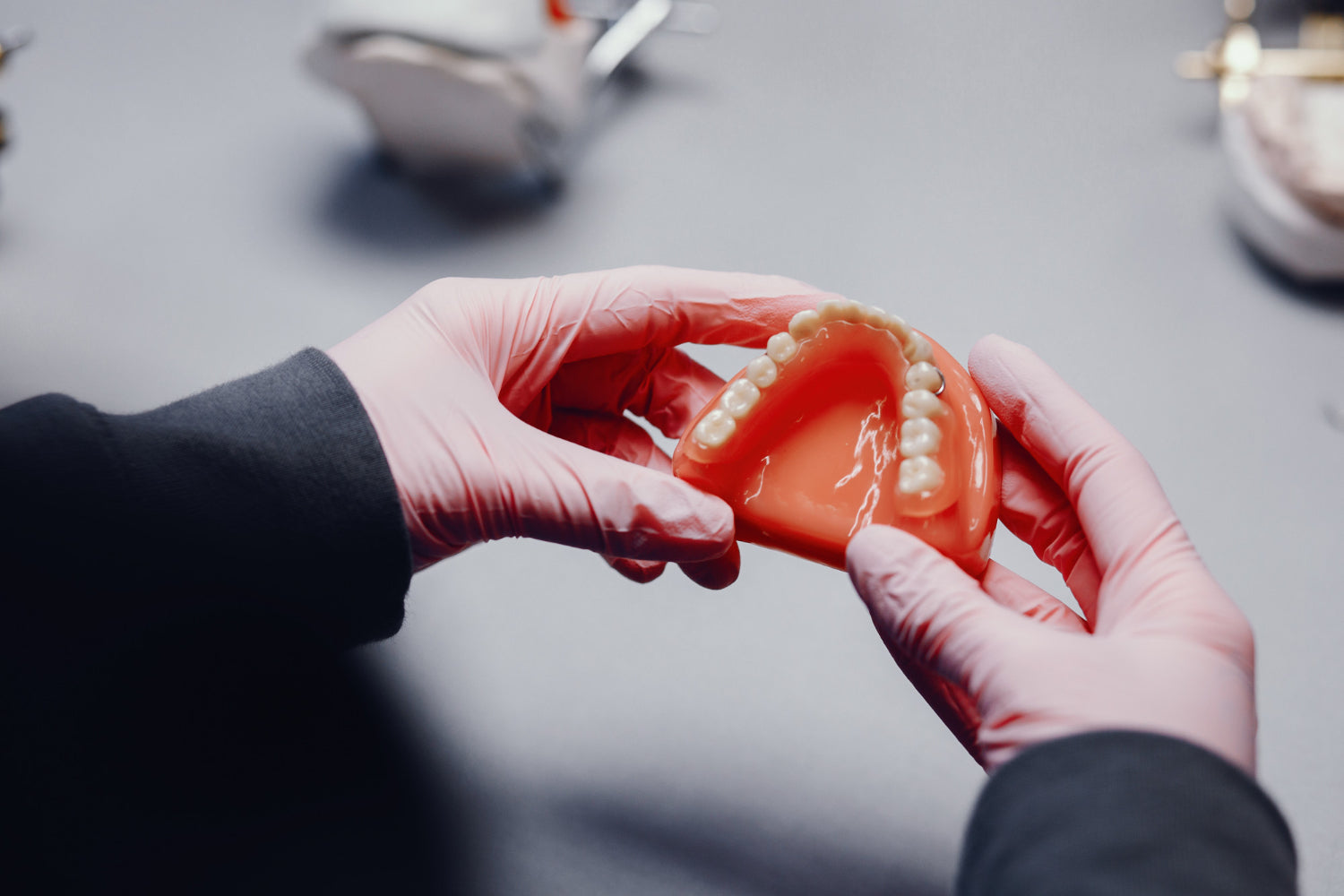
Polymethyl methacrylate has been a foundational dental prosthetics material since the 1940s introduced as a replacement for vulcanite rubber denture bases, it quickly became the standard because it offered biocompatibility, processability, and acceptable aesthetics in a single material. In the decades since, every major shift in dental technology has been accompanied by an updated role for PMMA: from conventional heat-cured processing to CAD/CAM milling to 3D printing. The material has adapted rather than been replaced, and for good clinical reason.
This guide covers what makes PMMA dental prosthetics clinically valuable its genuine benefits, the applications where it performs best, the considerations that limit its use, and how it integrates with dental zirconia and other dental lab materials in a complete digital workflow. For labs and clinicians specifying PMMA teeth and prosthetics, this is the practical context that sourcing decisions need to be grounded in.
What makes PMMA well-suited for dental prosthetics?
PMMA's sustained presence in dental prosthetics isn't inertia it reflects a genuine fit between the material's properties and the clinical demands of the applications it covers. Published prosthodontic research identifies five properties as the foundation of PMMA's clinical utility:
-
Low density.
PMMA is considerably lighter than ceramic, metal, or composite alternatives. For full-arch dentures where the patient wears the prosthesis continuously the weight difference directly affects comfort, retention, and the muscular effort required for daily use. A full upper denture in milled PMMA is noticeably more comfortable to wear than a heavier alternative, and patient-reported satisfaction with denture weight is consistently linked to prosthesis retention. -
Aesthetic quality.
PMMA's optical properties allow it to be manufactured in shades that closely replicate tooth enamel and gingival tissue. In multilayer formats, the colour gradient built into the blank produces natural-looking PMMA teeth and denture bases without extensive manual characterisation. For prosthetics that patients wear visibly and interact with socially, this aesthetic competence is clinically essential. -
Biocompatibility.
Properly polymerised PMMA is well-tolerated by oral mucosa. Residual monomer in incompletely processed conventional acrylic can cause tissue sensitivity, but milled PMMA from pre-polymerised industrial blanks where polymerisation is complete before the blank is machined essentially eliminates this concern. The residual monomer content of milled PMMA is substantially lower than conventionally processed acrylic. -
Ease of fabrication and adjustment.
PMMA machines on standard CAD/CAM equipment, adjusts chairside with standard instruments, and repairs with additional acrylic. No sintering furnace, no press cycle, no specialist equipment beyond what a modern digital lab already owns. That fabrication simplicity translates directly into workflow efficiency and lower per-unit production cost. -
Cost-effectiveness.
Across the dental lab materials spectrum, PMMA is one of the most economical options per unit of finished prosthetic surface. For applications where the material's mechanical limitations aren't clinically constraining temporaries, dentures, provisionals this cost profile makes PMMA the correct specification economically as well as clinically.
Clinical applications: where PMMA prosthetics perform best
Complete and partial dentures
Full and partial dentures represent PMMA's longest-standing clinical role and remain the application where its properties align most comprehensively with the clinical requirement. The combination of low weight, gingival shade availability, adjustability, and reparability makes PMMA the standard denture base material in most labs globally.
Milled PMMA denture bases from high-density industrial blanks offer meaningful improvements over conventionally processed acrylic: lower porosity, better dimensional accuracy, and more consistent mechanical properties across the base. Lower porosity reduces bacterial infiltration into the denture material over time an important hygiene consideration for patients who wear the prosthesis continuously. The Aidite Denture Base PMMA is formulated specifically for milled denture workflows a high-density disc producing dimensionally accurate bases with consistent gingival shade matching across batches.
Temporary crowns and bridges
PMMA temporary crowns and bridges cover two clinical scenarios: short-term temporaries placed for days or weeks while a permanent restoration is being fabricated, and longer-term implant temporaries worn during osseointegration. The clinical demands differ between these two uses, and the PMMA product specification should reflect that.
Short-term temporaries can be fabricated from standard single-shade PMMA the aesthetic requirement is low, the duration is short, and chairside adjustability matters more than shade precision. Implant temporaries worn for three to six months require more attention: the right emergence profile to condition soft tissue, adequate strength for the healing period, and acceptable aesthetics particularly in anterior positions. Multilayer PMMA is the appropriate specification for visible anterior implant temporaries the colour gradient built into the blank produces a result that satisfies patient expectations without additional chairside characterisation.
Anterior PMMA teeth for dentures and prosthetics
PMMA teeth the individual tooth-shaped components set into denture bases are a distinct product category from PMMA denture bases. Pre-fabricated PMMA teeth offer shade-matched, anatomically accurate tooth forms that are bonded to the base material. In digital denture workflows, PMMA teeth can also be milled directly from multilayer blanks as part of the denture unit eliminating the separate tooth-setting step and producing a monolithic prosthesis with better interfacial bond strength.
For labs producing milled anterior sections, the Aidite Multilayer PMMA disc covers both temporary crown and anterior denture tooth applications the gradient shading produces natural colour transitions from cervical to incisal in a single milling operation, appropriate for both aesthetic provisionals and visible anterior denture sections.
Orthodontic appliances and splints
PMMA's rigidity and dimensional stability make it suitable for removable orthodontic appliances, retainers, and occlusal splints where rigidity is the clinical requirement. It adjusts easily for activation and trimming, and the material's history in these applications is well-established across decades of clinical use.
Benefits of milled PMMA over conventionally processed acrylic
The transition from conventionally processed acrylic to milled PMMA from pre-polymerised blanks represents a genuine clinical improvement rather than a workflow preference. The differences are measurable:
- Residual monomer content — conventional acrylic processed in powder-liquid systems retains residual methyl methacrylate monomer that can leach into the oral environment. Milled PMMA from industrial blanks has essentially completed polymerisation before machining, substantially reducing residual monomer and the tissue sensitivity risk it carries.
- Porosity — conventionally processed acrylic develops microporosity during processing that provides sites for bacterial colonisation and stain absorption over time. Milled PMMA from dense industrial blanks has a non-porous surface that resists both relevant for dentures worn continuously and for temporaries in implant sites where soft tissue health is the priority.
- Dimensional accuracy — conventional heat-curing introduces processing shrinkage that affects fit. Milled PMMA is cut to CAD specifications from a dimensionally stable blank, producing restorations that fit the digital model accurately without the shrinkage compensation required for processed acrylic. Fewer chairside adjustments and better initial fit are consistent outcomes of the milled workflow.
- Mechanical consistency — milled PMMA has homogeneous mechanical properties throughout the blank, whereas conventionally processed acrylic can vary in polymerisation completeness and therefore in strength across the restoration. Flexural strength of properly milled industrial PMMA averages 80–120 MPa with lower variance than conventional processing.
Key considerations: where PMMA has limitations
Honest clinical use of PMMA requires understanding where its properties are insufficient as well as where they're appropriate.
-
Flexural strength is not adequate for permanent posterior crowns.
At 80–120 MPa, PMMA cannot withstand permanent posterior occlusal loading. Dental zirconia whether as zirconia blocks dental labs use for single units or dental zirconia discs for multi-unit production provides the 900–1,200 MPa needed for permanent posterior restorations. Using PMMA as a permanent crown material in posterior positions is a clinical error, not an economy. -
Wear resistance is lower than ceramic.
PMMA abrades faster than zirconia dental blanks or lithium disilicate under occlusal contact. For temporary restorations this is acceptable the material is designed to be replaced. For long-term denture bases where the opposing dentition is ceramic, wear management through occlusal design is important. -
Long-term colour stability requires quality material.
PMMA can absorb water and stain over time if the base material quality is poor. Industrial-grade milled PMMA from established manufacturers shows better colour stability than lower-grade alternatives, which is one of the strongest arguments for sourcing from a reliable dental lab material supplier rather than optimising purely on unit price. -
Temporary doesn't mean indefinite.
Implant temporaries are designed for the osseointegration period typically three to six months. Extended wear beyond the clinical indication reduces both aesthetic and mechanical performance. Labs should communicate the intended service life in crown delivery documentation.
PMMA prosthetics alongside dental zirconia: the complete workflow
In a complete digital dental lab, PMMA and zirconia dental lab materials aren't alternatives they're sequential. PMMA handles the prosthetic and temporary phases: dentures, implant temporaries, diagnostic provisionals, orthodontic appliances. Dental zirconia in zirconia blocks for single units or dental zirconia discs for multi-unit production handles the permanent crown and bridge work that follows the provisional phase.
Labs that run both from the same digital workflow same scan, same design file, different material at milling produce cleaner handoffs between temporary and permanent phases. The PMMA temporary establishes the occlusion and emergence profile; the zirconia dental restoration inherits a tissue environment that's been correctly conditioned. This sequencing produces better permanent restoration outcomes than skipping the PMMA provisional phase entirely.
Zirconia Guys stocks the full Aidite PMMA rang multilayer discs, denture base PMMA, and clear variants alongside Aidite and UPCERA zirconia blanks and zirconia dental discs, covering the complete digital workflow from provisional to permanent from a single supplier. Get in touch with the team to discuss which PMMA products and zirconia grades suit your lab's case mix and milling system.


