

The resin you select for your dental 3D printer matters more than the printer itself in determining clinical outcomes. Printer hardware establishes the resolution ceiling and build volume. The resin determines whether the printed part is biocompatible for the intended application, mechanically adequate for the clinical load it will face, and chemically stable enough to behave consistently across batches. A correctly specified resin on a mid-range printer outperforms a misspecified resin on a premium system every time.
The range of dental 3D printing resins now available each formulated for a specific clinical indication reflects how far the technology has matured since early model resins were the only option. For dental professionals evaluating which resins to stock or how to expand a 3D printing workflow, understanding the distinctions between resin types is the essential starting point. This guide covers each category in technical depth, including the properties that matter most and where the limits of each type lie.
The core principle: resin type follows clinical indication
The most common resin specification error in dental labs is selecting a resin by price or by printer compatibility alone, without reference to the specific clinical indication. A model resin that produces excellent diagnostic casts is not cleared for intraoral use and should never be used for temporary crowns. A splint resin that works well for night guards is not the same material as a surgical guide resin, despite both being "biocompatible." These distinctions have clinical and regulatory consequences.
The correct selection sequence is: define the clinical application first, identify the required properties and regulatory status for that application, then select a resin that meets those requirements and is validated for your specific printer. Every other consideration cost, brand preference, printer ecosystem is secondary to this sequence.
Model resins: the foundation of every 3D printing workflow
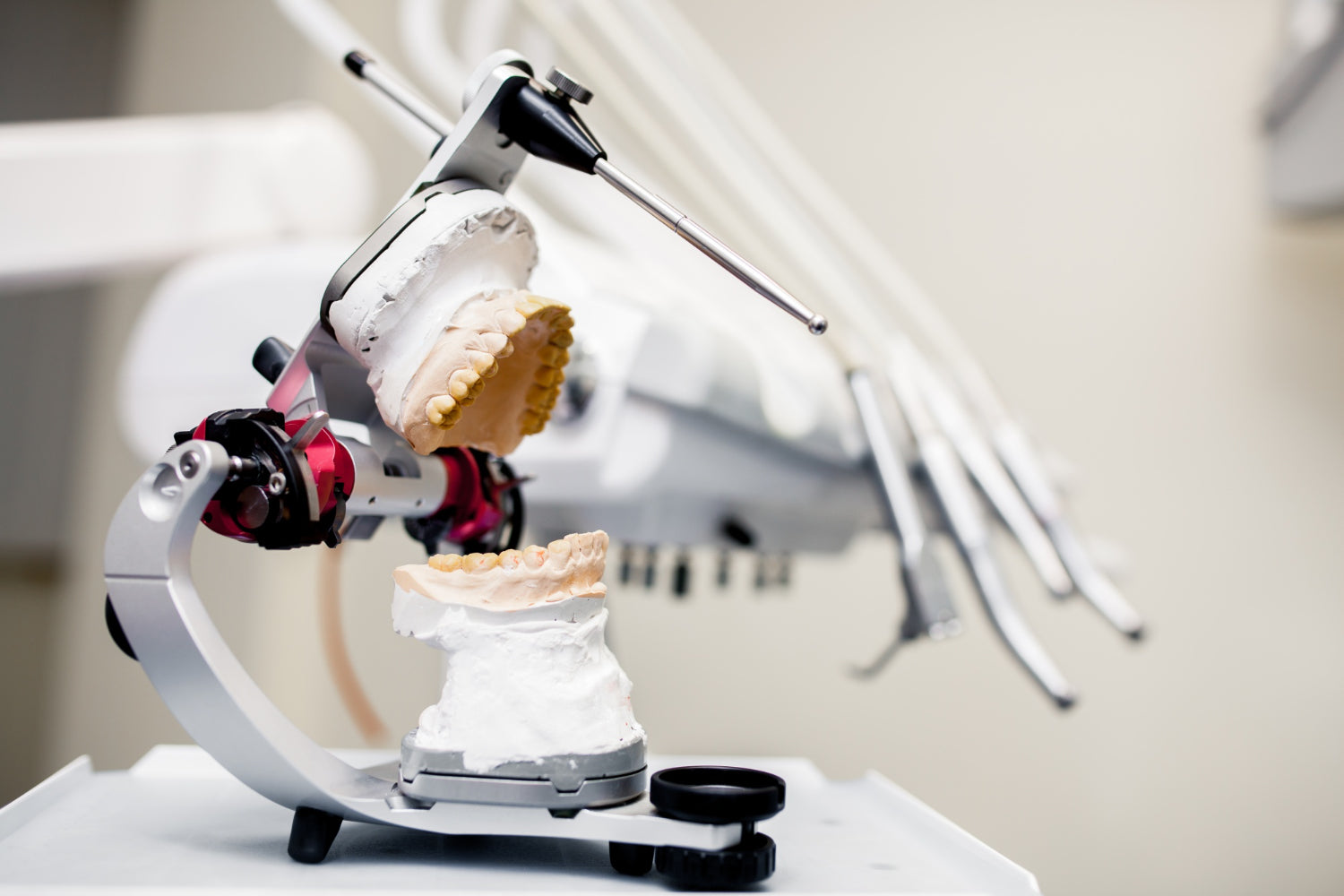
Key model resin and its equivalents represent the highest-volume resin category in most dental labs. Model resins are formulated for dimensional accuracy, surface detail, and hardness the combination required to produce diagnostic casts, working models for removable appliances, and implant analog models that survive handling and thermoforming without deforming.
The critical clinical properties for model resins are dimensional accuracy (typically specified as deviation from the digital reference within ±100 μm or better for clinically acceptable models), surface hardness (Shore D values typically above 80), and adequate stiffness for use as a thermoforming base. Heat resistance matters specifically for thermoforming applications a model that deforms under thermoforming temperature and pressure produces inaccurate appliances regardless of its print accuracy.
Model resins are not biocompatible for intraoral use. This is the most frequently misunderstood constraint in labs new to 3D printing. Model resins are tested and cleared for indirect contact the model touches the appliance, not the patient not for direct patient contact in the mouth. Using a model resin as a temporary crown is a regulatory and clinical error.
Orthodontic model resins: accuracy as the primary requirement
Orthodontic model printing is one of the highest-volume 3D printing applications in modern dental labs, driven by in-house clear aligner fabrication. The orthodontic model printing resin category is distinct from general model resin in one important respect: the printed model is used directly as a thermoforming substrate for aligner sheets. This imposes stricter requirements on dimensional accuracy, heat resistance, and surface smoothness than standard diagnostic model work.
For orthodontic aligner production, the dimensional accuracy of the model directly determines the fit of the printed aligner. A model with 200 μm of systematic error produces an aligner with equivalent fit error which compounds across a series of 20–30 aligners in a treatment plan. Resins validated specifically for orthodontic models are tested for thermoforming accuracy under the temperatures and pressures used in standard aligner production equipment (typically 120–140°C for vacuum thermoforming). General model resins may not meet these specifications.
Orthodontic model resins also typically offer a smooth, hard surface finish that allows aligner sheets to release cleanly without tearing or distorting. A surface that's too rough or too soft produces aligner seams and edge inaccuracies that require chairside trimming.
Surgical guide resins: precision and sterilisation compatibility
Surgical guide resins are among the most technically demanding resin categories. A surgical guide placed intraorally during implant surgery must be optically clear (for visual verification of positioning), dimensionally accurate (the sleeve positions the drill at the planned angulation and depth), mechanically rigid under surgical drilling forces, and biocompatible for intraoral use.
Sterilisation compatibility is the constraint most often overlooked. Most dental surgical guide workflows require the guide to be autoclaved before intraoral use. Standard biocompatible resins that have not been specifically validated for autoclave sterilisation may warp, discolour, or mechanically degrade under steam sterilisation temperatures (134°C). Any resin specified for a surgical guide that will be autoclaved must carry explicit manufacturer validation for that sterilisation method at those temperatures and cycle times.
Transfer accuracy how faithfully the guide translates the planned implant position to the actual drill position is the key clinical outcome measure for surgical guides. Published studies report that resin selection and post-curing protocol account for a significant proportion of the transfer accuracy variance, separate from the printer hardware. [2] Resins with higher Young's modulus (stiffer) typically show better guide stability under drill pressure, which directly affects transfer accuracy.
Temporary crown and bridge resins: matching strength to wear duration
Temporary C&B resins are biocompatible formulations for short-to-medium-term intraoral wear temporary crowns, bridges, and veneers worn while permanent restorations are fabricated or during implant integration periods. The clinical requirements are adequate flexural strength (typically 80–120 MPa for most temporary applications), shade availability, surface hardness for stain resistance, and wear resistance over the planned temporisation period.
The performance gap between 3D-printed temporary resins and milled PMMA is clinically relevant for longer-term temporisation. For an implant temporary worn for three to six months, milled PMMA from industrial-grade pre-polymerised blanks produces better fatigue resistance and lower surface porosity than most 3D-printed equivalents characteristics that matter across months of daily functional loading. For short-term temporaries (days to a few weeks), the 3D-printed approach has throughput and form-complexity advantages that typically outweigh the mechanical property difference.
Post-curing completeness is the variable most directly under a lab's control for printed temporary resins. Incompletely post-cured temporary resin retains residual monomer that reduces mechanical properties and in an intraoral application, may cause soft tissue sensitivity reactions. Following the manufacturer's specified wash and cure protocol exactly is the most important quality control step in temporary resin workflows.
Splint and night guard resins: the hardness vs. flexibility balance
Splint resins produce occlusal appliances night guards, occlusal splints, and bruxism appliances. The defining clinical challenge is that these appliances face opposing requirements: they need to be hard enough to resist wear under parafunctional load (which can exceed normal biting forces by a factor of three to five in heavy bruxers), and flexible enough to survive chairside adjustment without fracturing.
Hard splint resins typically reach Shore D hardness values above 85, with flexural strength in the 100–150 MPa range. They resist wear well but can fracture if over-adjusted. Flexible splint resins sacrifice some hardness for improved impact resistance and adjustability. Most labs stock both and select based on the patient's bruxism severity and the clinician's preference.
Clear resins used for soft splints and thermoformed appliances have different requirements again optical clarity for aesthetics in night guards that patients will wear visibly, and biocompatibility for extended intraoral use. Clarity must be maintained after post-curing and polishing, and some resins yellow or cloud over time under UV exposure a relevant factor for patients who wear appliances in daylight conditions.
Denture resins: a two-component challenge
Full denture fabrication via 3D printing involves two separate resin categories: denture base resin (for the gingival-toned acrylic base) and denture teeth resin (for the tooth-coloured prosthetic teeth). Both must be biocompatible for extended intraoral wear, and both must be colour-stable over years of use a requirement that many resins fail to meet adequately.
Printed denture bases offer better dimensional accuracy than conventionally processed acrylic and lower porosity than many PMMA alternatives which has tissue health implications for patients wearing the prosthesis long-term. The fit accuracy advantage of printed denture bases over conventional processing is well-documented.
For labs with existing milling capability that want to produce denture bases without a separate printing workflow, the Aidite Denture Base PMMA disc is a proven milled alternative producing accurate, low-porosity denture bases on the same CAD/CAM platform used for dental zirconia, without the post-processing requirements of 3D-printed resin.
Castable resins: for metal-casting workflows
Castable resins produce patterns for lost-wax metal casting used to fabricate metal crowns, bridges, and partial denture frameworks via investment casting. The primary requirement is clean, complete burnout: the resin must leave no ash or residue in the investment after burnout, which would contaminate the cast metal. Incomplete burnout produces porosity and surface defects in the final casting.
This resin category is the most technically specific in terms of processing requirements. Burnout temperature profiles must follow the resin manufacturer's validated schedule precisely deviations produce inconsistent results. Castable resins are also the most sensitive to overcuring during post-processing, which can cross-link the polymer structure in ways that resist clean burnout.
How 3D printing resins fit alongside dental zirconia in a complete lab
For dental professionals building or evaluating a digital lab workflow, the right frame is complementarity 3D printing resins and dental zirconia blocks handle different parts of the production spectrum.
Dental zirconia whether as zirconia blocks for single-unit cases or dental zirconia discs for multi-unit production handles permanent restorations where mechanical performance over 10–15 years is the requirement. High-strength 3Y-TZP dental zirconia reaches 900–1,200 MPa. No current 3D-printed resin approaches that mechanical range for permanent use. Zirconia dental blanks milled via CAD/CAM remain the clinical standard for permanent crowns, bridges, and implant prostheses. For labs evaluating dental lab materials across both technologies, zirconia blocks dental labs use daily remain irreplaceable for the permanent restoration category.
3D printing adds genuine value in the applications zirconia milling handles less efficiently: high-volume model production for orthodontic aligner workflows, complex surgical guides with internal channels, batch production of short-term temporaries, and orthodontic appliances requiring patient-specific geometry. The two workflows together zirconia blanks for permanent and resin printing for models, guides, and temporaries cover the complete scope of a modern digital dental lab.
As a North American dental lab material supplier stocking both dental zirconia and resin-adjacent PMMA materials, Zirconia Guys covers the milling side of this equation across Aidite and UPCERA ranges. Get in touch with the team to discuss which dental lab materials suit your workflow, case mix, and milling system.


