

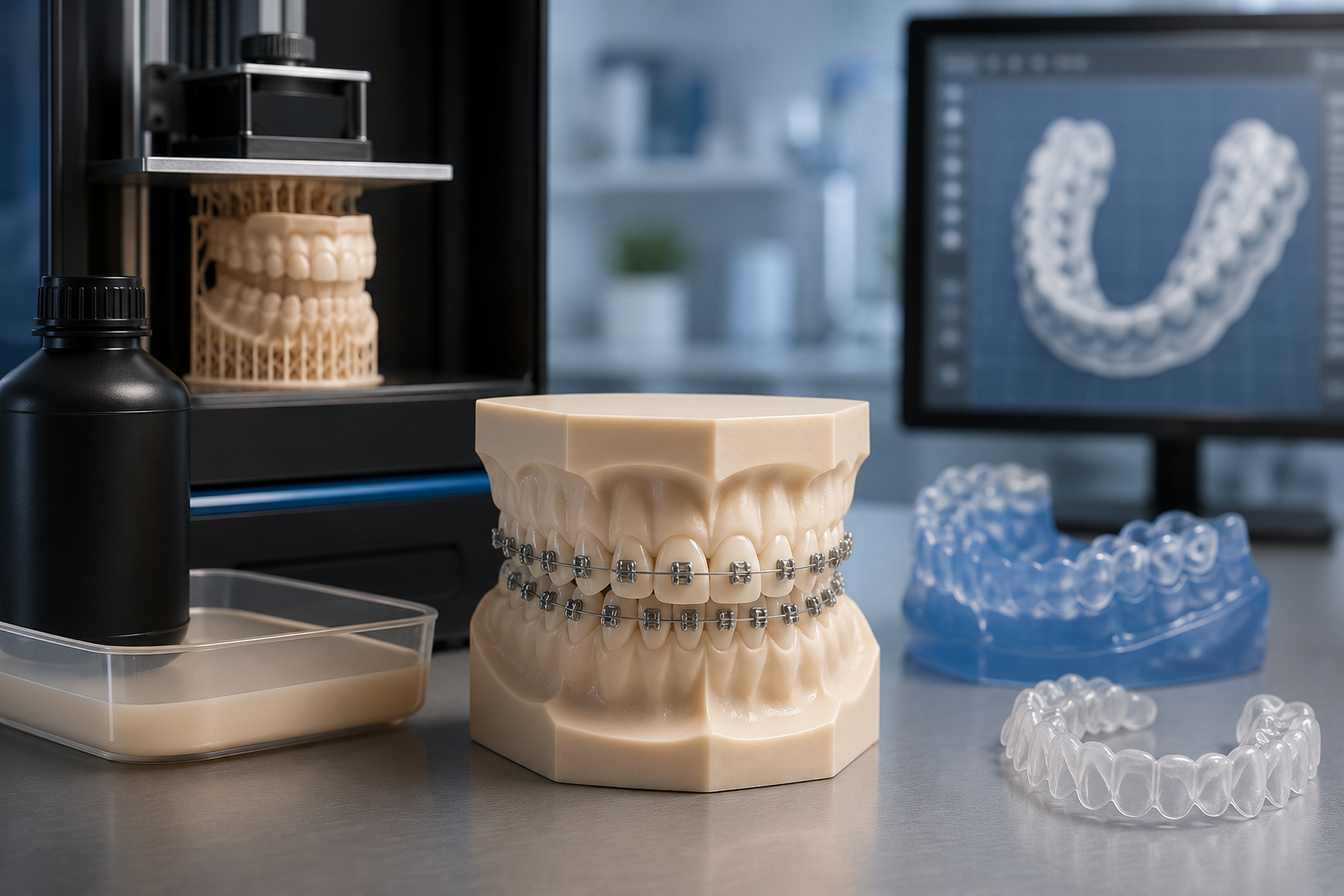
Orthodontic model production has changed more in the past five years than in the previous fifty. Digital scanning, CAD software, and desktop 3D printers have replaced plaster and stone in the vast majority of modern orthodontic practices and labs. The workflow is faster, cleaner, and far more scalable. But the shift to digital has also introduced a material selection decision that many labs underestimate: not all resins are suitable for orthodontic models, and using a general-purpose 3D printing resin for orthodontic applications is one of the most common sources of avoidable accuracy and biocompatibility problems in digital orthodontic production.
The reason orthodontic models demand a dedicated resin formulation rather than the same material used for surgical guides, splints, or diagnostic models comes down to the specific dimensional and surface requirements of orthodontic work. Aligner fabrication, indirect bonding trays, and bracket placement all depend on millimeter-level accuracy across the full arch. A diagnostic study model can tolerate minor surface imprecision that an aligner thermoforming model simply cannot. This guide explains what Key Ortho Model Resin is, why it is formulated specifically for orthodontic cases, and how it fits into a modern digital orthodontic lab workflow.
What Is Key Ortho Model Resin?
Key Ortho Model Resin is a photopolymer 3D printing resin from Keystone Industries formulated specifically for orthodontic model production. It is part of Keystone's KeyPrint product family a range of dental-specific resins each engineered for a distinct clinical application rather than adapted from general-purpose photopolymer chemistry.
The material is designed for printing high-accuracy dental arch models used in orthodontic treatment planning, clear aligner fabrication, retainer fabrication, and orthodontic appliance construction. It is not a general model resin. The formulation prioritizes the specific properties that orthodontic applications demand: tight dimensional accuracy across the full arch, a smooth surface finish that supports clean thermoforming and accurate bracket placement, and the hardness to withstand the pressure of vacuum-formed aligner materials without deformation.
Key Ortho Model Resin is compatible with 385 nm and 405 nm light-cure 3D printing systems the two wavelengths used by the majority of professional dental desktop printers including Carbon, Formlabs, Asiga, Envision TEC, and other open-system platforms. This broad compatibility means labs can adopt it without changing printer hardware.
Why Orthodontic Models Require a Dedicated Resin?
The dimensional accuracy requirement for orthodontic models is significantly more demanding than for other dental model applications. To understand why, consider what happens when an aligner is thermoformed over a printed model.
The thermoforming process applies heat and vacuum pressure to a thermoplastic sheet over the printed model. If the model surface has micro-irregularities from under-cured resin, insufficient layer adhesion, or surface porosity, those imperfections transfer directly to the internal surface of the aligner. The patient then wears an appliance with internal surface artifacts that cause discomfort, affect seating accuracy, and can compromise tooth movement vectors in precision cases.
For key ortho model resin for braces and aligner workflows, the resin must deliver three specific properties that general photopolymers do not reliably provide:
Surface smoothness at the post-cure stage.
Orthodontic models need a surface smooth enough that thermoforming produces a clean internal aligner surface without requiring additional manual finishing of the model. General model resins produce adequate surface finish for diagnostic viewing but not consistently enough for aligner thermoforming in a production environment.
Dimensional stability under thermoforming heat.
The heat deflection temperature of the resin must be high enough that the model does not deform during the thermoforming cycle. A model that softens under vacuum-forming heat will change shape mid-cycle, producing an aligner that does not accurately represent the designed tooth movement. Key Ortho Model Resin is formulated with a heat deflection temperature above the operating range of standard thermoforming equipment.
Consistent accuracy across the full arch.
A single orthodontic model spans 14 teeth from molar to molar a distance that amplifies any dimensional drift in the printing process. Resin formulations with inconsistent polymerization shrinkage cause cumulative error across the arch that shows up as aligner misfit at the posterior segments even when the anterior region looks correct. The tight shrinkage control in Key Ortho Model Resin keeps cumulative arch error within clinical tolerance across the full dental span.
How Key Ortho Model Resin Fits into the Digital Orthodontic Workflow?
Understanding where resin selection matters requires mapping it to the actual production steps in a digital orthodontic lab. For labs new to 3D printing resin selection, the broader guide to Resin for Dental 3D Printing: Uses, Types, and Tips covers the full application landscape but for orthodontic-specific workflows, the steps below show where Key Ortho Model Resin directly impacts output quality.
As a reliable key ortho model resin supplier in the US market, ZirconiaGuys stocks Key Ortho Model Resin from domestic inventory which matters in orthodontic lab environments where consistent supply and predictable lead times are part of maintaining treatment schedule commitments to patients.
Step 1 — Digital scan and model preparation.
The orthodontic treatment workflow begins with an intraoral scan or digital model from a CBCT. The scan data is processed in orthodontic planning software (Invisalign ClinCheck, uLab, 3Shape Ortho, or others) to produce individual stage models representing tooth positions at each aligner step. These models are exported as STL files ready for printing.
Step 2 — Print orientation and support placement.
Orthodontic models are printed at an angle typically 45° to minimize suction cup forces on the flat base during layer separation and to distribute layer lines across the arch in a way that avoids vertical striations on critical tooth surfaces. to minimize suction cup forces on the flat base during layer separation and to distribute layer lines across the arch in a way that avoids vertical striations on critical tooth surfaces. Supports are placed on the model base, never on the tooth surfaces or gingival anatomy. Incorrect orientation is one of the most common sources of surface quality problems in orthodontic model printing.
Step 3 — Printing.
Key Ortho Model Resin is printed at the exposure settings specified by Keystone for the specific printer being used. These settings are validated to produce the layer-to-layer adhesion and cure depth that deliver the required dimensional accuracy. Running the resin at default general-purpose settings rather than the validated orthodontic settings is a common cause of under-cure and reduced surface quality.
Step 4 — Post-processing.
After printing, models are washed in isopropyl alcohol (IPA) at 90–99% concentration to remove uncured resin from surfaces and cavities. This step is critical residual uncured resin on the model surface will prevent proper aligner seating and transfer surface artifacts to the thermoformed appliance. After washing, models are post-cured under UV light at the validated time and intensity. Key Ortho Model Resin achieves its specified mechanical properties — including the heat deflection temperature needed for thermoforming only when the post-cure protocol is followed exactly.
Step 5 — Thermoforming.
The post-cured model is used directly for aligner thermoforming. No additional treatment or coating is required. The resin surface provides the release characteristics needed for clean aligner removal after thermoforming without adhesion or tearing.
Key Ortho Model Resin vs. General Dental Model Resins
Not all orthodontic labs run dedicated orthodontic resin. Many start with a general dental model resin and discover the limitations through production problems. The comparison below clarifies the specific differences that matter in orthodontic production.
The available orthodontic model resin options from ZirconiaGuys span multiple validated formats for different printer systems and production volumes. For labs evaluating which format to standardize on, the key differentiator is whether the resin has been validated specifically for aligner thermoforming — not just for model printing in general.
| Property | Key Ortho Model Resin | General Dental Model Resin |
|---|---|---|
| Surface smoothness | Optimized for thermoforming | Adequate for viewing only |
| Heat deflection temp | Above thermoforming range | Variable often insufficient |
| Dimensional accuracy | Full-arch validated | Single-tooth validated |
| Polymerization shrinkage | Tight control | Standard may drift |
| Aligner release | Clean separation | May require manual release |
| Post-cure requirement | Defined protocol | Generic protocol |
| Application validation | Orthodontic-specific | General dental |
The practical difference shows up most clearly in full-arch aligner series. A lab producing single-stage models for diagnostic purposes can use general model resin without significant clinical consequence. A lab producing a 20-stage aligner series needs every model to be dimensionally consistent so that the aligner series produces the designed tooth movement and that consistency requires a resin validated for the full-arch accuracy demand of orthodontic production.
Indirect Bonding Trays and the IBT Resin Distinction
One additional application closely related to orthodontic model production is indirect bonding trays the transfer trays used to position brackets precisely on tooth surfaces in a single chairside step. IBT production involves a different set of material requirements than model printing and requires a distinct resin formulation.
The key ortho ibt dental resin is engineered specifically for this application with the flexibility, dimensional accuracy, and surface properties needed for bracket transfer rather than the hardness and thermoforming compatibility required for aligner model production. Labs running both aligner and bracket workflows need both resins in inventory: Key Ortho Model Resin for aligner models and Key Ortho IBT Resin for indirect bonding trays. Using the model resin for IBT production or vice versa produces results that the application-specific formulations outperform.
Sourcing Key Ortho Model Resin in the US
For US dental and orthodontic labs, sourcing from domestic inventory eliminates the lead time variability of international supply. ZirconiaGuys stocks the full Keystone orthodontic resin range including Key Ortho Model Resin and Key Ortho IBT Resin from US inventory with same-day or next-day shipping on in-stock items.
Labs that run mixed material workflows combining 3D printed orthodontic models with milled zirconia blocks dental restorations, dental zirconia discs for permanent crown and bridge cases, or zirconia blank stock for posterior work can consolidate resin and zirconia dental blanks procurement through a single US supplier. The same zirconia blocks volume pricing that makes ZirconiaGuys a cost-effective source for fixed restoration materials applies to the Keystone resin range as well, simplifying ordering and reducing the administrative overhead of managing multiple dental material vendors.
Key Ortho Model Resin is not a premium version of a general model resin. It is a distinct formulation engineered for the specific surface, dimensional, and thermal demands of orthodontic aligner and appliance production. For labs that have been using general-purpose resins for orthodontic models and experiencing aligner fit inconsistency, posterior arch inaccuracy, or thermoforming surface transfer artifacts, switching to an orthodontic-specific resin is the highest-leverage material change available. The workflow stays identical. The results are measurably more consistent from the first production run.


