

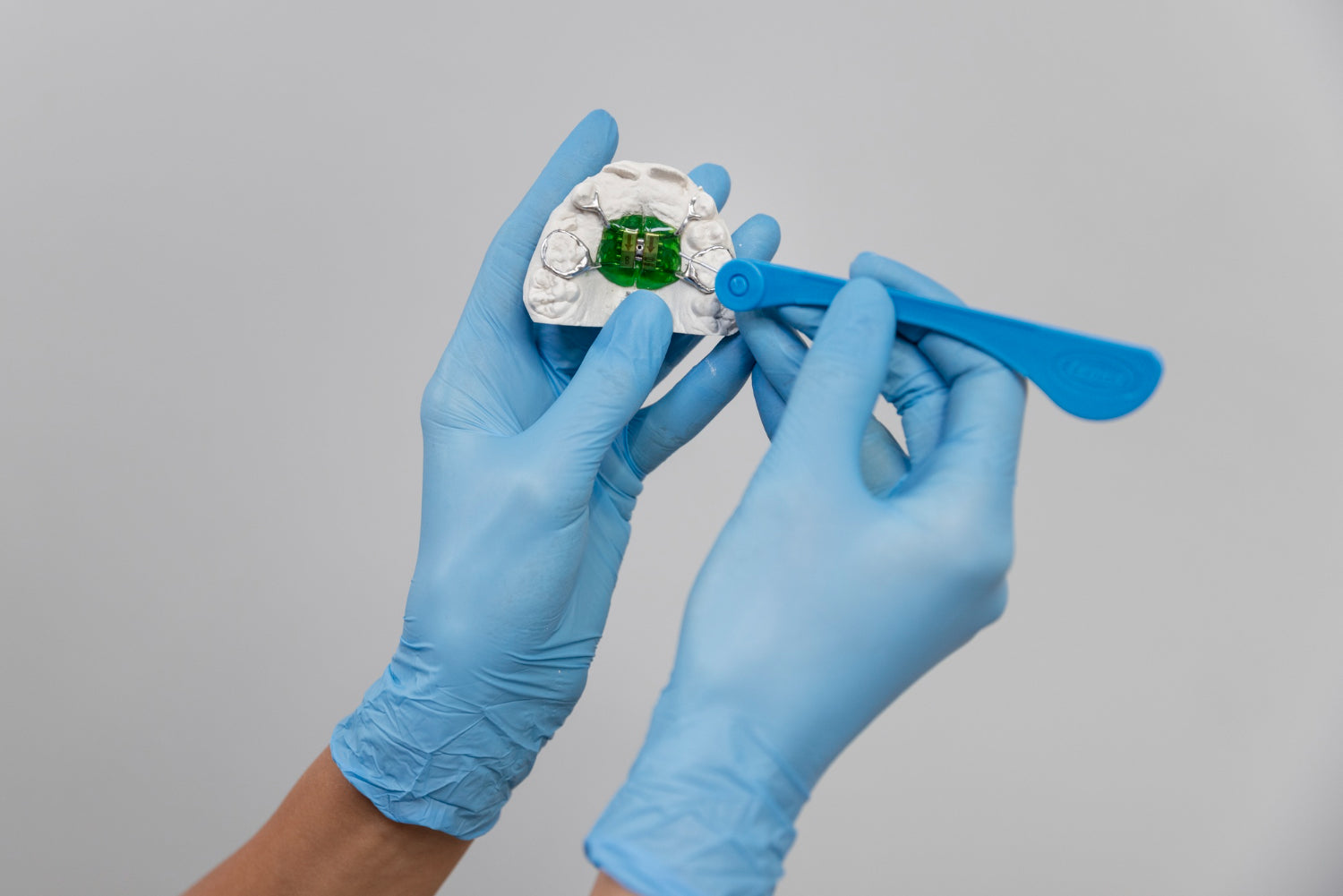
3D printing has moved from a novelty to a standard production tool in dental labs faster than most expected. And at the centre of every dental 3D printing workflow is the resin the photosensitive liquid material that the printer converts, layer by layer, into a finished appliance or model. If you're new to 3D printing in dentistry or evaluating whether to add it to an existing milling workflow, understanding what dental resin is and how it works is the right starting point.
This guide covers the fundamentals clearly what dental resin is, how it cures, the different types and what each one is for, how printing compares to milling, and what the post-processing requirements look like. It's written for lab technicians, lab owners, and clinicians who want a practical understanding rather than a product pitch.
What dental resin for 3D printing actually is?
Dental resin for 3D printing is a photopolymer a liquid monomer mixture that undergoes polymerisation (chain-linking into a solid polymer network) when exposed to light at a specific wavelength, typically 385nm or 405nm UV-visible light. The printer exposes the liquid resin in precise patterns, curing it layer by layer until the complete three-dimensional object is formed.
The base chemistry of most dental resins involves methacrylate monomers the same monomer family used in conventional dental acrylics combined with photoinitiators that trigger polymerisation on light exposure, diluent monomers that control viscosity and handling properties, and inorganic fillers that improve mechanical properties in higher-performance formulations.
What distinguishes dental resins from general-purpose 3D printing resins is biocompatibility formulation, clinical-grade accuracy requirements, and regulatory compliance. Dental resins used for intraoral applications temporary crowns, surgical guides, splints must meet biocompatibility standards (ISO 10993) and in the US market, FDA 510(k) clearance for the specific clinical indication. Not all 3D printing resins marketed to dental labs meet these requirements, and the distinction matters clinically.
How dental 3D printing works: SLA vs. DLP
Most dental 3D printers use one of two light-curing technologies. Understanding the difference helps when evaluating which platform suits a lab's workflow.
SLA (stereolithography) uses a single laser point that traces each layer precisely across the resin surface. The point-source nature of the laser produces very fine detail and smooth surfaces particularly valuable for surgical guides and diagnostic models where marginal accuracy is the primary criterion. Formlabs' Form 3B is the most widely used SLA dental printer, with 25-micron XY resolution. The tradeoff is speed tracing each layer point-by-point is slower than curing an entire layer at once.
DLP (digital light processing) projects a complete image of each layer onto the resin surface simultaneously, curing the entire layer at once. This makes DLP significantly faster than SLA a meaningful production advantage in labs running multiple units daily. The image projection can introduce slight edge distortion at the boundary of the build platform, which makes calibration and build platform positioning more important than in SLA systems. Most high-volume dental lab printers use DLP.
For most dental lab applications models, temporaries, splints both technologies produce clinically acceptable results when calibrated correctly. The accuracy difference matters most in surgical guide applications where implant angulation tolerances are tight.
The main types of dental resin and what each is for
This is where beginner confusion is most common. "Dental resin" isn't a single material it's a product category covering several formulations with very different properties, indications, and regulatory status.
Model resin
The most widely used resin in dental labs. 3D printing dental model resin is formulated for producing accurate diagnostic casts, study models, aligner models, and working models for removable appliance fabrication. The primary requirements are dimensional accuracy, surface detail, and hardness the model needs to survive handling and thermoforming without deforming.
Model resins are not biocompatible for intraoral use they're designed for indirect contact only. Using a model resin to produce a temporary crown or splint is a clinical error that labs new to 3D printing sometimes make. The biocompatibility status of every resin should be verified against its intended use before clinical application.
Surgical guide resin
Surgical guide resins are biocompatible formulations designed for guides placed intraorally during implant surgery to control drill angulation and depth. These resins must be optically clear the surgeon needs to verify drill positioning visually and mechanically rigid enough to maintain guide accuracy under surgical drilling forces. Regulatory clearance for intraoral use is mandatory. Most clinical protocols also require sterilisation compatibility, which should be verified for the specific resin before clinical use.
Temporary crown and bridge resin
Temporary C&B resins are biocompatible formulations for short-to-medium-term intraoral wear temporary crowns and bridges during healing or waiting periods. They need adequate flexural strength (typically 80–120 MPa for most temporary applications), shade availability across standard prescriptions, and surface finish that resists staining over the wearing period.
It's worth noting that milled PMMA from industrial-grade pre-polymerised blanks produces better mechanical properties and lower porosity than most 3D-printed temporary resins particularly in fatigue resistance and surface hardness. For longer-term temporaries worn during implant integration (three to six months), milled PMMA is clinically the more durable choice. 3D-printed temporary resins have a throughput advantage for batch production of short-term temporaries.
Splint and night guard resin
Splint resins produce occlusal appliances night guards, occlusal splints, and bruxism appliances. They need to balance hardness (to resist wear under parafunctional load) with some flexibility (to allow chairside adjustments without fracturing). Some formulations are available in hard and soft variants for different clinical requirements.
Denture resin
Denture base resins produce the acrylic base of full and partial dentures. The requirements include tissue-matching gingival shades, dimensional stability during post-processing, and mechanical properties adequate for long-term prosthetic use. For labs running denture workflows in both 3D printing and milling, the Aidite Denture Base PMMA milling disc is an alternative approach producing denture bases with lower porosity and better dimensional accuracy than most printed alternatives in labs with existing CAD/CAM milling capability.
Clear and diagnostic resin
Clear resins serve diagnostic and orthodontic applications whitening trays, thermoforming templates, clear retainer models, and diagnostic mockups where optical transparency is required. For labs needing a clear milled alternative, the Aidite Clear PMMA disc provides a transparent milling option compatible with standard open-system CAD/CAM platforms.
Post-processing: the step labs underestimate
A printed dental resin part is not finished when it comes off the printer. Every photopolymer resin used in dental 3D printing requires two post-processing steps before clinical use, and skipping or shortchanging either produces inferior results and potential biocompatibility issues.
Washing removes uncured liquid resin from the surface and interior of the printed part. This is typically done in isopropyl alcohol (IPA) or a purpose-formulated resin wash solution, using a dedicated wash unit for consistent results. Insufficient washing leaves residual monomer on the surface in biocompatible applications, this creates tissue sensitivity risk. It also affects surface finish and adhesion of characterisation materials.
Post-curing uses UV light exposure in a dedicated curing unit to complete polymerisation throughout the part. Without post-curing, the printed resin retains a proportion of unreacted monomer that reduces mechanical properties flexural strength, hardness, and wear resistance all increase with proper post-curing. Most manufacturers specify the curing time and light intensity required for their resin, and those parameters should be followed exactly. Overcuring can cause colour shift and brittleness in some formulations; undercuring leaves the part mechanically and biologically suboptimal.
3D printing vs. milling: how they fit together in a dental lab
For labs evaluating whether to add 3D printing to an existing zirconia milling workflow, the right frame is complementarity rather than competition. Each technology handles different parts of the production spectrum better than the other.
Milling from zirconia dental material whether a zirconium block for single units or a zirconia disc for multi-unit production produces permanent restorations with mechanical properties that no current 3D-printed resin approaches. High-strength 3Y-TZP zirconia reaches 900–1,200 MPa. Even the best 3D-printed crown resin reaches 150–200 MPa. For permanent crowns, bridges, and implant prostheses, zirconia blanks milled via CAD/CAM remain the clinical standard and zirconia blocks price is appropriate for a permanent restoration with a 10-15 year expected lifespan.
3D printing adds value in the applications that milling handles less efficiently: high volumes of diagnostic models where batch production overnight is more efficient than individual milling cycles; complex surgical guides with internal channels that milling tools can't reach; orthodontic models at scale for aligner fabrication; and multi-unit temporary appliances where the speed of printing and the complexity of form suits additive manufacturing better than subtractive.
The practical implication for most digital labs: milling handles permanent restorations (zirconia multilayer for anterior aesthetic work, high-strength zirconia for posterior and implant cases), and 3D printing handles models, guides, temporaries at volume, and orthodontic applications. Stocking both workflows zirconia blanks in the milling system and appropriate resins in a validated printer covers the complete clinical range of a modern digital dental lab.
Regulatory and biocompatibility basics every lab should know
Every dental resin used for patient-contact applications in the US requires FDA 510(k) clearance for that specific indication. "Biocompatible" on a product label is not the same as FDA-cleared for intraoral use the regulatory documentation should specify the cleared indication explicitly.
In practice, this means labs should verify the regulatory status of each resin product for each application before clinical use. A model resin cleared for indirect contact is not cleared for use as a temporary crown. A surgical guide resin cleared for single-use intraoral application may not be cleared for sterilisation-dependent reuse. These distinctions are the lab's clinical and legal responsibility, not just the resin manufacturer's.
Getting started: what labs need to evaluate
For labs new to 3D printing, the evaluation sequence that makes sense is: define which applications the printer will serve; select a printer platform validated for those applications; then select resins validated for that printer and those clinical indications not the other way around. Printer compatibility constraints often narrow resin choices significantly, which is one reason open-system printers (those that accept third-party resins with appropriate exposure profiles) provide more sourcing flexibility than closed systems tied to proprietary resin lines.
For labs with existing milling capability, 3D printing can be added incrementally. Start with model printing the lowest regulatory barrier, the most forgiving application, and the one that creates immediate workflow value for aligner and removable appliance cases. Once the printing and post-processing workflow is consistent, expand to more demanding applications with appropriate resin validation.
Zirconia Guys supplies both Aidite zirconia and resin-adjacent PMMA materials including milled PMMA alternatives for labs that want to run temporary and denture workflows on existing milling equipment rather than adding a separate printing system. Get in touch with the team to discuss which combination of milling materials and printing resins suits your lab's case mix and current equipment.


