

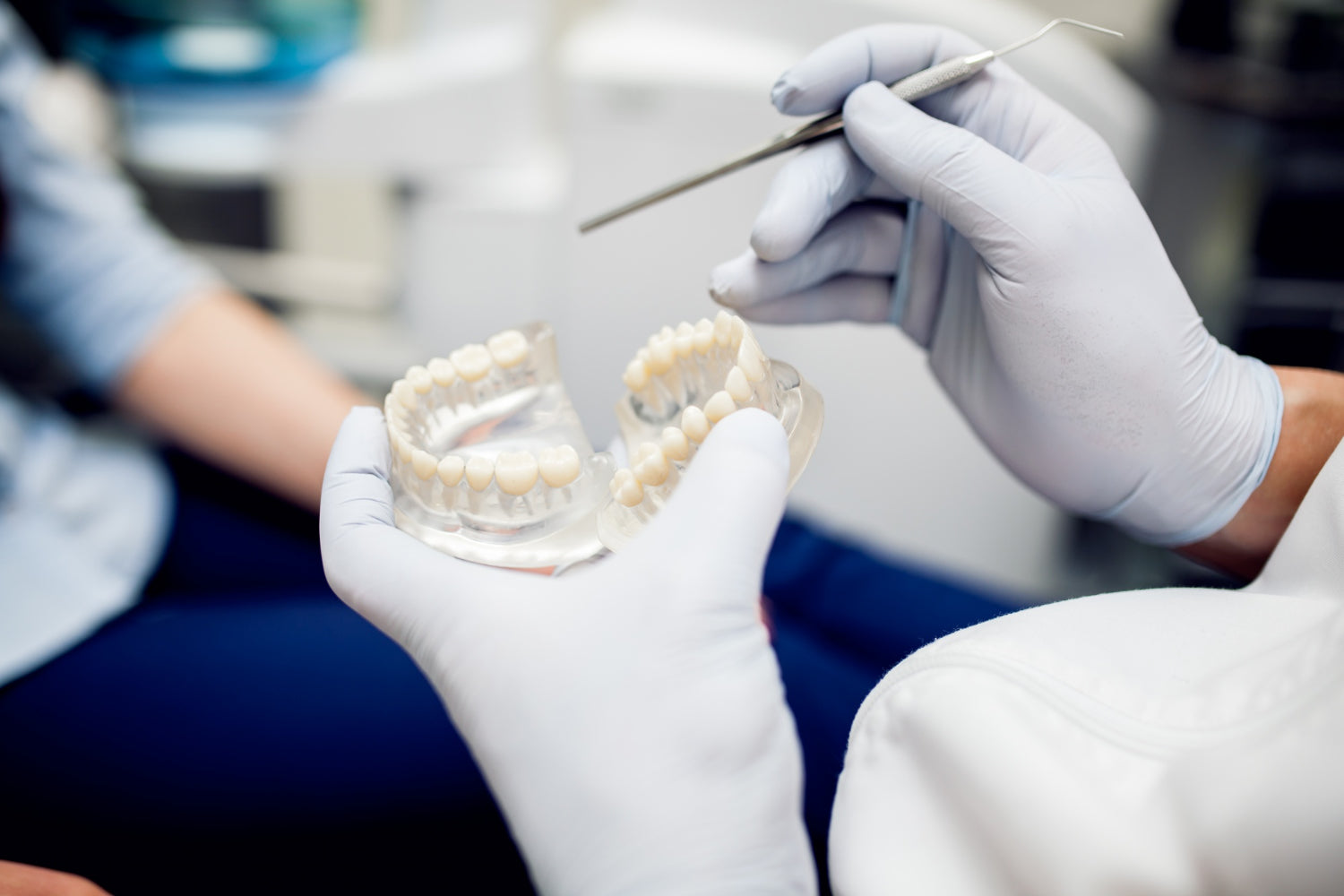
Dental ceramic is the material category most restorations now fall into — and yet it's one of the least understood by the people ordering it, using it, and in some cases fabricating it. The term covers everything from the feldspathic porcelain on a traditional PFM crown to the high-strength zirconia blocks a digital lab mills thirty units from every day. Those materials share a name and very little else.
This guide breaks down what dental ceramic actually is, how each type performs clinically, and what the distinctions mean when you're choosing materials for a specific case. It's written for dental labs and clinicians who want to make informed decisions, not recite a textbook definition.
What dental ceramic actually is?
In simple terms, dental ceramic is an inorganic, non-metallic material processed at high temperature to produce a hard, stable structure suitable for long-term use inside the mouth. The common thread across all ceramic types is that heat — firing or sintering — is what develops their final mechanical properties.
What varies enormously between types is composition. Change the crystalline structure, the firing temperature, or the stabilising compounds, and you get materials with completely different strength, translucency, and clinical range. A feldspathic porcelain and a 3Y-TZP zirconia block are both dental ceramics. They have almost nothing in common in how they behave under load.
That distinction — same category, very different properties — is why understanding ceramic types matters practically. Selecting the wrong one for a case isn't a minor oversight. It affects longevity, aesthetics, and in some situations, whether the restoration survives at all.
The main types of dental ceramic
Feldspathic porcelain
The original dental ceramic. Feldspathic porcelain has been used in restorations since the late 19th century and remains the standard for veneering — layering over a stronger substructure to build natural colour and translucency. Its aesthetic ceiling is genuinely high; skilled technicians can achieve optical properties that closely mimic natural enamel.
The limitation is strength. Feldspathic porcelain has a flexural strength of 60–100 MPa — far too low to function as a structural material on its own. It exists in modern dentistry almost exclusively as a veneering ceramic or in low-stress veneer applications on natural teeth. For implants or any high-load posterior work, it isn't a viable standalone option.
Lithium disilicate
Lithium disilicate sits in the middle of the ceramic spectrum — stronger than feldspathic porcelain at approximately 400 MPa [1], and significantly more aesthetic than zirconia. It became the preferred material for anterior single-unit restorations in the early 2000s because of how it handles light — the translucency and colour depth are difficult to replicate with any other dental ceramic.
The tradeoff is that 400 MPa, while adequate for anterior crowns on natural teeth, is borderline for implant-supported restorations and insufficient for posterior bridges under heavy occlusal load. Patient bite assessment and careful case selection matter significantly when specifying lithium disilicate. It's the right material in a specific band of cases — not a general-purpose ceramic.
Zirconia
Zirconia is now the dominant restorative ceramic across most dental lab workflows, and the reason is mechanical. High-strength 3Y-TZP zirconia reaches 900–1,200 MPa through transformation toughening — where the crystal structure actively resists crack propagation rather than fracturing through it. That makes it the only ceramic suitable for posterior implant crowns, multi-unit bridges, and full-arch prostheses where other ceramics fall short on strength.
The aesthetic limitation of early zirconia — the opaque, chalky appearance of first-generation materials — has been substantially addressed by 4Y and 5Y formulations that increase translucency by adjusting yttria content. Multilayer dental zirconia discs now build a strength-to-translucency gradient directly into the blank, giving labs a single material that covers both structural and aesthetic requirements across most indications.
The upcera zirconia covers this spectrum directly — from the high-strength Explore Functional for posterior and implant work, through to the multilayer Explore Esthetics for anterior cases where translucency is the priority.
Glass ceramics
Lithium disilicate sits within the broader glass ceramic family, which also includes leucite-reinforced ceramics. These materials share a partially crystalline structure that gives them better strength than pure glass while retaining high translucency. They can be etched with hydrofluoric acid for strong adhesive bonding — a genuine clinical advantage for veneers and inlays where conservative preparation is the goal.
Where each type is actually used?
The practical question isn't which ceramic is technically superior — it's which ceramic fits the clinical situation.
Anterior veneers and conservative restorations — feldspathic porcelain or lithium disilicate, depending on preparation depth and the technician's preference for characterisation control. Both offer the aesthetic quality these cases need. Neither is appropriate for a posterior implant crown.
Anterior single-unit crowns — lithium disilicate where aesthetics dominate and bite load is light. Multilayer zirconia where the patient has parafunctional habits or the clinician wants to reduce fracture risk without sacrificing aesthetics.
Posterior crowns on natural teeth — monolithic zirconia handles this well. Strength is the priority, aesthetic demands are lower than anterior work, and zirconia delivers at a lower cost and with less lab time than layered ceramics.
Implant-supported restorations — zirconia for anything posterior or multi-unit. Without a periodontal ligament, load transfers directly to the ceramic — which rules out lithium disilicate for most implant cases. The Aidite zirconia range covers this workflow comprehensively, from high-strength implant crowns through to multi-unit bridges, in both pre-shaded and white variants.
Full-arch prostheses — high-strength 3Y-TZP zirconia only. Nothing else has the mechanical properties to handle full-arch loading reliably.
Why the shift to ceramic matters clinically?
The move away from metal-based restorations has accelerated for reasons that go beyond patient preference. Zirconia in particular is chemically inert, doesn't corrode in the oral environment, and doesn't cause the soft tissue discolouration that dark metal margins produce when gums recede over time. For anterior restorations, that matters enormously to patient satisfaction at five and ten years post-placement.
Ceramic surfaces also accumulate less plaque than metal. A properly sintered and glazed zirconia surface is less hospitable to bacterial adhesion — relevant for both tissue health around the restoration and for long-term maintenance of the case.
Full-ceramic workflows — from fixture to final crown — are now clinically viable for most cases, and labs that can support them are meaningfully more useful to the clinicians they work with.
What this means for dental lab material selection?
For a dental lab, the ceramic decision comes down to three questions: what does the case demand mechanically, what does the clinician and patient expect aesthetically, and what can your milling and sintering setup handle reliably?
Most modern digital labs mill zirconia as their primary restorative ceramic, use PMMA for temporaries, and handle lithium disilicate either in-house on compatible equipment or outsourced. That covers the large majority of cases. Where labs differ — and where it actually affects clinical outcomes — is in which specific dental lab materials they stock and how consistent their sintering process is.
Consistency matters as much as specification. Pre-sintered density variation causes uneven shrinkage. Shade instability creates furnace surprises. Hardness inconsistency wears milling tools faster than it should. These issues don't show up in a single test milling — they accumulate over months as unexplained remake rates. Sourcing from a reliable dental lab material supplier who provides batch documentation alongside the product is worth considerably more than saving a few dollars per disc.
If you want to talk through which ceramic materials suit your milling system and case mix, get in touch with the team directly.


