

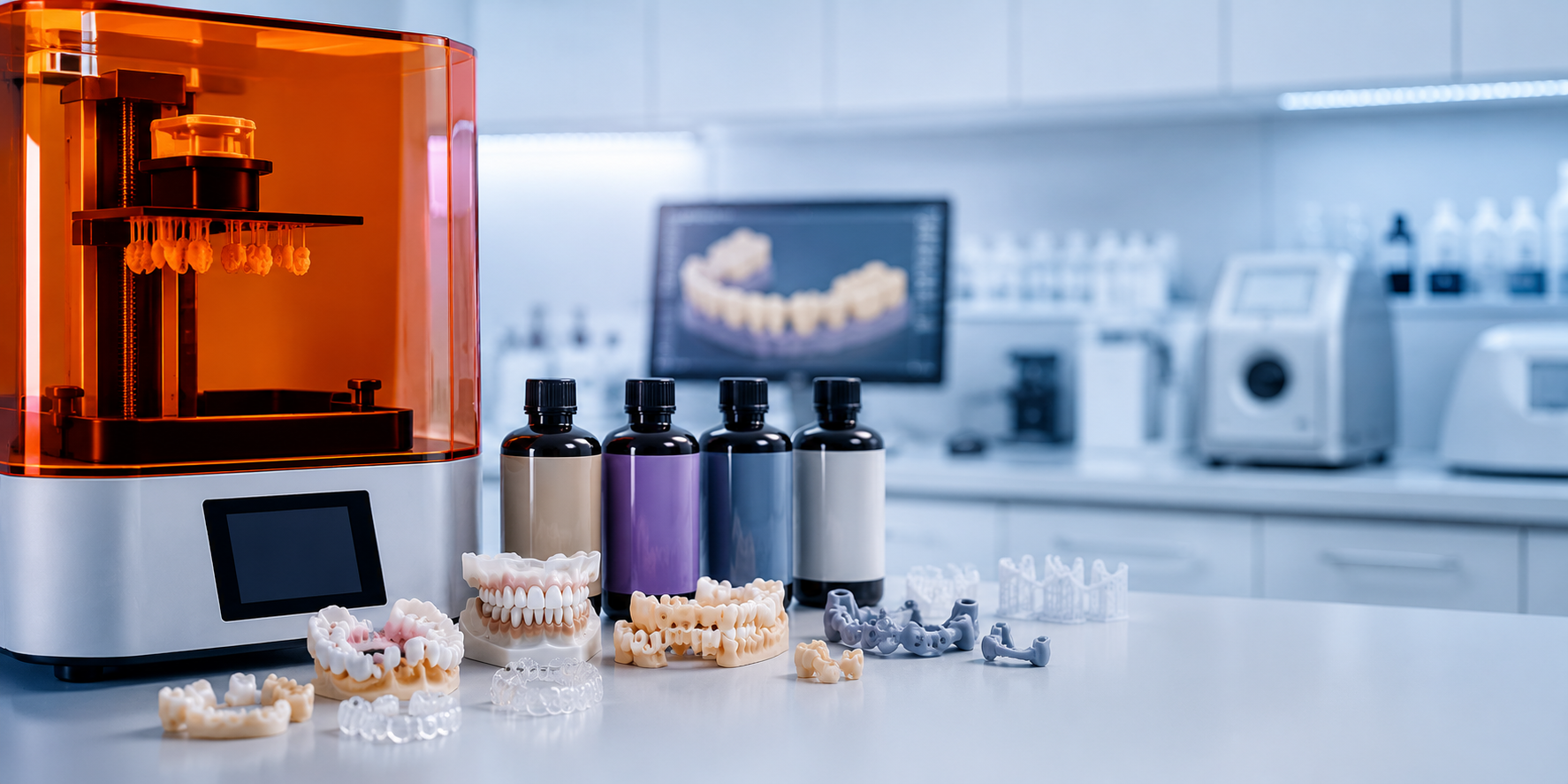
The dental laboratory has always been defined by its materials. For decades, the workflow was built around subtractive processes milling zirconia blocks, pressing ceramic, pouring plaster. The tools were precise and the outcomes were reliable, but the range of what a lab could produce was constrained by what those subtractive systems could achieve. 3D printing with dental-grade resins has changed that constraint fundamentally. It has added a parallel production pathway that handles applications that milling cannot serve efficiently and in doing so, has expanded what modern dental labs can offer their referring dentists.
This is not a speculative shift. Dental 3D printing is already a standard workflow component in labs across the US, producing surgical guides, diagnostic models, occlusal splints, orthodontic appliances, and temporary restorations at speeds and accuracy levels that were not possible five years ago. The question is no longer whether to adopt dental resin for 3d printing it is which resins to use, for which applications, and how to integrate them into a workflow that also runs zirconia milling, PMMA production, and the full range of traditional lab services. That is what this guide addresses.
What 3D Printing Actually Changes in a Dental Lab Workflow?
To understand why 3D printed resins are expanding lab services, it helps to understand exactly what the technology changes and what it does not change in daily production.
Subtractive CAD/CAM milling milling zirconia blocks dental and PMMA discs — is the correct process for permanent restorations requiring high material density, excellent surface finish from the mill, and the mechanical properties that only a pre-polymerized or pre-sintered disc can deliver. A milled zirconia blank exits the process as a dimensionally accurate, dense restoration ready for sintering or polishing. Milling is not going away. It is the right process for permanent fixed restorations.
Where milling is inefficient is in applications that require complex internal geometries, hollow structures, or very thin walls and where the material does not need to be a dense pre-sintered ceramic or fully polymerized acrylic. Surgical guides need thin walls, precise internal channels, and biocompatible surfaces. Diagnostic models need accurate occlusal anatomy across a full arch. Orthodontic retainers need to flex slightly. These applications are poorly served by subtractive milling and well served by additive 3D printing.
The labs that are expanding their service range most effectively are the ones running both systems in parallel milling dental zirconia discs and zirconia dental blanks for permanent fixed restorations, and printing dental resins for surgical guides, models, splints, and appliances. Each system does what it does best. The result is a lab that can handle a broader range of referring dentist requests from a single facility, without outsourcing categories of work that printing now makes achievable in-house.
This is the core reason dental resin 3d printing has become standard in modern labs not because it replaces milling, but because it adds production capability that milling cannot provide and that referring dentists increasingly expect their lab partners to offer.
The Application Map: What Each Resin Category Covers
Not all dental 3D printing resins are the same material. The resin category determines the mechanical properties, biocompatibility classification, and clinical application of the printed part. Using the wrong resin for an application a soft splint resin for a surgical guide, or a model resin for a temporary crown produces clinical failures. Understanding the application map is the prerequisite for any resin procurement decision.
Keystone dental products cover the full range of dental 3D printing resin categories required for comprehensive lab service from diagnostic models and surgical guides to occlusal splints and temporary restorations. The product line is organized by application, which is the correct way to approach resin selection: start with the clinical application and work backward to the material specification.
Diagnostic and study models
Model resins are formulated for dimensional accuracy and surface detail reproduction the two properties that determine whether a printed model is clinically useful for case planning, shade matching, or occlusal analysis. Model resins are not biocompatible for intraoral use. They are for out-of-mouth diagnostic purposes only. The material priority is accuracy, not strength or flexibility.
Surgical and implant guides
Guide resins are biocompatible, rigid, and optically clear or translucent clarity allows the clinician to verify tissue contact and guide seating visually. They are classified as Class II medical devices in most regulatory frameworks, requiring documented biocompatibility testing. Labs producing surgical guides must use resins with ISO 10993 biocompatibility certification.
Occlusal splints and night guards
Splint resins come in hard and soft formulations. Hard splint resins produce rigid occlusal splints for bruxism management and TMD treatment requiring high surface hardness to resist wear, smooth polish, and dimensional stability under repeated thermal cycling in the mouth. Soft/clear splint resins produce flexible night guards and sports guards where material compliance is part of the therapeutic effect.
Temporary crowns and bridges
Temporary resin formulations for 3D printing are tooth-shaded, biocompatible for short-term intraoral use, and formulated for smooth surface finish after post-processing. They differ from PMMA milling discs in application range printed temporaries are typically used for short-term provisional periods rather than long-term extended provisional wear, where milled PMMA's denser polymerization matrix offers better durability.
Orthodontic models and appliances
Ortho model resins are high-accuracy formulations designed for the dimensional tolerance required in aligners and retainer fabrication. Ortho IBT (indirect bonding tray) resins are formulated for the specific combination of rigidity and bond release behavior needed in bracket placement trays.
Custom impression trays
Tray resins are rigid, biocompatible for short-term mucosal contact, and formulated for the stiffness that impression materials require for accurate registration. Printed custom trays have largely replaced vacuum-formed tray systems in labs that have adopted 3D printing workflows because of their superior fit accuracy and faster production per unit.
Model Resins: The Entry Point for Most Labs
For dental labs adding 3D printing to an existing milling workflow, diagnostic model production is typically the first and most immediately valuable application. Every milling lab already produces models from plaster pours, vacuum-formed duplications, or outsourced printing. Bringing model printing in-house eliminates outsourcing cost and turnaround time on one of the highest-volume production items in the lab.
The key model resin is one of the most widely used diagnostic model formulations for open-system dental 3D printers. It delivers the dimensional accuracy required for crown and bridge case planning, the surface smoothness needed for accurate shade matching and die work, and the color contrast that makes occlusal anatomy readable under lab lighting conditions. Compatible with standard 385 nm and 405 nm cure wavelengths across the major open-system printer platforms.
Model resin selection should be evaluated on three criteria dimensional accuracy (deviation from the digital design file), surface resolution (ability to reproduce fine occlusal anatomy and margin detail), and color/contrast (ability to distinguish occlusal features under standard lab lighting). Labs should run a minimum of five test prints from different positions across the build platform before committing a model resin to clinical production build platform position affects cure uniformity, and edge-printed models may deviate from center-printed models on printers with lower-quality light engines.
For labs also managing zirconia dental blanks and milled restoration production, printed models serve as the verification step before the final restoration is delivered allowing the technician to check occlusal contacts, margin accuracy, and proximal contacts on a printed model before committing to the final case.
Splint Resins: The High-Margin Application
Occlusal splints are one of the highest-margin applications in dental 3D printing, and one of the strongest arguments for labs to add printing capability. A night guard or occlusal splint milled from PMMA requires a full disc and generates significant milling waste. A 3D printed splint uses only the material in the part itself waste is minimal, and multiple splints can be printed simultaneously on a single build plate.
Key splint hard resin is formulated for rigid occlusal splint production on open-system 3D printers. The material delivers the surface hardness needed to resist occlusal wear from bruxing patients, polishes to a smooth, biocompatible intraoral surface, and maintains dimensional stability across the thermal cycling of daily intraoral use and cleaning. Compatible with standard 385 nm and 405 nm cure printers.
The lab workflow for printed splints is significantly faster than for milled splints in most cases. Digital design of the splint from the scan takes 15–20 minutes. Print time for a single splint is 30–60 minutes depending on printer speed and layer height settings. Post-processing support removal, washing, and final cure — adds 20–30 minutes. Total production time from scan to finished splint: 90–120 minutes per unit in a typical workflow. That time comparison against conventional vacuum-form or milled splint production, at a fraction of the material cost, is what makes splint printing the application with the fastest ROI for labs adding printing capability.
Hard vs. soft splint resins when to use each:
Hard splint resins (like Key Splint Hard) are the correct choice for therapeutic occlusal splints for bruxism and TMD cases applications where the rigidity of the material is part of the therapeutic mechanism and where the surface must resist wear from opposing dentition over months of nightly use.
Soft/clear splint resins are the correct choice for sports guards, bleaching trays, and appliances where material compliance is the clinical requirement. The flexible character of soft resin allows the appliance to adapt slightly under pressure appropriate for impact protection, not for occlusal therapy where rigidity is needed.
How 3D Printing Fits Into a Full-Service Lab's Material Portfolio?
The most practically important point for labs evaluating 3D printing resins is how the technology integrates with, rather than replaces, the milling-based material portfolio. A full-service dental lab in 2025 runs both systems because they serve different clinical applications and the labs that run both are the ones that can say yes to every case type a referring dentist sends.
The material portfolio for a full-service lab today includes:
Milling materials: Zirconia blocks: (3Y for posterior bridges, 4Y/5Y multilayer for anterior esthetic cases), PMMA discs (multilayer for temporaries, denture base for removables), and any additional ceramic or composite milling blocks for specific indications.
3D printing resins: Model resin for diagnostic cases, guide resin for surgical and implant cases, hard and soft splint resins for occlusal appliances, tray resin for custom impressions, and ortho model and IBT resin for orthodontic case support.
For US labs building this dual-material portfolio, sourcing from a single domestic zirconia materials distributor usa that stocks both milling materials and 3D printing resins eliminates the multi-vendor complexity that managing separate supply chains creates. ZirconiaGuys stocks the full Keystone dental resin range alongside zirconia blocks dental and dental zirconia discs from Upcera and Aidite all from US inventory with no international lead times.
The referring dentist relationship benefits directly from this expanded capability. A lab that can handle a surgical guide request on the same case as a zirconia bridge order, without outsourcing either component, is a more valuable lab partner than one that handles only the milling work and farms out the printing. That is the commercial case for 3D printing integration in a full-service dental lab and it is why resin capability is no longer optional for labs that want to grow their referring dentist relationships.
Dental resin for 3d printing is not a replacement for zirconia blank milling or for any other established lab production method. It is an additive capability one that covers applications milling cannot serve and that referring dentists increasingly request from their lab partners. The labs expanding fastest in the current market are the ones that have added printing alongside milling, built a resin inventory mapped to clinical applications, and positioned themselves as single-source partners for the full range of their referring dentists' production needs.
Getting the resin selection right using guide-grade material for guides, hard splint resin for therapeutic splints, high-accuracy model resin for diagnostic cases is the foundation of a reliable 3D printing workflow. The material determines the outcome just as directly in printing as in milling. Invest in quality resin from a documented, consistent source, run your printer qualification correctly before committing to clinical production, and integrate printing into your existing milling workflow as the complementary system it is designed to be.


