

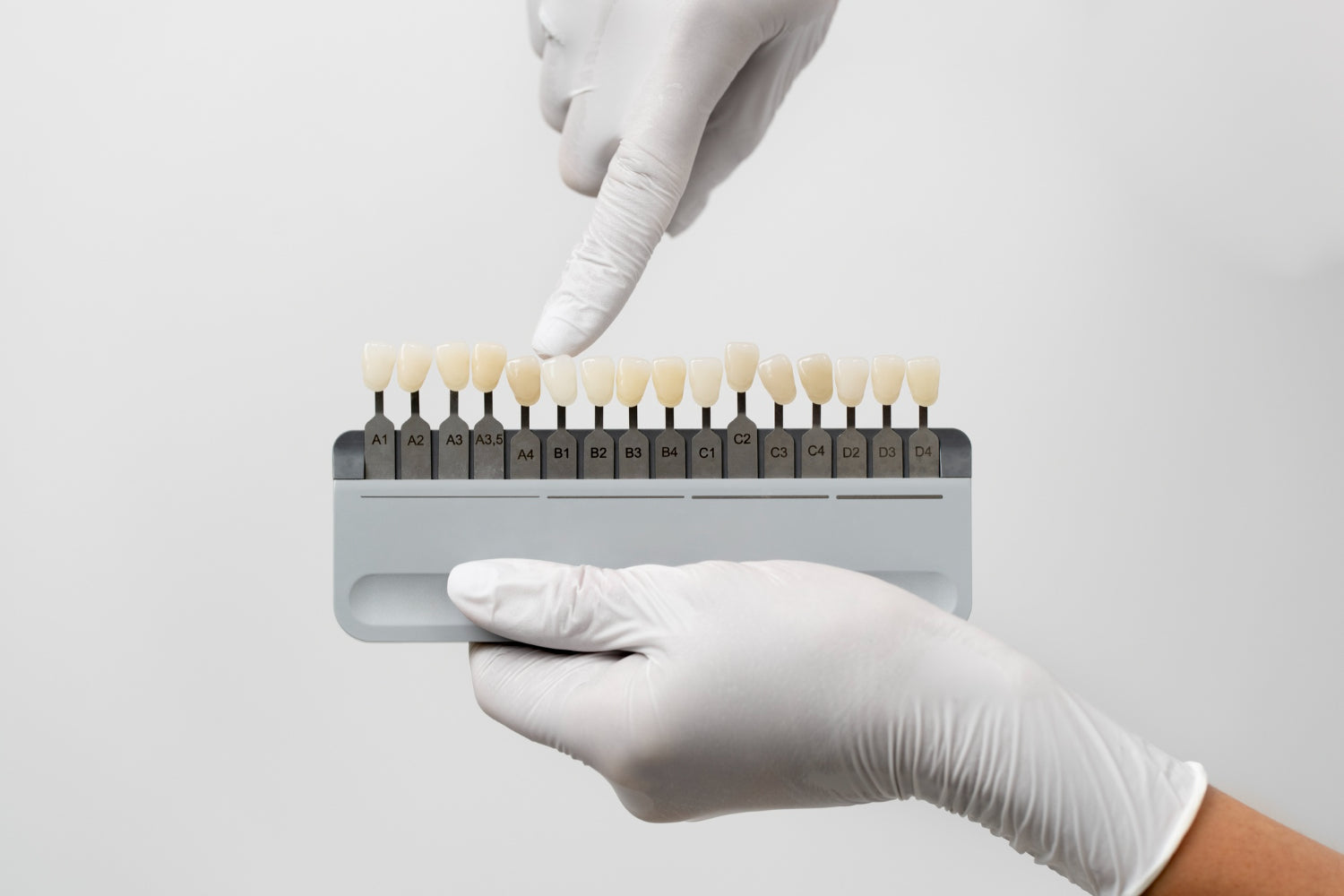
Dental zirconia blocks are the starting point for most crown and bridge restorations in a modern digital dental lab. Every monolithic zirconia crown a lab mills whether it's a simple posterior crown or a complex anterior aesthetic case begins as a pre-sintered blank that gets loaded into a milling machine and shaped into a restoration before being sintered to its final strength and dimensions.
Despite how central zirconia blocks are to the daily workflow of most labs, there's genuine confusion about what distinguishes one block from another grades, formats, shade configurations, and how those choices connect to clinical outcomes. This guide covers everything a lab needs to know to make informed sourcing decisions.
What a dental zirconia block actually is?
A dental zirconia block also called a zirconia blank or zirconia dental blank is a pre-sintered compact of zirconium dioxide (ZrO₂) stabilised with yttria (Y₂O₃). The blank is manufactured by pressing zirconia powder under high pressure and partially sintering it at moderate temperatures to produce a firm but machinable solid. At this stage, the material has roughly 60–70% of its final density strong enough to hold its shape during milling, but not yet fully dense or mechanically optimised.
The dental lab mills the crown or bridge from this pre-sintered blank at an oversized dimension typically 20–25% larger than the final restoration because the material shrinks to final size during the sintering step that follows. A CAD/CAM milling machine cuts the restoration geometry from the blank, the milled piece is placed in a sintering furnace at 1,450–1,550°C, and the final product emerges with full mechanical strength and accurate dimensions.
This process scan, design, mill from a zirconia blank, sinter is now the standard workflow in most digital dental labs. The entire workflow runs on equipment most modern labs already operate, which is a large part of why dental zirconia displaced traditional casting and pressing techniques in posterior restorations over the past fifteen years.
Why dental zirconia became the dominant restorative material?
Three properties drove zirconia's adoption across dental labs worldwide: strength, biocompatibility, and workflow efficiency.
Strength is the defining advantage. High-strength 3Y-TZP zirconia reaches 900–1,200 MPa flexural strength several times stronger than feldspathic porcelain and more than twice the strength of lithium disilicate. That mechanical performance is what makes dental zirconia the only ceramic suitable for posterior implant crowns, multi-unit bridges, and full-arch prostheses where other materials fracture at a clinically meaningful rate.
Biocompatibility adds clinical and patient-facing advantages. Zirconia is chemically inert, doesn't corrode in the oral environment, and produces no tissue discolouration at the margin a real limitation of metal-ceramic restorations when gingival recession exposes the margin years after placement. Its smooth post-sintering surface also resists bacterial adhesion better than metal, which matters for periodontal health around the restoration long-term.
Workflow efficiency is what made adoption practical at scale. A zirconia block mills on the same CAD/CAM equipment labs already use, sinters in a furnace already present in most labs, and delivers a complete restoration in one workflow without the casting, pressing, or manual layering steps that previous materials required.
Zirconia grades: the most important specification
Not all dental zirconia blocks are the same material. The grade determined by the mole percentage of yttria used in manufacturing controls the fundamental tradeoff between strength and translucency. Choosing the wrong grade for a clinical indication creates risk that no amount of skilled technique can compensate for.
| Grade | Flexural Strength | Translucency | Best Indication |
|---|---|---|---|
| 3Y-TZP | 900–1,200 MPa | Low (20–35%) | Posterior implant crowns, bridges, full-arch |
| 4Y-PSZ | 700–900 MPa | Moderate (35–45%) | Premolar crowns, short-span bridges |
| 5Y-PSZ | 500–700 MPa | High (45–57%) | Anterior single-unit crowns, low-load cases |
| Multilayer (3Y–5Y gradient) | 700–1,050 MPa | Graduated | Anterior and premolar, aesthetic + structural |
The practical rule: use 3Y for anything posterior, load-bearing, or implant-supported. Use 4Y or 5Y for anterior single units where aesthetics matter and bite load is light. Use multilayer discs for the majority of anterior and premolar cases where both strength at the margin and translucency at the incisal edge are required in the same restoration.
For high-strength posterior and implant applications, the Explore Functional dental zirconia blocks from UPCERA are a proven 3Y-TZP option engineered specifically for cases where flexural strength is the non-negotiable requirement and shade complexity is secondary.
Blocks vs. dental zirconia discs: choosing the right format
Dental zirconia comes in two physical formats compact rectangular blocks and larger round discs. The zirconia dental material inside them is identical. The choice is entirely about throughput and workflow.
Zirconia blocks dental labs use for single-unit work are the more flexible format. One block, one restoration, minimal waste. They're practical for lower-volume labs, atypical shades that aren't worth stocking in disc format, or one-off cases outside the normal production run. Blocks are also the right format when trialling a new material committing to a box of blocks before moving to discs is a sensible evaluation sequence.
Dental zirconia discs typically 95–98mm in diameter allow nesting software to place multiple restorations in a single milling cycle. The per-unit material cost drops significantly at volume, setup time is reduced, and throughput improves across a production day. Labs running 10 or more units daily will find disc format meaningfully more efficient than individual blocks for the same indication.
Most digital labs stock both: discs for regular production flow, zirconia blocks dental labs keep on hand for custom cases or shades not available in the current disc inventory. The UPCERA dental zirconia blank range covers both formats across all grades TT, ST, and HT lines in white, pre-shaded, and multilayer configurations.
Pre-shaded vs. white dental zirconia blanks
Within both blocks and discs, dental zirconia blanks are available in two shade configurations that affect the post-sintering workflow significantly.
Pre-shaded zirconia dental blanks have colour built into the material before sintering. The finished crown exits the furnace with a natural shade gradient already established reducing or eliminating external liquid staining time on standard prescriptions. A2 and A3 cover the majority of cases in most labs. For high-volume posterior work, pre-shaded blanks reduce bench time per unit without compromising shade accuracy, which compounds to significant time savings across a week of production.
White dental lab materials in zirconia give technicians full control over characterisation through liquid shade systems and surface stains applied before sintering. These are the right choice for complex custom shading, unusual prescriptions, or cases where the finishing work is the differentiator in a lab's service offering. The Aidite zirconia blocks range including HonorZir SHT and Superfect Zir lines covers both pre-shaded and white options across multiple translucency grades, letting labs build a practical inventory from a single supplier relationship.
Most labs settle on pre-shaded multilayer discs for standard production and white blocks for custom cases. That combination handles the large majority of prescriptions without overstocking.
Sintering: where outcomes are actually determined
Material grade and format are the decisions labs focus on but sintering accuracy determines whether the chosen material performs to specification in the clinic.
Every zirconia block and disc has a manufacturer-specified sintering curve: a precise ramp rate, hold temperature, and cool-down profile. Deviating from that curve even modestly can reduce the restoration's final flexural strength by 20–30% with no visible sign that anything went wrong. The crown seats correctly, looks fine, and then fails under load months later in a way that's difficult to trace back to the sintering program.
Following the specified sintering curve exactly for every product, every batch is the single most important quality control step in a zirconia milling workflow. It costs nothing and prevents a category of clinical failure that better material selection alone cannot address.
Most major zirconia brands including UPCERA and Aidite provide both standard and fast-fire sintering programs. Fast-fire cycles complete in under two hours for single units and short bridges, enabling same-day crown delivery in fully digital workflows.
What to look for when sourcing dental zirconia blocks?
The specification on a datasheet describes potential performance. Batch-to-batch consistency determines whether that potential is reproducible in your lab across months of production. These are the factors that matter most when evaluating a zirconia supplier:
Pre-sintered density uniformity inconsistent density across the blank produces uneven shrinkage during sintering, which causes marginal gaps and poor fit. This is the most common source of unexplained remake rates in labs that have switched to a cheaper zirconia source.
Shade stability across batches pre-shaded zirconia should produce the same shade outcome after sintering on batch 50 as it did on batch 1. Shade drift between deliveries forces labs to reverify every new shipment, which eliminates most of the efficiency advantage of pre-shaded material.
Open system compatibility dental zirconia blocks and discs should mill on any standard CAD/CAM platform without proprietary software keys or machine-specific restrictions. All UPCERA and Aidite products available through Zirconia Guys are open-system compatible with major milling platforms including Roland, vhf, Zirkonzahn, and Imes-icore.
Technical support from the supplier sintering curves, milling parameters, and shade verification protocols are product-specific. A supplier who can answer technical questions about the materials they sell is worth more than a marginally cheaper source with no support capability.
For dental labs in North America sourcing zirconia blocks, dental zirconia discs, and related dental lab materials, Zirconia Guys supplies both the UPCERA and Aidite ranges with full batch documentation and technical support. Get in touch with the team to discuss which grade, format, and shade configuration suits your milling system and case mix.


