

Getting a dental implant is one of the most significant investments a patient can make in their oral health. The procedure takes months, the restoration takes precision, and the materials from the titanium post in the bone to the crown seated on top are chosen specifically to last. So when a patient gets their implant restored and walks out of the clinic, the expectation is simple: this should hold.
For many patients, it does. But for a surprisingly large number particularly those who clench or grind their teeth at night the restoration remains at risk even after successful osseointegration. The culprit is bruxism, and the most effective clinical tool to protect against it is a well-fitted night guard. This is why an increasing number of dentists and prosthodontists are recommending occlusal protection as a standard part of implant aftercare, not just for patients who already know they grind, but for anyone whose bite history suggests parafunctional risk.
Why Implants Are More Vulnerable Than Natural Teeth?
Before understanding why night guards matter for implant patients specifically, it helps to understand what makes implants different from the natural dentition they replace.
Natural teeth sit in the jawbone via the periodontal ligament a thin, flexible tissue that acts as a shock absorber between root and bone. When you bite down hard, the periodontal ligament compresses slightly, distributing force and providing the tooth with a degree of proprioceptive feedback. Your nervous system senses that force, and the jaw muscles modulate accordingly.
Dental implants have no periodontal ligament. They integrate directly into bone a process called osseointegration which is what gives them their stability and longevity. But the trade-off is that there is no natural cushion between the crown and the bone. Force applied to an implant crown transfers directly to the bone-implant interface. In patients who grind or clench at night, this means the same forces that wear down enamel are instead concentrating at the junction between titanium post and jaw repeatedly, for hours at a time, while the patient is asleep and completely unaware.
Clinical research supports this concern. A study published in the International Journal of Implant Dentistry found that parafunctional habits are a recognised risk factor for peri-implant bone loss and implant prosthesis fracture. The forces generated during nocturnal grinding can be two to three times higher than those produced during normal chewing and unlike chewing, bruxism is not a controlled, purposeful movement that stops when the job is done.
What Happens to the Implant Restoration Without Protection?
The crown or prosthetic component sitting on top of the implant is the most directly exposed element when a bruxing patient has no occlusal protection. Depending on the restoration material, the outcomes of prolonged unprotected grinding vary:
Porcelain and ceramic crowns are susceptible to chipping and fracture under repeated lateral loading the exact type of force that bruxism generates. A restoration that looks perfect at the six-month check may show significant wear or even a fracture line at the twelve-month mark if the patient has been grinding unprotected every night.
Zirconia restorations, including crowns milled from zirconia blocks or cut from zirconia blank material, fare significantly better due to zirconia's exceptional flexural strength. This is one reason why zirconia has become the dominant restorative material for implant crowns — its resistance to fracture under load is far superior to feldspathic porcelain. However, even the toughest restoration is not immune to the cumulative effect of nightly grinding without any force distribution. Screw loosening, abutment wear, and accelerated wear on opposing dentition are all documented complications in unprotected bruxing patients regardless of the crown material used.
The bone around the implant is also at risk. Excessive lateral forces particularly the non-axial loading that bruxism produces have been associated with crestal bone loss in the peri-implant region. Once bone recedes around an implant, the structural foundation that keeps the entire restoration stable is compromised. Protecting the restoration from bruxism is, in this sense, also protecting the bone.
The Role of a Night Guard in Implant Aftercare
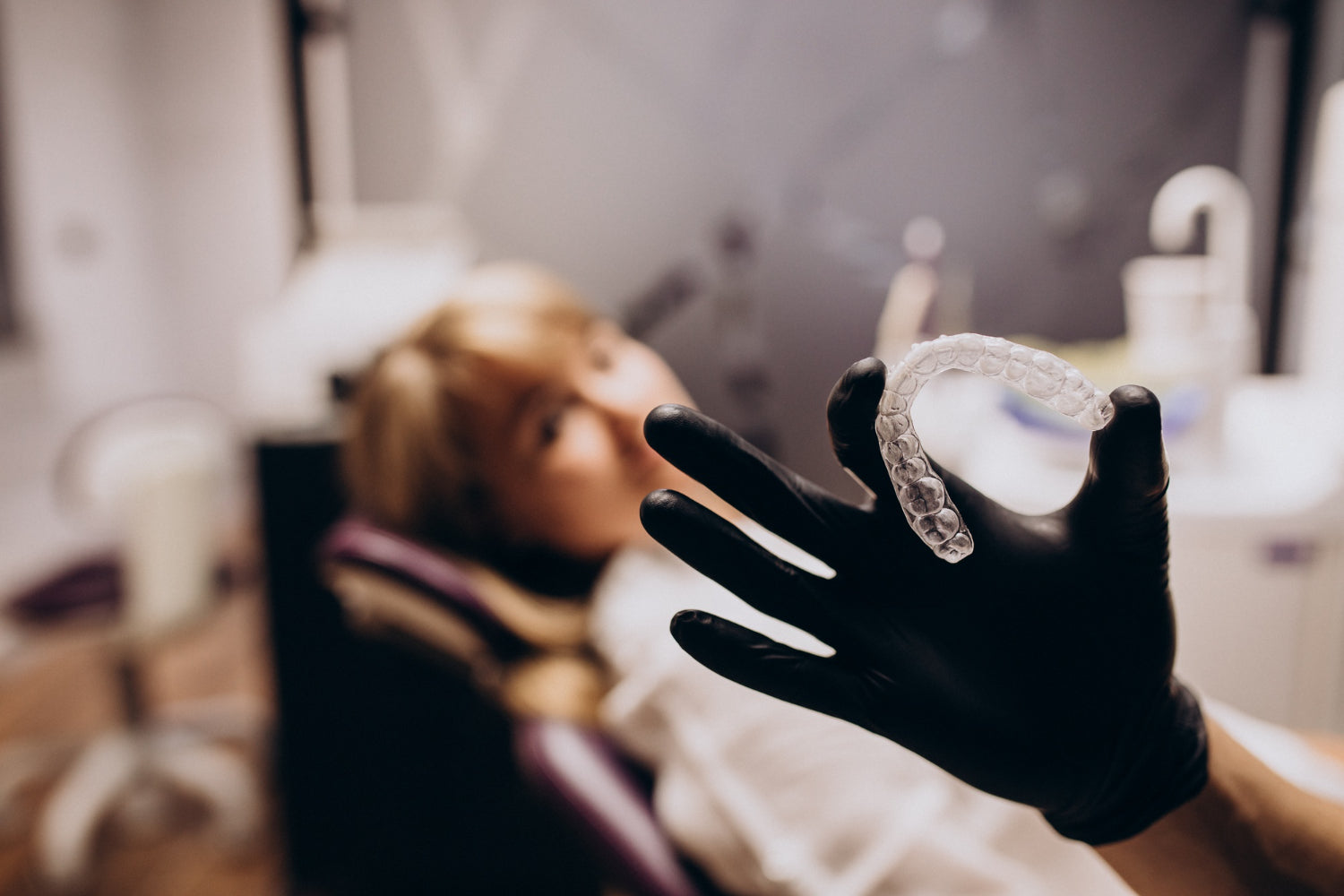
A night guard also called an occlusal splint or bite guard is a custom-fitted appliance worn over the upper or lower arch during sleep. Its function is to create a protective barrier between upper and lower teeth, redistribute occlusal forces more evenly across the arch, and prevent the concentrated lateral loads that bruxism generates from focusing on any single tooth or implant.
For implant patients, the night guard serves several specific purposes:
- Force redistribution — instead of grinding forces bearing down on the implant crown and bone interface, the guard spreads those forces across the entire arch, reducing peak stress at any single point.
- Prevention of screw loosening — abutment screws in implant restorations are the first thing to show signs of mechanical fatigue in bruxing patients. A well-fitted night guard reduces the frequency and severity of the torsional forces that gradually work screws loose.
- Protection of the crown surface — whether the restoration is zirconia or ceramic, the night guard absorbs the abrasive contact that would otherwise occur between upper and lower restorations during grinding episodes.
- Peri-implant tissue preservation — by reducing the abnormal loading at the bone-implant interface, the guard helps preserve the crestal bone that supports long-term implant stability.
Who Needs One and How Labs Play a Role?
The clinical recommendation for a night guard is typically straightforward when a patient presents with obvious signs of bruxism wear facets on existing teeth, fractured restorations in their history, muscle hypertrophy, or a sleep partner who confirms nocturnal grinding. But the reality is that many patients with parafunctional habits are unaware of them. Bruxism during sleep is involuntary, and without a bed partner to observe it, it often goes unreported until physical evidence accumulates.
This is why many clinicians now recommend night guard fabrication as a standard protocol for all implant patients, not only those with a confirmed bruxism diagnosis. The cost of fabricating a guard is significantly lower than the cost of repairing or replacing a failed restoration or managing peri-implant bone loss.
For dental labs, this represents both a clinical responsibility and a workflow consideration. The guard needs to be fabricated from a material that is durable enough to withstand grinding forces, comfortable enough that the patient actually wears it every night, and accurate enough in its fit that it does not itself introduce occlusal problems. Modern digital fabrication has made this significantly more achievable — guards designed from intraoral scans and printed or milled from high-performance resins offer consistency and precision that traditional thermoforming methods cannot always match.
Labs stocking dental zirconia discs and dental zirconia blanks for their implant crown production are already working in the digital workflow environment where guard fabrication fits naturally. The same digital models used to design the implant restoration can be used to design the protective appliance reducing turnaround time and eliminating the need for additional impressions.
Choosing the Right Guard Material for Implant Cases
Not all night guards are appropriate for implant patients. Over-the-counter boil-and-bite guards are generally inadequate they don't fit precisely enough to distribute forces correctly and can in some cases worsen occlusal loading rather than reduce it. For implant patients specifically, a custom-fabricated guard is the standard of care.
In terms of material, hard acrylic guards remain the clinical standard for heavy bruxers because of their durability and their ability to maintain a stable occlusal surface over time. Softer materials are more comfortable for mild grinders but may not offer adequate protection for patients with significant parafunctional habits.
For labs and clinicians looking for a digitally fabricated option, the Key Guard Sportguard Resin by Keystone represents a purpose-built solution for 3D printed mouthguards and protective appliances. Designed for precise digital fabrication from DLP and LCD printers, it delivers the custom fit and protective durability that implant patients need without the manual labour and variability of traditional thermoforming.
After the Implant: The Complete Picture
A successful implant outcome is not just about what happens in the operating chair or at the lab bench. It is about what happens every night for the following years. A patient who grinds their teeth and has no occlusal protection is exposing a significant clinical investment and all the upcera dental zirconia materials and precision lab work that went into it to forces that accumulate silently until something fails.
The recommendation to wear a night guard after implant restoration is not overcautious. It is practical, preventive, and increasingly considered best practice across the implant community. For the clinician, it is an easy conversation to have at the delivery appointment. For the lab, it is a natural extension of the same digital workflow already in use. And for the patient, it is one of the most cost-effective ways to protect one of the more significant investments they have made in their own health.
The implant and its restoration deserve to last. A night guard helps make sure they do.


