

Ask most dental lab technicians what material keeps their workflow running smoothly, and after zirconia and lithium disilicate, the honest answer is PMMA dental material. Polymethyl methacrylate doesn't get discussed much because it isn't glamorous it's not the permanent restoration, it's not the aesthetic showpiece. But it's the material that temporises implants during osseointegration, fabricates denture bases, produces same-day provisionals in digital workflows, and keeps patients functional through some of the longest treatment sequences in restorative dentistry.
This guide covers PMMA dental materials from a lab perspective what they are, the specific uses where they perform best, the clinical benefits that make them irreplaceable in certain workflows, and the different product types a lab should understand before building out a PMMA inventory.
What PMMA dental material is?
Polymethyl methacrylate is a thermoplastic acrylic polymer a long-chain molecule formed when methyl methacrylate monomers link under thermal or chemical initiation. In its dental form, it's supplied as a pre-polymerised, pigmented disc or block that mills on standard CAD/CAM equipment, or as a liquid/powder system for conventional processing.
Its defining mechanical characteristic is a flexural strength of 80–120 MPa too low for permanent crowns under functional occlusal load, but entirely appropriate for temporaries, provisionals, and denture bases where adjustability and patient comfort matter more than fracture resistance. That mechanical profile, combined with easy machinability and low cost, is what makes PMMA the right material for a specific and important band of dental lab work.
Uses of PMMA dental material in the lab
Temporary crowns and bridges
The most common use of milled PMMA in a modern digital lab is fabricating temporary crowns and bridges restorations worn by patients while a permanent restoration is being made or while an implant is integrating. In a fully digital workflow, the temporary is designed from the same digital scan as the permanent restoration, milled from a PMMA disc or block on the same CAD/CAM equipment, and delivered at the same appointment as the impression.
The clinical benefits here go beyond convenience. A PMMA temporary that exactly mirrors the planned permanent restoration allows the clinician to verify occlusion, aesthetics, and patient comfort before committing to the permanent material. Adjustments to the temporary translate directly into adjustments to the final design which reduces chairside time at permanent crown delivery significantly.
Implant temporization
PMMA's role in implant workflows is clinically more significant than it typically gets credit for. During the three-to-six-month osseointegration period, the temporary restoration worn by the patient actively shapes the soft tissue emergence profile that the permanent crown will inherit. A temporary that doesn't maintain the correct emergence geometry or that applies excessive force to the healing tissue creates a tissue environment that complicates the permanent restoration.
PMMA is the appropriate material for this role because it can be adjusted, relined, and modified chairside as tissue heals. Unlike a zirconia block or a ceramic temporary that can't be easily modified after sintering, a PMMA provisional can be adapted incrementally as the site evolves over the healing period.
Denture bases
PMMA has been the dominant denture base material for decades, and milled PMMA from high-density blanks has substantially improved on conventionally processed acrylic in terms of dimensional accuracy, surface finish, and porosity. Lower porosity means less bacterial infiltration into the denture base a hygiene and tissue health advantage that compounds over years of daily use.
Milled PMMA denture bases also eliminate the processing shrinkage and distortion that affects conventionally polymerised acrylic, producing a base that fits the model more accurately from the first try. For patients who have struggled with ill-fitting conventional dentures, a milled PMMA base is often a meaningful clinical improvement.
Diagnostic and trial restorations
Before committing to a final zirconia dental blanks milling run or a pressed ceramic restoration, some clinicians request a diagnostic PMMA trial a full-contour restoration in PMMA that allows the patient to evaluate aesthetics and occlusion in the mouth before the permanent material is processed. This is particularly useful in complex anterior cases where shade and morphology are critical.
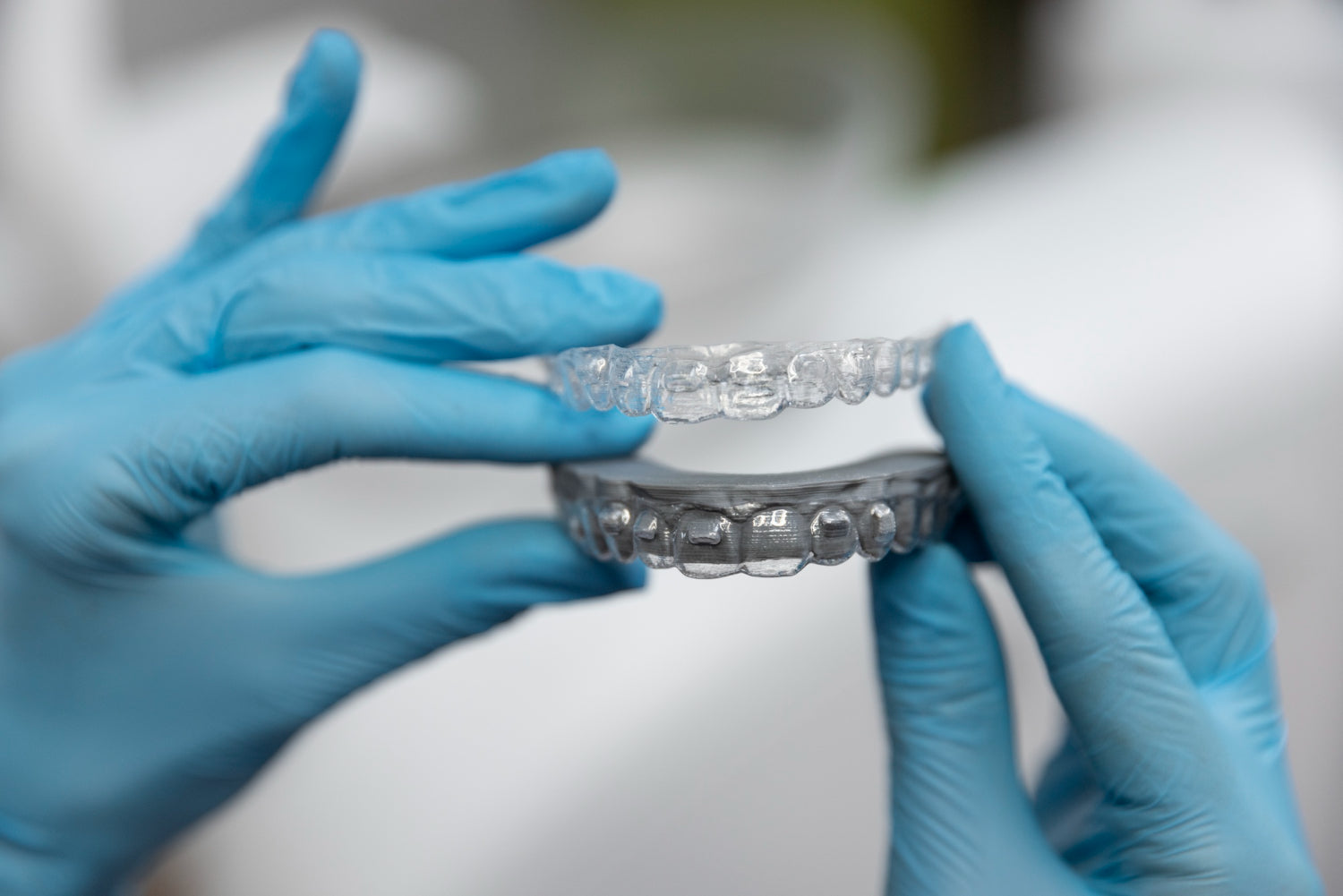
Clear PMMA is also used for thermoforming applications whitening trays, bleaching matrices, and retention appliances where optical clarity is required alongside the dimensional stability of an acrylic base.
Orthodontic appliances
PMMA's rigidity, dimensional stability, and ease of adjustment make it suitable for removable orthodontic appliances, retainers, and some functional appliance components. It doesn't have the flexibility of soft acrylic materials, but for appliances where rigidity is the clinical requirement, PMMA performs well and adjusts easily with standard laboratory instruments.
The key benefits of PMMA in a dental lab workflow
Mills on existing CAD/CAM equipment. PMMA discs and zirconia blocks dental labs already use run on the same milling platforms. No additional hardware investment is required to add PMMA to an existing digital workflow just a different blank and compatible burs. This makes PMMA the lowest-friction material addition available to a lab already running CAD/CAM.
Fast turnaround. PMMA mills significantly faster than zirconia dental blanks and requires no sintering step. A temporary crown can be milled, finished, and delivered in a single clinical session a workflow that no permanent ceramic material supports. For practices running same-day dentistry, this is a genuine operational advantage.
Chairside adjustability. Unlike sintered ceramic or milled zirconia which can't be meaningfully modified after processing PMMA can be trimmed, relined, and repaired chairside with standard equipment. For implant temporaries that need adjustment as tissue heals, and for dentures that need rebasing as ridge anatomy changes, this adjustability is clinically essential.
Biocompatibility. Properly polymerised PMMA is biocompatible and well-tolerated by gingival tissue. Residual monomer in incompletely polymerised material can cause sensitivity reactions, which is why milled PMMA from industrial-grade pre-polymerised blanks is clinically preferable to chairside-mixed acrylic for most applications.
Cost efficiency. PMMA disc and block costs are substantially lower than any permanent restorative ceramic. For temporary restorations that will be replaced by a permanent zirconia crown after a defined period, the economics of PMMA are straightforwardly correct high performance for the indication, at the right price point.
Types of PMMA dental material: choosing the right product
Not all PMMA products serve the same purpose. Understanding the main categories helps labs stock the right materials without unnecessary overlap.
Multilayer PMMA for anterior temporaries and aesthetic provisionals
Standard single-shade PMMA produces flat, uniform colour adequate for most posterior temporaries but visually unconvincing in anterior positions where the restoration sits alongside natural teeth with colour gradients and incisal translucency. Multilayer PMMA addresses this by building a shade gradient into the disc itself, similar in principle to multilayer dental zirconia discs.
The cervical region carries a deeper, more saturated shade; the incisal region is lighter and more translucent. A temporary milled from a multilayer disc produces significantly better anterior aesthetics without additional chairside characterisation. The aidite pmma multilayer disc covers this indication across standard VITA shades pre-shaded, open-system compatible, 12mm thickness suited to both single units and short-span bridges.
Denture base PMMA for full and partial denture frameworks
Denture base PMMA is formulated at higher density than crown and bridge PMMA, with colour matching for gingival tissue rather than tooth shade. It produces the base onto which denture teeth are set or bonded, and its dimensional stability through processing and wear is the primary quality criterion. The Aidite Denture Base PMMA is a milling-grade disc formulated specifically for full and partial denture frameworks producing accurate bases with good surface finish and tissue-matching gingival colour across standard shades.
Clear PMMA for diagnostic and thermoforming applications
Clear or transparent PMMA serves a different category of applications diagnostic trial restorations, whitening trays, thermoformed appliances, and some orthodontic work where optical clarity is the requirement. The Aidite Clear PMMA covers this indication a transparent milling disc compatible with standard open-system CAD/CAM platforms, suited for clear appliance fabrication and diagnostic workflows.
PMMA and zirconia: how they work together
In a modern digital dental lab, PMMA and zirconia occupy complementary roles. Zirconia whether sourced as zirconia blocks for single units or dental zirconia discs for multi-unit production handles permanent crowns, bridges, and implant restorations where strength and long-term performance are the requirements. PMMA handles everything before that: the provisional that temporises the case, the temporary that shapes the tissue during healing, the diagnostic that confirms the final design before the permanent material is committed.
Labs that run both materials from the same digital design file same scan, same CAD software, different material at milling report cleaner case handoffs and fewer surprises at permanent crown delivery. The patient's bite and soft tissue profile are established and verified through the PMMA temporary; the final zirconia dental blanks restoration inherits that environment rather than trying to establish it at seating.
Sourcing both materials from a single dental lab material supplier simplifies ordering, technical support, and workflow management. Zirconia Guys carries the full Aidite PMMA range multilayer, denture base, and clear alongside Aidite and UPCERA zirconia, covering the complete material spectrum for a digital zirconia and PMMA workflow.


