

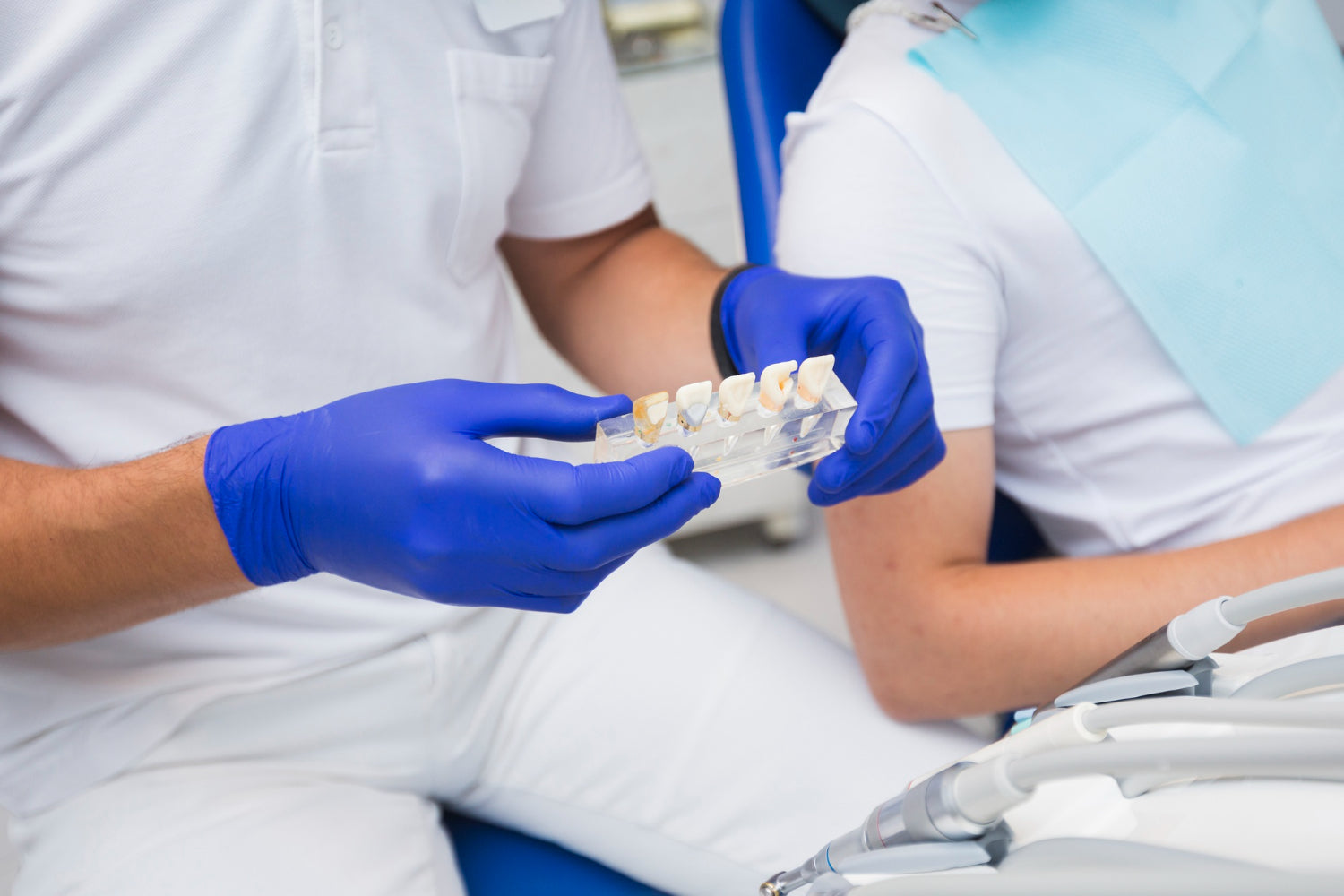
The lithium disilicate crown changed expectations for what an all-ceramic restoration could do. Before its clinical introduction in the late 1990s, achieving genuinely lifelike anterior aesthetics in a ceramic crown required hand-built feldspathic porcelain a labour-intensive process with an inherent chipping risk. Lithium disilicate offered a more efficient path to the same aesthetic outcome, with better strength than feldspathic porcelain and the ability to produce full-contour monolithic restorations that didn't depend on a veneering layer that could fracture.
Two decades of clinical use have confirmed that promise. This guide covers what actually makes lithium disilicate crowns clinically transformative for the patients who receive them and the dental labs that fabricate them and where the material's limits require a different specification.
The optical benefit: why lithium disilicate looks like a natural tooth
The defining characteristic of a lithium disilicate crown is its optical behaviour. Unlike opaque zirconia dental material or metal-ceramic restorations that block light at the substructure, lithium disilicate is a glass ceramic a partially crystalline material with a residual glassy phase that transmits and diffuses light in a way that closely resembles natural enamel.
The microstructure is what makes this possible. After heat treatment, approximately 70% of the material consists of interlocking needle-like lithium disilicate crystals, 3–5 µm in length, embedded in the glass matrix. The crystals scatter light similarly to the hydroxyapatite prisms in natural enamel producing the characteristic warmth, translucency, and depth that distinguishes high-aesthetic ceramic crowns from their more opaque alternatives.
For a dental lab, this means that a well-selected lithium disilicate crown can pass aesthetic scrutiny in anterior positions that other materials can't. The incisal translucency, the way colour shifts subtly from cervical to incisal, the surface texture and gloss all of these derive from the material's optical properties rather than from extensive manual characterisation work. That's clinically significant and operationally efficient.
The strength benefit: better than porcelain, appropriate for its range
Lithium disilicate's flexural strength of 360–500 MPa positions it in the middle of the ceramic spectrum far stronger than feldspathic porcelain at 60–100 MPa, and substantially weaker than high-strength 3Y-TZP zirconia at 900–1,200 MPa. Understanding what that means clinically is more important than the number itself.
For anterior single-unit crowns on natural teeth, 360–500 MPa is clinically adequate under normal bite forces. The fracture toughening mechanism where interlocking crystals deflect crack propagation rather than allowing it to travel directly through the material means the restoration resists crack initiation well under the loading patterns typical of anterior function. Clinical survival rates confirm this: published studies report 92–97% survival at five years for lithium disilicate crowns in appropriate anterior indications.
The transformation from ceramic crowns that chipped regularly to crowns that survive five and ten years of clinical use is what earns the word "transformative." Feldspathic veneered restorations chip at rates of 5–15% over five years. A well-placed lithium disilicate crown in an appropriate indication chips at a fraction of that rate a genuine clinical improvement that changed what restorative dentistry could reliably offer patients.
The conservation benefit: less tooth preparation
One of the most clinically meaningful but least discussed advantages of lithium disilicate is the reduction in tooth preparation it allows. Because the material can be adhesively bonded to tooth structure through hydrofluoric acid etching and silanation, it doesn't require the retentive preparation geometry that conventional cementation demands.
A lithium disilicate veneer requires as little as 0.3 mm of preparation. A full-coverage crown requires 1.0–1.5 mm of axial reduction. Compared to the 1.5–2.0 mm required for metal-ceramic or zirconia restorations relying on conventional cementation, this is a substantial difference in the amount of tooth structure removed. Over a lifetime of dental care, preserving more natural tooth structure produces better long-term prognosis for the restored tooth.
This conservative preparation profile is what makes lithium disilicate the preferred material for minimally invasive restorative dentistry cases where the clinical goal is to restore function and aesthetics with the smallest possible intervention into the remaining tooth structure.
The workflow benefit: pressed and milled options for different labs
Lithium disilicate is available in two fabrication forms, and the right choice depends on the lab's equipment and workflow preferences.
Pressed lithium disilicate uses ingots processed through a heat press furnace via the lost-wax technique. The resulting restoration is fully crystallised, with flexural strength of approximately 400 MPa and fracture toughness of 2.75 MPa·m½. Multiple restorations can be pressed in a single cycle, and the technician has direct morphological control through the wax-up process. For labs with existing press furnace capability, this workflow remains clinically excellent and cost-effective.
Milled lithium disilicate (IPS e.max CAD) is supplied in a partially crystallised "blue" state soft enough to mill cleanly on CAD/CAM equipment without the diamond tooling that fully crystallised ceramic requires. After milling, a crystallisation firing at approximately 840°C develops final strength (~360 MPa) and the characteristic optical properties. For labs running full digital workflows on CAD/CAM systems already used for zirconia blanks, adding lithium disilicate in the milled format requires no additional hardware.
The adhesive bonding benefit: how cementation strengthens the restoration
Unlike zirconia dental material, which cannot be etched with hydrofluoric acid, lithium disilicate's glassy phase is highly receptive to HF etching. A 20-second application of 5% HF creates a micromechanical retention pattern on the ceramic surface that, combined with silanation and resin cement, produces bond strengths that reinforce the restoration against fracture under load.
The clinical implication is that adhesive bonding doesn't just hold the crown in place it meaningfully increases the load-bearing capacity of the restoration in situ. A lithium disilicate crown cemented with resin adhesive after proper surface treatment performs significantly better under clinical loading than the same crown placed with conventional glass ionomer cement. This is why cementation protocol is inseparable from material specification when prescribing lithium disilicate.
Labs should include the recommended etching protocol in the crown delivery documentation for every lithium disilicate case. Clinicians who are unfamiliar with HF etching and silanation for ceramic crowns should be guided through the protocol restorations placed without it are mechanically compromised at delivery regardless of how well they were fabricated.
Where lithium disilicate crowns genuinely transform outcomes
The clinical situations where lithium disilicate delivers its most transformative results are consistent across the published literature and experienced lab practice:
- High-aesthetic anterior crowns — particularly for patients with high expectations or complex shade matching requirements. The optical properties that lithium disilicate produces in these cases are genuinely difficult to achieve with any other single material. Patients who receive a well-placed lithium disilicate anterior crown in a correct indication rarely report aesthetic dissatisfaction.
- Veneers — the combination of minimal preparation, adhesive bonding, and exceptional translucency makes lithium disilicate the gold standard for porcelain veneers. The clinical survival data for lithium disilicate veneers in appropriate patients is among the best in restorative dentistry.
- Inlays and onlays — conservative posterior restorations where full crown preparation isn't indicated. The adhesive bonding mechanism produces a restoration that strengthens the remaining tooth structure rather than relying on it for mechanical retention.
- Three-unit anterior bridges — pressed lithium disilicate spans up to the second premolar with adequate connector cross-section (minimum 16 mm²). Patient selection matters here bruxism and heavy posterior loading are contraindications.
Where the limits are: when to specify zirconia instead
The transformative benefits of lithium disilicate are real and well-documented but they apply within a defined clinical range. Outside that range, zirconia dental material is the appropriate specification.
- Posterior implant crowns — the absence of a periodontal ligament means bite force transfers directly to the restoration. At 360–400 MPa, lithium disilicate fracture risk in posterior implant positions is clinically unacceptable. High-strength 3Y-TZP zirconia whether from a zirconium block or a zirconia disc is the appropriate material without exception.
- Bruxism patients — cyclic parafunctional loading accelerates crack propagation in glass ceramics faster than in polycrystalline zirconia, which has a crack-arrest mechanism lithium disilicate lacks.
- Full-arch cases and long-span bridges — zirconia blanks in high-strength formulations handle full-arch loading. Lithium disilicate isn't indicated for spans beyond three units or posterior positions.
For anterior cases where the aesthetic benchmark is high but the clinician wants to avoid lithium disilicate's fracture risk particularly in implant cases multilayer zirconia is the practical middle ground. The Explore Esthetics zirconia multilayer from UPCERA delivers translucency levels that satisfy most anterior aesthetic requirements at zirconia's strength covering the overlap zone between the two materials for labs and clinicians who want aesthetic depth without the limitations of a glass ceramic.
Clinical survival: what the evidence says
The long-term clinical evidence for lithium disilicate crowns in appropriate indications is strong. Published systematic reviews report survival rates of 95–98% at five years for single-unit anterior crowns, with ten-year data approaching 90% in well-selected cases with correct cementation. Failures when they occur are typically cohesive fractures or debonding both of which trace back to either incorrect indication selection or improper cementation protocol rather than material failure per se.
This survival data is what justifies the clinical confidence that both dentists and patients place in lithium disilicate crowns. It's not theoretical performance it's verified outcomes across millions of restorations placed globally since the material's introduction.
Sourcing lithium disilicate and zirconia for your lab
For dental labs building a complete ceramic material inventory, the relationship between lithium disilicate and zirconia defines how cases get allocated. Lithium disilicate handles the aesthetic-priority anterior band. Zirconia in zirconium block or zirconia disc format, from 3Y high-strength to multilayer formulations handles everything else. Stocking both and using each in its correct indication produces better clinical outcomes than defaulting to one material for all cases.
The Aidite zirconia range covering high-strength, multilayer, pre-shaded, and white options in both disc and block formats is available through Zirconia Guys alongside the UPCERA range for labs that need a complete zirconia material inventory to complement their lithium disilicate workflow.


