

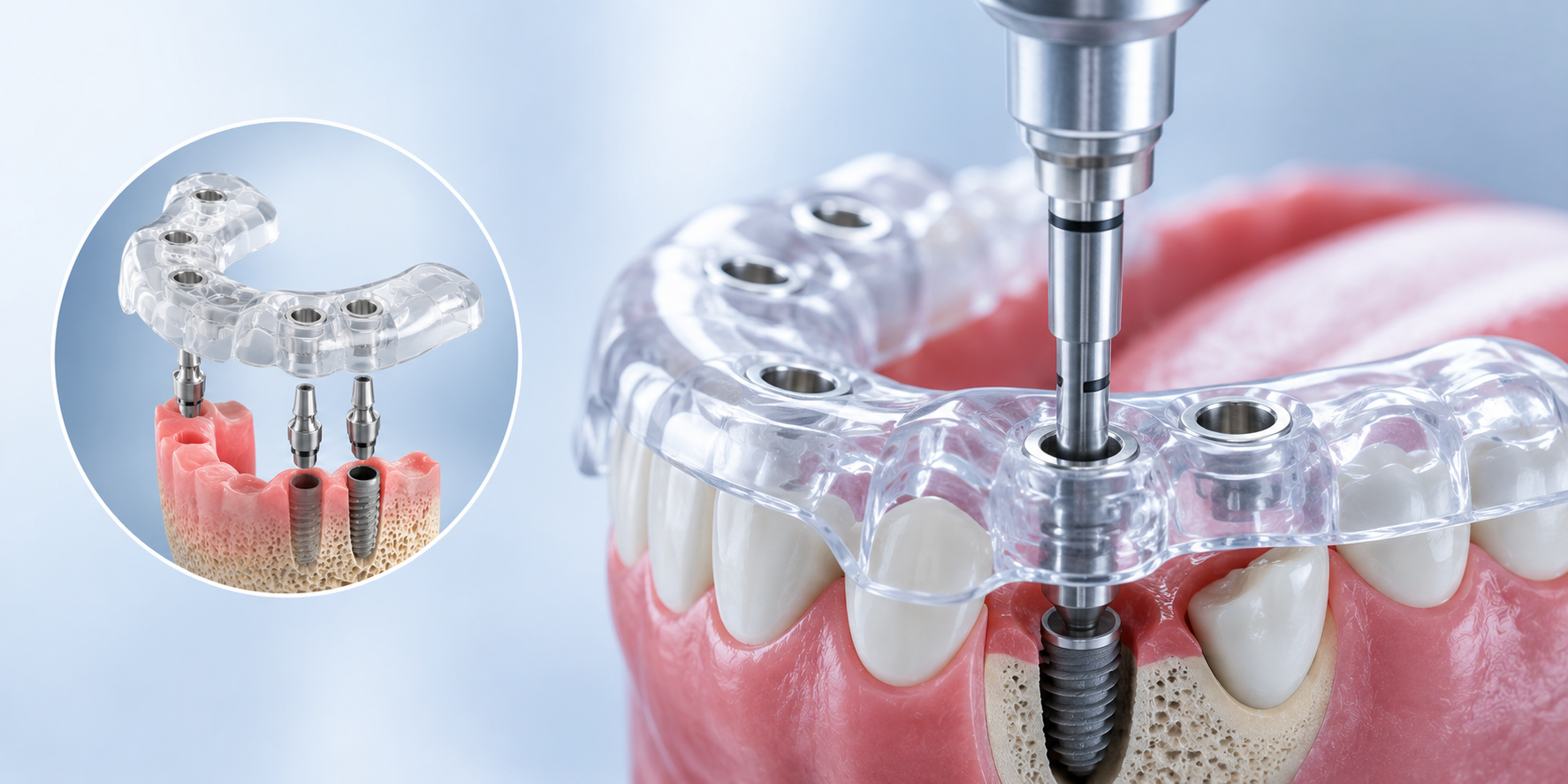
Dental implant surgery has always demanded a level of anatomical precision that separates it from most other restorative procedures. An implant placed 2 millimeters off the planned axis can compromise the final restoration, damage adjacent roots or nerves, or create bone loading angles that accelerate implant failure. For decades, achieving that precision depended almost entirely on the surgeon's skill, experience, and ability to mentally translate a two-dimensional radiograph into a three-dimensional surgical reality. That dependency is now being systematically replaced by digital surgical guides and the shift is one of the most significant changes in implant dentistry in the last twenty years.
This guide covers how surgical guides work, what they are made from, how dental labs produce them, and why the resin material selection is as important as the digital planning behind them. It also explains where surgical guides fit in the broader CAD/CAM workflow alongside zirconia blocks and other milled restorative materials that complete the implant treatment chain.
What Is a Dental Implant Surgical Guide?
A dental implant surgical guide is a custom-fabricated appliance typically clear or translucent that fits precisely over the patient's existing teeth or soft tissue and contains metal sleeves or open channels that direct surgical drills to the exact position, angle, and depth planned digitally. The surgeon follows the guide rather than freehand anatomy, making the physical execution of the surgery a confirmation of the digital plan rather than a real-time judgment call.
The workflow that produces a surgical guide begins with a CBCT scan of the patient's jaw, which generates a three-dimensional volumetric dataset of bone anatomy, nerve location, sinus floor height, and existing tooth positions. This dataset is imported into implant planning software platforms like coDiagnostiX, Simplant, or Nobel Clinician where the implant position, diameter, length, and angulation are planned virtually against the actual bone volume available. The surgeon and restorative dentist review the planned position relative to the final prosthetic outcome before the guide is designed around it.
The guide is then designed digitally and sent to a 3D printer for fabrication in biocompatible resin. The entire workflow from CBCT scan to printed guide in the hands of the surgeon can be completed in a matter of days when the lab is running a streamlined digital production process.
Why Surgical Guides Improve Implant Outcomes?
The case for surgical guides is built on a specific, measurable problem: freehand implant placement deviates from the planned position. Clinical studies consistently document entry point deviations of 0.9–1.5 mm and angular deviations of 3–5 degrees in experienced surgeons performing freehand implant placement. For single posterior implants in well-spaced bone, these deviations are manageable. For anterior esthetic cases, full-arch cases, cases with limited bone volume, or cases where the implant axis must align precisely with the planned crown, a 3-degree angular error is clinically significant.
Surgical guides reduce these deviations to entry point errors below 0.5 mm and angular errors below 2 degrees in most studies comparing guided versus freehand placement. The reduction in deviation directly translates into clinical benefits:
Nerve and Structure Avoidance
The inferior alveolar nerve, mental foramen, sinus floor, and adjacent root structures can all be damaged by freehand placement when the surgeon's real-time spatial judgment diverges from the preoperative plan. A well-fabricated guide physically prevents the drill from traveling outside the planned path, converting spatial planning into mechanical constraint.
Reduced Chair Time
Guided surgery eliminates much of the intraoperative decision-making that extends freehand procedures. The surgeon follows the guide; there is no need to repeatedly pause, recheck orientation, or adjust trajectory mid-drilling. This reduction in operating time reduces anesthetic exposure, patient fatigue, and complication risk associated with prolonged procedures.
Flapless Surgery Capability
Fully guided surgical protocols enable flapless implant placement inserting the implant through a small punch in the gingiva without reflecting a full mucoperiosteal flap. Flapless surgery reduces surgical trauma, eliminates suturing in straightforward cases, and substantially accelerates patient recovery. Without a surgical guide providing drill guidance through the gingival tissue, flapless placement is not safely achievable.
Prosthetically Driven Placement
Conventional implant surgery is anatomy-driven; the surgeon places the implant where the bone allows. Guided surgery is prosthetically driven; the implant is placed where the planned restoration requires it to be, within the bone volume available. This distinction is most significant in full-arch and esthetic anterior cases where implant axis directly determines prosthetic outcome.
The Resin Behind the Guide: Why Material Selection Matters
The precision of a surgical guide is only as good as the material it is printed from. A guide that distorts during printing, warps during post-curing, or creeps dimensionally when it absorbs oral fluids during surgery will place implants at positions that diverge from the digital plan defeating the purpose of guided surgery entirely.
For dental labs producing surgical guides, surgical guide dental resin is the material category that defines production quality. The Whip Mix VeriGuide Clear resin is formulated specifically for this application engineered to deliver the dimensional stability, optical clarity, and biocompatibility that surgical guide production requires.
Dimensional Accuracy
Is the primary requirement. The guide must reproduce the digital design within tolerances of ±0.1 mm or better at the sleeve positions. This demands a resin with low polymerization shrinkage, minimal post-cure warping, and stable dimensions after sterilization. Resins formulated for model printing or tray production do not meet these tolerances when used for surgical guides; the application requires a purpose-engineered formulation.
Biocompatibility
Is non-negotiable. A surgical guide contacts oral mucosa, bone, and saline irrigation during implant surgery. The material must meet ISO 10993 biocompatibility standards for short-term mucosal contact. Not all 3D printing resins marketed to dental labs carry this certification; labs must verify biocompatibility documentation before using any resin in an application with direct tissue contact.
Optical Clarity
Enables the surgeon to visually verify seating and confirm that the guide is fully seated on the reference teeth or tissue before drilling begins. A clear or translucent guide allows the operator to check for tissue folds, debris, or incomplete seating that would compromise positional accuracy. Opaque resins eliminate this visual confirmation and introduce a source of placement error.
Sterilization Compatibility
Matters because surgical guides must be sterilized before entering the operative field. Most surgical guide resins are compatible with cold chemical sterilization (glutaraldehyde, alcohol-based) and some tolerate autoclave sterilization at lower cycle temperatures. Confirm sterilization compatibility against the resin manufacturer's documentation; exposure to incompatible sterilization methods can cause dimensional distortion that makes the guide unusable.
How Dental Labs Produce Surgical Guides: The Production Workflow?
Understanding the production workflow helps labs optimize their surgical guide output and identify the points where material quality has the most impact on clinical outcome.
For labs looking at the full range of 3D printing resin options, the key guide 3d printing resin category covers surgical guide and custom tray applications giving labs the material flexibility to handle both guided surgery production and impression tray fabrication from a compatible product range.
Step 1 — CBCT Data Import and Planning
The lab receives the CBCT DICOM files and intraoral scan or model scan from the referring dentist or surgeon. These are merged in the implant planning software to overlay the bone volume data with the soft tissue and tooth anatomy.
Step 2 — Digital Guide Design
The guide body is designed around the planned implant positions, incorporating metal drill sleeves or printed drill channels at the correct position, angulation, and depth stop. The guide adapts to the patient's teeth, mucosa, or a combination of both as the positional reference.
Step 3 — Print File Preparation
The guide design is exported as an STL file, oriented in the print software for optimal support placement, and sliced for the specific printer and resin combination. Orientation affects dimensional accuracy; the guide should be oriented to minimize support contact on the sleeve surfaces and seating surfaces.
Step 4 — Printing
The guide is printed in biocompatible surgical guide resin. Layer thickness of 50–100 microns is standard for surgical guide applications. Post-printing, the guide is washed in isopropyl alcohol to remove residual uncured resin from surfaces and internal channels.
Step 5 — Post-Curing
The washed guide is cured in a UV post-cure unit for the manufacturer-specified time and intensity. Insufficient post-curing leaves residual unreacted monomer a biocompatibility issue. Over-curing can cause brittleness and dimensional distortion. Follow the resin manufacturer's curing protocol precisely.
Step 6 — Sleeve Insertion and Quality Control
Metal drill sleeves are press-fit or bonded into the printed channels. The guide is verified on the model for fit accuracy before delivery. Any rocking, instability, or gap between the guide and the reference surfaces indicates a fit problem that must be corrected before the guide goes to surgery.
Surgical Guides in the Broader Digital Implant Workflow
Surgical guides do not complete the implant treatment; they initiate it. The final restorations that complete the implant case are typically milled from zirconia blank and zirconia blocks dental material, bringing the same digital precision that placed the implants to the fabrication of the crowns and bridges that restore function and esthetics.
For labs sourcing the full implant restoration material range, zirconia dental blanks from Upcera cover the 3Y, 4Y, and 5Y grade range needed across the full spectrum of implant crown and bridge indications from high-strength posterior bridge frameworks in 3Y to esthetic anterior implant crowns in multilayer 5Y.
The relationship between surgical guide accuracy and final restoration fit is direct. When the implant is placed at the planned axis, the CAD/CAM-designed crown or bridge seats passively without the stress that off-axis placement creates at the implant-abutment interface. This is why the material quality of the surgical guide the dimensional accuracy of the resin, the precision of the print has downstream consequences that reach all the way to the final restoration's long-term performance.
For labs that also produce the fixed restorations completing the implant case, stocking dental zirconia discs alongside surgical guide resin enables a complete digital implant workflow under one roof from the guide that places the implant to the zirconia crown that restores it.
As a zirconia materials distributor usa, ZirconiaGuys stocks both surgical guide resins and the full zirconia disc range from US inventory, enabling dental labs to source the complete implant workflow material chain without international lead times.
Surgical guides have shifted dental implant surgery from a procedure dependent on individual surgical skill to one anchored in digital planning and material precision. The accuracy improvements are real, the patient experience benefits are measurable, and the integration with CAD/CAM workflows makes surgical guides a natural part of the same digital production chain that produces zirconia blank restorations, dental zirconia discs, and every other digitally designed restoration in the modern dental lab.
For labs looking to add surgical guide production to their capabilities, the material foundation is straightforward: a purpose-formulated biocompatible surgical guide resin, a calibrated 3D printer, and a reliable US supply chain that delivers consistent batch quality on every order.


