

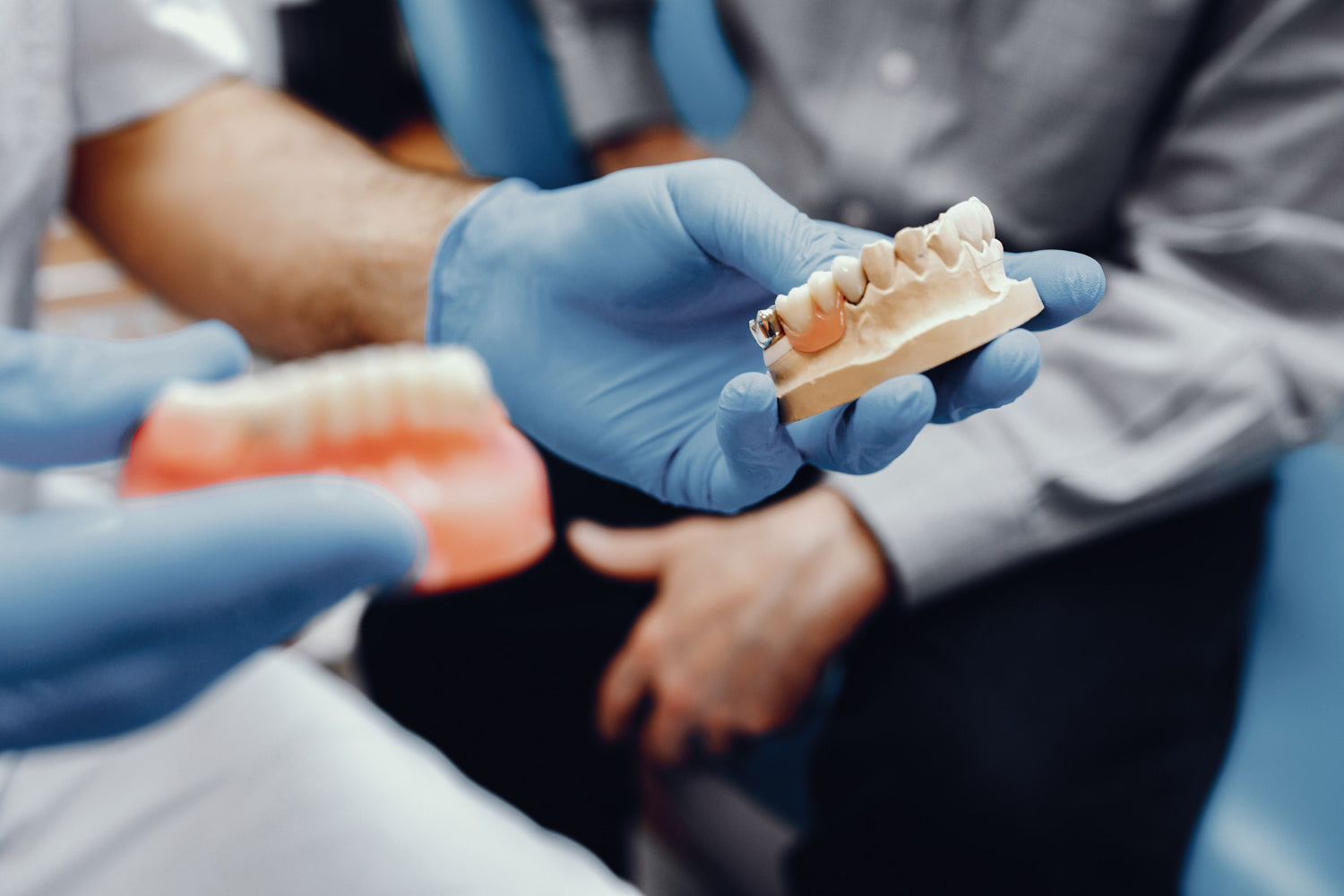
When a tooth is damaged or missing, the two most common restorative solutions a dentist will recommend are a dental crown or a dental bridge. Both restore function and appearance, but they work very differently, suit different clinical situations, and require different materials and fabrication approaches.
This guide explains exactly what crowns and bridges are, how they differ, when each is the right choice, and what materials dental laboratories use to fabricate them. Whether you are a patient trying to understand your treatment options or a dental professional looking at material specifications, this page covers everything you need to know.
What Is a Dental Crown?
A dental crown is a custom-made cap that fits over and completely covers a damaged or weakened tooth above the gum line. It restores the tooth to its original shape, size, and function and protects it from further deterioration.
Dentists recommend crowns in these situations:
- A tooth has severe decay that cannot be addressed with a filling alone
- A tooth is cracked, fractured, or structurally compromised
- A tooth has undergone root canal treatment and needs protection
- Significant wear has reduced the tooth structure
- A dental implant requires a visible restoration placed on top of it
In a dental laboratory, every crown begins as a zirconia blank or milled zirconia block shaped using CAD/CAM technology. The technician designs the restoration digitally from a scan sent by the dentist, then mills it to precise tolerances before sintering and finishing. This process, when executed with quality materials and calibrated equipment produces restorations that can last 15 years or more.
What Is a Dental Bridge?
A dental bridge is a fixed restoration that replaces one or more missing teeth by spanning the gap between neighboring teeth. It consists of:
- Abutment crowns: Crowns placed over the teeth on either side of the gap, which serve as anchors for the bridge
- Pontic(s): The artificial tooth or teeth suspended in the gap, held in place by the abutment crowns
Once placed, a bridge restores chewing ability, prevents neighboring teeth from drifting into the gap, and maintains proper bite alignment with all problems that develop when a missing tooth is left untreated.
Bridge frameworks place significantly higher mechanical demands on materials than single crowns. A 3-unit bridge spanning a gap must resist flexural forces across its full span on every chew. This is why dental labs fabricate bridge frameworks from high-density zirconia blocks with flexural strength above 900 MPa lower-strength materials risk fracture at the connectors, the most common failure point in ceramic bridges.
Dental Crown vs Bridge: What Is the Difference?
The core distinction is simple: a crown restores a tooth that exists; a bridge replaces a tooth that does not. Everything else the number of units, the material requirements, the abutment preparation, and the cost follows from that single difference.
The table below provides a full side-by-side comparison across all key factors. This is the most important section of this guide if you are deciding between the two treatments, the table below answers the question directly.
| Factor | Dental Crown | Dental Bridge |
|---|---|---|
| Purpose | Restores a damaged existing tooth | Replaces one or more missing teeth |
| Tooth present? | Yes tooth is still in the mouth | No gap exists where tooth was lost |
| Number of units | Single unit (1 crown per tooth) | 3+ units (2 abutment crowns + 1–3 pontics) |
| Abutment needed? | No crown fits over the prepared natural tooth | Yes adjacent teeth are prepared to anchor the bridge |
| Material | Monolithic zirconia block or zirconia blank | Multi-unit zirconia framework milled from high-strength zirconia blocks |
| Strength required | 900–1,200 MPa (posterior); 700–900 MPa (anterior) | Minimum 900 MPa higher span = higher load requirement |
| Avg. lifespan | 10–20+ years depending on material and care | 10–15 years abutment teeth carry additional load |
| Implant option? | Crown can be implant-supported (no natural tooth needed) | Implant-supported bridge avoids preparing healthy adjacent teeth |
| Cost comparison | Lower single unit fabrication | Higher multi-unit framework with precise connector sizing |
From our experience supplying U.S. dental labs
The most common material-related bridge failure we see reported by labs is connector fracture almost always traced to either under-dimensioned connectors in the CAD design or use of a zirconia block with flexural strength below 900 MPa for a posterior span. For any posterior bridge of 3 or more units, we recommend monolithic 3Y-TZP zirconia blocks with a minimum 1,000 MPa flexural strength rating. Upcera TT White and Explore Functional are the products most consistently specified by labs in our network for this case type.
When Do Dentists Recommend a Crown?
A crown is the appropriate treatment when the natural tooth is still present but needs structural reinforcement or protection. Common clinical indications include:
- Large cavity: When decay removes so much tooth structure that a filling would not provide adequate support
- Cracked or fractured tooth: A crown holds the tooth together and prevents the crack from propagating further
- Post root canal: Root canal-treated teeth become brittle over time a crown distributes bite forces and prevents fracture
- Severe wear: Teeth worn down by bruxism or acid erosion can be rebuilt to correct height and occlusion with a crown
- Implant restoration: A crown placed over a dental implant functions like a natural tooth without requiring preparation of adjacent teeth
For posterior crowns particularly in bruxism cases dental labs typically specify monolithic zirconia blocks dental materials with flexural strength above 1,000 MPa. Explore Functional Zirconia from Upcera is a multilayer 4Y/5Y option that balances this strength requirement with natural shade depth one of the most specified products in our catalogue for crown cases where both durability and esthetics matter.
When Is a Dental Bridge Recommended?
A bridge is recommended when one or more teeth are missing and the teeth adjacent to the gap are healthy enough to serve as abutments. The absence of a tooth even a back molar creates a cascade of problems if not addressed:
- Adjacent teeth begin to tilt or drift into the gap within months
- The opposing tooth can over-erupt without contact from below
- Bite alignment changes, creating uneven pressure distribution
- Bone loss begins under the gap as the jaw resorbs without tooth root stimulation
A bridge addresses the visible gap and prevents drift but it does not stop bone loss, which is one reason implant-supported restorations are increasingly preferred for single-tooth replacement when bone volume allows.
Bridge frameworks require zirconia dental blanks with higher density and tighter lot consistency than single-unit crowns. Variable material density across a disc causes inconsistent sintering shrinkage this affects connector dimensions after firing, which directly impacts bridge fit and long-term fracture risk. TT Multilayer Zirconia for Crowns & Bridges from Upcera is manufactured to tight sintering tolerances and is ISO 13356-certified two of the most important specifications for labs fabricating multi-unit bridge frameworks.
Crown and Bridge Materials: What Dental Labs Use
| Material | Flex Strength | Esthetics | Best Use Case | ZirconiaGuys SKU / Notes |
|---|---|---|---|---|
| Monolithic 3Y zirconia | 900–1,200 MPa | Moderate–high | Posterior crowns, molar bridges, bruxism cases | Upcera TT White, HT White strongest all-ceramic option |
| Multilayer 5Y zirconia | 700–900 MPa | Very high | Anterior crowns, esthetic 3-unit bridges | Upcera TT Multilayer, TT One Multilayer |
| Explore Functional zirconia | 900+ MPa | High | Crowns and bridges requiring high strength + good esthetics | Upcera Explore Functional balanced 4Y/5Y multilayer |
| PFM (legacy) | ~400 MPa | Moderate | Being phased out porcelain chipping risk on bridges | Not stocked by ZirconiaGuys |
| Lithium disilicate | ~400 MPa | Very high | Anterior veneers and single crowns only | Not suitable for bridge frameworks |
| PMMA | 80–100 MPa | High | Temporary crowns and provisional bridges only | Aidite Multilayer PMMA 12mm, 16mm, 20mm |
For the majority of crown and bridge cases in 2026, monolithic and multilayer zirconia milled from ISO-certified zirconia blocks and zirconia dental blanks delivers the optimal combination of strength, esthetics, and fabrication reliability. Browse the full range of Upcera zirconia blocks and dental blanks and Aidite zirconia blocks and PMMA materials available through ZirconiaGuys.
How Long Do Crowns and Bridges Last?
- Zirconia crowns: 15–20+ years. Peer-reviewed 5-year survival rate of 96–98% for monolithic zirconia (Guess et al., Journal of Dentistry, 2020). The highest survival rate of any all-ceramic crown material.
- Zirconia bridges: 10–15 years typical; longer with correct connector design and high-strength zirconia blocks. The connector is the most common failure point undersized connectors fail earlier regardless of material quality.
- PFM crowns and bridges: 10–15 years. Lower survival due to porcelain chipping at the veneer layer a failure mode essentially eliminated by monolithic zirconia.
- PMMA temporaries: 2–6 weeks. Provisional use only never used as permanent restorations.
For patients: regular dental check-ups, twice-daily brushing, flossing around bridge pontics with floss threaders, and wearing a night guard if you grind your teeth are the most impactful habits for extending crown and bridge lifespan.
Crown and Bridge vs Dental Implants: When to Consider an Alternative
A dental bridge requires preparing drilling down the healthy teeth on either side of the gap to serve as abutment crowns. For patients with otherwise intact neighbouring teeth, this is a permanent modification that many clinicians increasingly advise against when an implant is feasible.
- No abutment preparation: Adjacent healthy teeth are left untouched
- Bone preservation: The implant root stimulates the jawbone and prevents resorption
- Independent function: Each implant crown functions independently failure of one does not compromise the others
The choice between a conventional bridge and an implant-supported restoration depends on bone volume, patient health, treatment timeline, and cost. This decision should always be made in consultation with the treating dentist and, where relevant, an oral surgeon.
Dental crowns and dental bridges are both reliable, long-lasting restorations but they serve fundamentally different purposes. A crown protects a tooth that is still in the mouth. A bridge replaces a tooth that is gone.
The materials that make both possible have advanced significantly. Today's monolithic and multilayer zirconia milled from ISO-certified zirconia blocks and zirconia dental blanks using precision CAD/CAM workflows deliver the strength, fit accuracy, and natural esthetics that modern restorative dentistry demands. Whether you are specifying a single posterior crown or a full-arch bridge framework, the material you choose and the supplier you source it from determines the outcome.


