

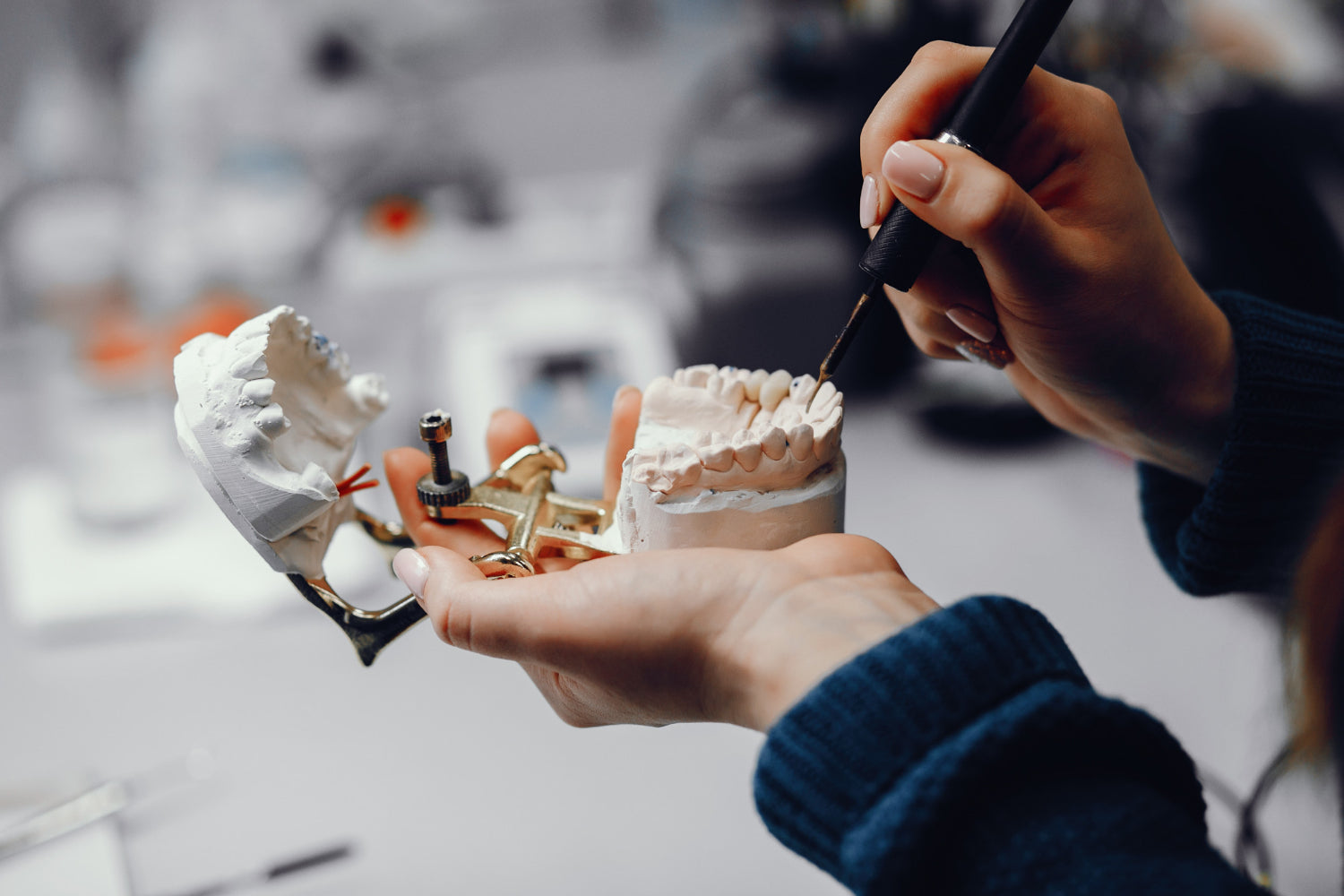
"Zirconia vs ceramic" is one of the most searched comparisons in restorative dentistry and one of the most misleading, because the framing implies they're separate categories. They aren't. Zirconia is a ceramic. What the question is really asking is: what's the difference between zirconia and other dental ceramics, and which one is right for the case?
That's a better question, and it has a clear answer. This guide breaks down how zirconia and other dental ceramics actually differ in composition, mechanical behaviour, aesthetics, cost, and clinical application so labs and clinicians can make the decision based on the case rather than habit or assumption.
Why "ceramic crown" means different things
The term ceramic crown covers several distinct materials that share a name but perform very differently. When a patient or clinician says "ceramic crown," they usually mean one of three things: a feldspathic porcelain restoration, a lithium disilicate crown, or a zirconia crown. Understanding the difference between them is the starting point for any meaningful comparison.
Feldspathic porcelain is the original dental ceramic glass-based, highly aesthetic, and weak in structural terms. Flexural strength of 60–100 MPa makes it unsuitable as a standalone crown material for anything beyond low-stress veneers. It survives in modern dentistry primarily as a veneering material layered over stronger substructures.
Lithium disilicate is a glass ceramic with flexural strength around 400 MPa strong enough for anterior single-unit crowns on natural teeth, with optical properties that closely mimic natural enamel. It's the material most people mean when they ask about a "ceramic crown" in the aesthetic sense. It handles light beautifully. It does not handle posterior implant loading safely.
Zirconia is a polycrystalline ceramic structurally and chemically distinct from glass ceramics. High-strength 3Y-TZP zirconia reaches 900–1,200 MPa through transformation toughening, a crack-resistance mechanism that glass ceramics don't have. That single difference is what makes zirconia viable for posterior implants, bridges, and full-arch cases where other ceramics cannot be safely used.
Strength: where the real difference lies
The strength gap between zirconia and other dental ceramics isn't a minor margin it's an order of magnitude. 3Y-TZP zirconia at 900–1,200 MPa is three to twelve times stronger than feldspathic porcelain, and more than twice the strength of lithium disilicate. In practical terms, this means zirconia dental material can be used in clinical situations that would result in predictable fracture with any other ceramic.
The mechanism behind this is transformation toughening. When a crack begins to propagate through a zirconia crown, the crystal structure at the crack tip undergoes a phase transformation that expands the material slightly effectively closing the crack rather than allowing it to travel. Glass ceramics like lithium disilicate don't have this mechanism. Once a crack starts, it progresses.
For posterior implant cases specifically, this distinction matters enormously. Natural teeth have a periodontal ligament a thin layer of connective tissue that absorbs and distributes bite forces. Implants don't. All of that force goes directly into the restoration. Lithium disilicate at 400 MPa is borderline even for natural posterior crowns; on an implant, the fracture risk becomes clinically unacceptable in most cases. Zirconia doesn't have this problem.
Aesthetics: where ceramic still has an edge
For all of zirconia's mechanical advantages, glass ceramics particularly lithium disilicate still produce superior aesthetics in the hands of a skilled technician. The reason is optical. Glass ceramics transmit and diffuse light in a way that closely resembles natural enamel. The internal translucency, colour depth, and surface character of a well-executed lithium disilicate crown in an anterior position is genuinely difficult to distinguish from a natural tooth.
Early zirconia was opaque and flat a significant aesthetic limitation that made it unsuitable for anterior work regardless of its strength. That limitation has been substantially reduced by newer 4Y and 5Y zirconia formulations with higher translucency, and most significantly by zirconia multilayer discs that build a translucency gradient into the blank itself. The cervical region retains 3Y-level strength; the incisal edge approaches 5Y optical quality. For most anterior cases, this is now good enough patients and clinicians who aren't directly comparing under ideal conditions won't see a meaningful difference.
The exception is high-profile anterior cases where the aesthetic benchmark is exact. A skilled layered ceramic crown built over a lithium disilicate substructure, in the hands of an experienced technician, remains the clinical gold standard for anterior aesthetics. Zirconia approaches it but doesn't surpass it.
Cost: zirconia blocks price vs ceramic materials
Cost comparison between zirconia and ceramic crowns involves both the material cost and the lab time. Zirconia blocks price varies by brand, grade, and format, but the more important cost factor for a dental lab is throughput how many units can be produced per hour of bench time.
A monolithic zirconia crown milled from a zirconium block is significantly faster to produce than a layered ceramic crown built over a substructure. Mill, sinter, stain, glaze, done. The layered ceramic workflow building up feldspathic porcelain by hand, multiple firings, risk of porcelain fracture during handling is labour-intensive and slower. At volume, that time difference is the larger cost factor, not the raw material price.
Lithium disilicate pressed or milled crowns sit in between faster than fully layered work, but with more steps than monolithic zirconia. For a posterior crown where aesthetics aren't the primary concern, monolithic zirconia is almost always the most cost-efficient option in a digital lab.
For labs evaluating zirconia blanks and disc formats, the multilayered zirconia options from UPCERA available in both disc and block format give labs a single material that covers most indications, reducing the number of SKUs needed to run a complete posterior and anterior workflow.
Biocompatibility: a genuine advantage for zirconia
Both zirconia and glass ceramics are biocompatible for intraoral use. Neither corrodes in the oral environment, and neither triggers an immune response in properly processed form. Where zirconia has a specific advantage is in soft tissue response around the restoration margin.
Zirconia's smooth, non-porous surface after sintering and glazing accumulates less plaque than metal or glass ceramic surfaces. In the long term, this matters for the health of the gingival tissue around the margin less bacterial load means less inflammation and better tissue stability over years of use. For patients with a history of periodontal issues, or for restorations in positions where hygiene is difficult, this is a clinically meaningful advantage rather than a theoretical one.
Zirconia also eliminates metal sensitivity concerns entirely. Patients who have reacted to metal restorations or who request fully metal-free treatment can receive zirconia from fixture to crown without compromise.
Which to use a practical decision framework
The choice between zirconia and other ceramics should follow the clinical demands of the case, not a default preference. A useful framework:
Use zirconia when: the restoration is posterior, the patient has any history of bruxism or heavy occlusal load, implants are involved, it's a bridge spanning more than one unit, or it's a full-arch case. In all of these situations, the strength of zirconia is not a preference it's a clinical requirement that other ceramics can't safely meet.
Use lithium disilicate or layered ceramic when: the case is a single anterior crown on a natural tooth, occlusal load is light, and the aesthetic benchmark is at the highest level. This is the narrower category, and the patient selection matters a bruxer with a high aesthetic requirement still needs zirconia, and the clinician conversation should reflect that.
Use multilayer zirconia as your middle ground: for the large majority of cases that don't fall clearly into either extreme, a high-quality zirconia disc with built-in translucency gradient covers both strength and aesthetic requirements without the failure risk of veneered ceramics. This is where most modern digital labs are landing for the bulk of their production.
Sourcing zirconia for your lab
Once the clinical decision is made, the sourcing decision matters more than most labs give it credit for. The grade and format of zirconia blank you choose affects every outcome downstream fit, shade accuracy, sintering predictability, and remake rate.
A zirconia disc for multi-unit production runs and zirconia blanks for single-unit or custom cases is the inventory approach most digital labs settle on. Within that, the choice between pre-shaded and white, and between 3Y, 4Y, 5Y, and multilayer formulations, should follow the case mix your lab actually runs rather than what's simplest to stock.
For labs running standard shade prescriptions, the st pre shaded zirconia and ST Pre Shaded disc exits the furnace with the shade gradient already established reducing staining time significantly on high-volume posterior work. For anterior cases where translucency is the priority, the pre-shaded zirconia blocks aidite in the Aidite HonorZir line offer a multilayer shaded option built for natural-looking anterior restorations.
Both ranges are available through Zirconia Guys get in touch to discuss which grade, format, and shade configuration suits your milling system and case mix.


