

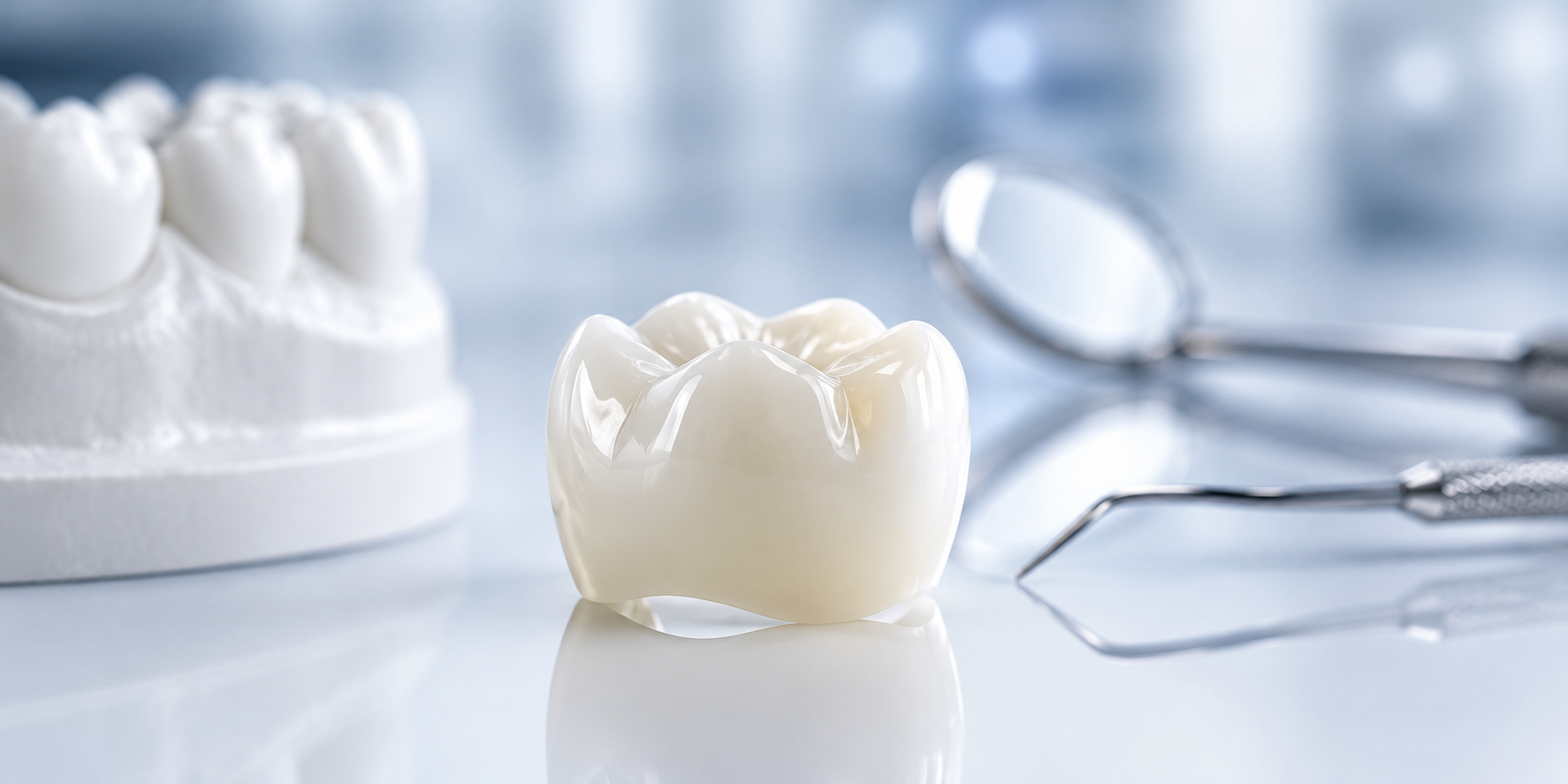
Zirconia crowns have become the default choice for permanent fixed restorations in modern dentistry and that shift has happened for good reason. The material delivers a combination of mechanical performance, esthetic versatility, and long-term clinical reliability that no previous generation of crown material could match. Porcelain-fused-to-metal restorations show dark lines at the gingival margin as patients age. All-ceramic pressed restorations fracture under heavy posterior occlusal load. Metal crowns work structurally but fail esthetically. Zirconia solves all three problems in a single material.
But zirconia is not one thing. It is a family of materials with distinct grades, distinct disc formats, and distinct clinical performance profiles. A dental professional who treats all zirconia as equivalent is making the same mistake as treating all antibiotics as equivalent — the class is the same, but the specific indication matters enormously. This guide covers the facts you need to select the right zirconia for every clinical scenario, understand what your lab is working with, and set accurate expectations for patients and referring practitioners.
What Zirconia Actually Is?
Zirconia is the common name for zirconium dioxide (ZrO₂) a crystalline ceramic oxide that is chemically inert, extraordinarily strong, and white in its pure form. In dentistry, it is always used in a yttria-stabilized form: yttrium oxide (Y₂O₃) is added to the zirconia crystal structure to prevent a destructive phase transformation that would otherwise cause the material to crack and crumble at room temperature.
The zirconia dental material category has expanded dramatically over the past decade. Early clinical zirconia was a single grade high-strength, opaque, posterior-focused. Today the range covers multiple yttria content levels (3Y, 4Y, 5Y), multiple disc architectures (monolithic, multilayer gradient), and multiple preparation formats (white unshaded, pre-shaded). Each combination produces a material with a different clinical performance profile.
The core chemistry is the same across all grades: zirconium dioxide stabilized with yttria. What changes is the yttria percentage, which controls the ratio of crystal phases present after sintering, which controls the material's translucency, and which determines its strength. Higher yttria means more cubic crystal phase, more translucency, and lower — though still clinically significant — flexural strength. This is the single most important fact about dental zirconia that every prescribing dentist and lab technician should internalize.
Zirconia Crown Strength: What the Numbers Mean in Practice
Flexural strength is the primary mechanical property used to compare zirconia blocks and other crown materials. It measures how much stress a material can withstand before fracturing under a bending load directly relevant to the occlusal and masticatory forces a crown experiences daily.
3Y zirconia delivers 900–1200+ MPa flexural strength. For reference, lithium disilicate (e.max) delivers approximately 400 MPa. PFM ceramic veneering material is typically 80–150 MPa on its own. 3Y zirconia is the strongest crown material in routine clinical use, and its margin of superiority over alternatives is substantial. It is the correct material for posterior bridges of three or more units, high-load posterior single crowns, and implant-supported frameworks where connector cross-section dimensions must meet structural requirements.
4Y zirconia delivers 600–800 MPa. Still dramatically stronger than lithium disilicate or PFM ceramic, but with meaningfully higher translucency due to increased cubic phase content. This is the workhorse grade for anterior and premolar single crowns in daily lab production strong enough for these indications and translucent enough to blend naturally with adjacent dentition.
5Y zirconia delivers 500–650 MPa. Maximum translucency within the zirconia family, approaching the optical character of natural enamel in the incisal zone. The correct choice for anterior single crowns in patients with highly translucent natural dentition, but not appropriate for posterior bridge connectors under heavy occlusal loading.
The zirconia blocks dental labs source for posterior bridge work are almost always 3Y-TZP grade because no other grade safely meets the connector cross-section strength requirements for multi-unit posterior spans. Using 5Y or high-translucency 4Y material in this indication is a structural compromise that puts the patient at risk of connector fracture.
Esthetic Performance: How Zirconia Matches Natural Tooth Appearance
The earliest clinical zirconia had an esthetic limitation that was widely acknowledged: it looked white and opaque compared to natural dentition, particularly in the incisal zone of anterior teeth. Staining and glazing improved results significantly, but heavily stained 3Y restorations still read as "ceramic" rather than "tooth" under direct or lateral lighting in many cases.
Modern multilayer gradient discs have resolved this limitation for the majority of clinical cases. Dental zirconia discs in multilayer pre-shaded format are manufactured with four to five distinct chromatic zones transitioning from a warmer, more opaque cervical zone through a body zone to a cooler, more translucent incisal zone all within a single blank. When the CAD/CAM toolpath is aligned correctly with these zones, the milled crown exits sintering with a natural shade gradient already built in, without any external staining required for standard A-D shade cases.
The esthetic performance difference between flat 3Y monolithic discs and modern multilayer 4Y/5Y gradient discs is not incremental it is the difference between a restoration that requires significant finishing effort to look natural and one that exits the furnace looking right. For anterior single crown cases, this distinction determines whether the case is a production-efficient standard procedure or an intensive hand-finishing exercise.
Factors that determine zirconia crown esthetics:
- Grade selection — 5Y for maximum translucency, 4Y for everyday anterior esthetic production, 3Y for posterior structural cases
- Disc format — multilayer gradient for esthetic cases, monolithic for structural cases
- CAD design alignment — the toolpath must orient the incisal edge of the crown in the incisal zone of the multilayer disc; reversed orientation produces an inverted gradient
- Sintering profile — esthetic-grade discs require controlled ramp rates and precise peak hold temperatures; accelerated sintering reduces translucency
- Surface finish — glazed and polished zirconia has a natural surface lustre that unfinished milled surfaces lack
Disc Formats: White, Pre-Shaded, and Multilayer
Every zirconia crown starts as a disc or block. The format of that disc shapes the downstream workflow more than any other single material decision.
White unshaded discs give the lab complete shade control through external staining. The correct choice for unusual shades outside the VITA A-D range, strong chroma B/C shade cases, characterization effects, or any case where the technician needs to build a custom shade from scratch. The tradeoff is bench time — every unit requires individual staining, and multi-unit shade consistency depends on technician skill.
Pre-shaded discs carry VITA-compatible gradients embedded in the manufacturing. For the significant majority of everyday crown cases, pre-shaded discs eliminate the staining step entirely and deliver more consistent shade results across units in a multi-tooth case. They are less flexible for unusual shades but dramatically more efficient for standard production volume.
Multilayer discs combine gradient architecture with either white or pre-shaded pigmentation. The internal gradient means the disc itself replicates the optical zonation of a natural tooth without requiring the lab to recreate that gradient through staining.
The zirconia dental blanks stocked by labs for anterior esthetic production are almost universally multilayer pre-shaded formats today. Labs that have made the transition from flat white 3Y discs to multilayer 4Y pre-shaded consistently report significant reductions in post-sintering finishing time on standard anterior cases and lower remake rates driven by shade inconsistency.
Zirconia blank selection by indication:
| Indication | Recommended Format |
|---|---|
| Posterior bridge 3+ units | Flat white or pre-shaded 3Y |
| Posterior single crown | Pre-shaded 4Y or white 3Y |
| Anterior single crown | Multilayer pre-shaded 4Y or 5Y |
| Anterior bridge | Multilayer 4Y verify connector strength |
| Implant anterior crown | Multilayer 4Y/5Y |
| Full-mouth rehabilitation | Mixed per quadrant |
Biocompatibility and Long-Term Clinical Performance
Zirconia is chemically inert in oral environments. It does not corrode, does not leach metal ions into surrounding tissue, and does not trigger the allergic or sensitivity responses associated with metal alloys. For patients with nickel, cobalt, or chromium sensitivities conditions that preclude PFM restorations, dental zirconia discs fabricated restorations are the standard of care alternative.
Long-term clinical data consistently supports zirconia's durability. Studies report 10-year survival rates above 95% for zirconia single crowns and above 90% for three-unit bridges. These are among the highest survival rates reported for any crown material in clinical use. When zirconia restorations do fail, the primary failure mode is chipping of veneering porcelain in layered systems a failure mode that monolithic and multilayer zirconia eliminate entirely by removing the veneering porcelain layer.
For patients who grind their teeth, zirconia's hardness is both an advantage and a consideration. It withstands bruxism forces that would fracture lithium disilicate or wear through PFM veneering ceramic. However, its hardness means it can accelerate wear of opposing natural dentition in heavy bruxers if not polished to a smooth final surface. Glazing and polishing zirconia restorations to a smooth occlusal surface is not an optional finishing step — it is a clinical requirement that directly affects the opposing dentition.
Sourcing Zirconia: What Dentists Need to Know About Their Lab's Materials
Most dentists interact with zirconia at the prescription and delivery stage without direct visibility into what material their dental lab is using at the disc level. That gap matters more than it might seem — because two zirconia crowns that look identical in the prescription form can be produced from dramatically different disc grades, from different manufacturers, with different strength specifications and different esthetic performance profiles.
Working with a zirconia materials distributor USA that stocks a documented, consistent product range from established manufacturers is the foundation of reliable clinical outcomes. Labs that source from low-cost undocumented suppliers gain short-term cost savings at the expense of batch consistency, documented strength specifications, and biocompatibility certification.
As a trusted zirconia crown supplier dentists across the US rely on, ZirconiaGuys stocks the full range of Upcera and Aidite zirconia grades including 3Y, 4Y, and 5Y formulations in white, pre-shaded, and multilayer formats from US inventory with full batch documentation. Labs sourcing from ZirconiaGuys know exactly what grade they are milling, what the documented flexural strength is, and what sintering profile delivers the specified performance.


