

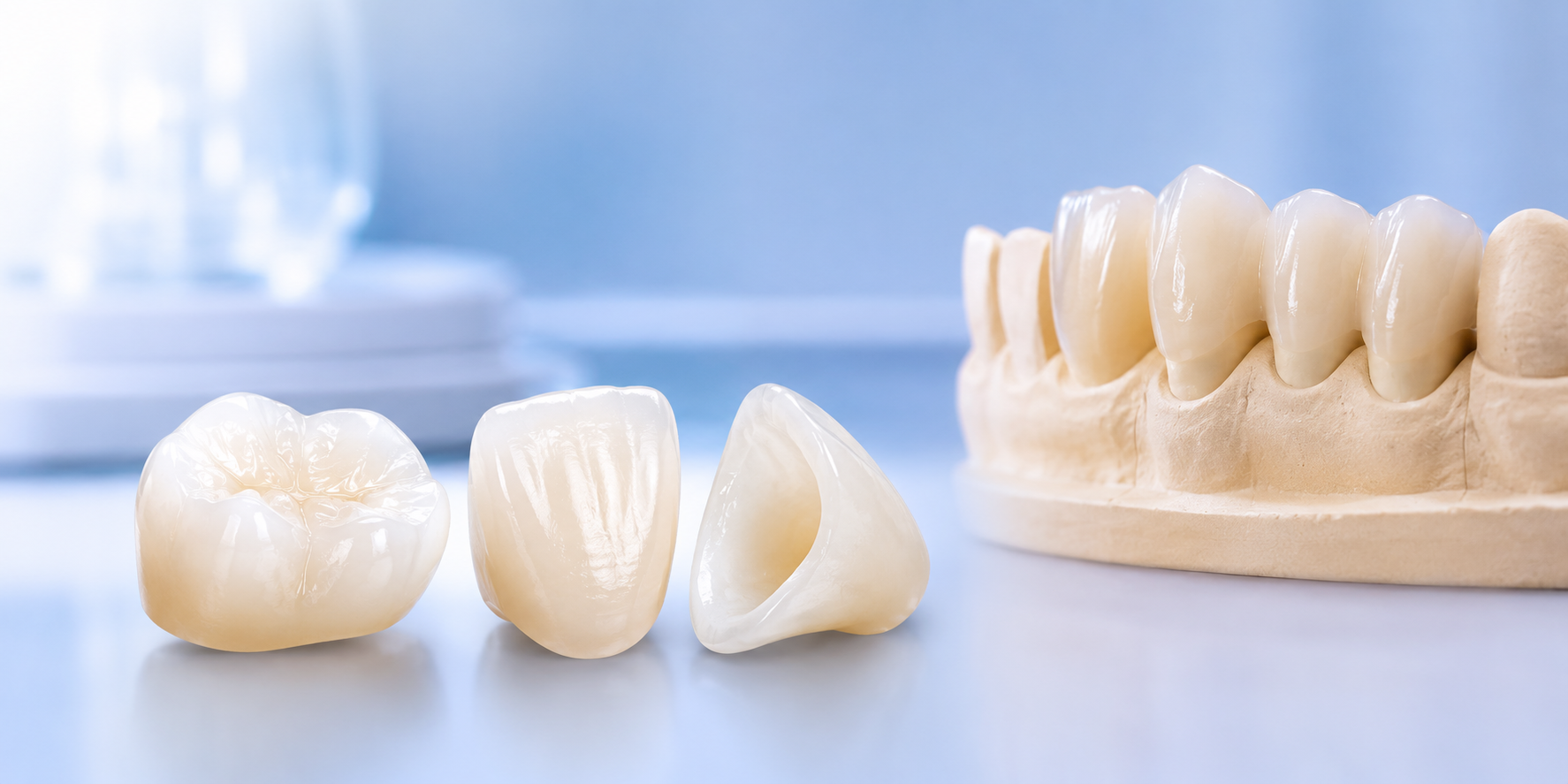
Lithium disilicate has been one of dentistry's most discussed restoration materials for over two decades and in recent years, advanced formulations have pushed its clinical performance significantly beyond what traditional glass-ceramic could deliver. Labs and clinicians evaluating it today are not looking at the same material that entered the market in the 1990s. The chemistry has evolved, the processing options have expanded, and the clinical evidence base has matured.
The question is no longer whether lithium disilicate works. It clearly does. The question is exactly how good it is where it genuinely excels, where its limits are, and how it compares to the dental zirconia and other CAD/CAM materials that now compete for the same clinical indications. This guide answers all of it with the specificity that labs and prescribing clinicians need to make accurate material selection decisions.
What Is Lithium Disilicate and How Does It Work?
Lithium disilicate (Li₂Si₂O₅) is a glass-ceramic material composed of a glassy matrix embedded with interlocking plate-like lithium disilicate crystals. These crystals typically make up 70% of the material by volume. The interlocking plate architecture is the key to its mechanical performance when a crack initiates under stress, it encounters the plate-like crystals and is deflected, branched, and absorbed rather than propagating through the material in a straight line. This crack deflection mechanism is what gives lithium disilicate its fracture resistance of approximately 360–400 MPa far above traditional feldspathic porcelain (~80–100 MPa) and within the range needed for most single-unit restorations.
The material also has a glass content high enough to produce natural optical behavior: translucency, fluorescence, and opalescence that closely mimic natural enamel. This combination of reasonable strength and excellent optical quality is what positioned lithium disilicate as the go-to material for esthetic anterior single crowns through the 2000s and 2010s.
The most widely used lithium disilicate product is IPS e.max, available in both pressed (IPS e.max Press) and CAD/CAM milled (IPS e.max CAD) formats. A lithium disilicate crown produced from e.max CAD is milled in a partially crystallized "blue phase" state that is softer and easier to mill, then crystallized in a furnace to achieve final strength and optical properties. This two-stage process is what distinguishes it from dental zirconia milling zirconia is also milled pre-sintered, but achieves its strength through sintering rather than a crystallization firing.
Advanced Lithium Disilicate: What Makes It Different?
Advanced lithium disilicate refers to next-generation formulations that go beyond the standard Li₂Si₂O₅ chemistry. The most clinically significant example is CEREC Tessera (Dentsply Sirona), which incorporates a dual crystal structure lithium disilicate crystals combined with virgilite crystals within a glassy zirconia-containing matrix.
The addition of a zirconia-containing matrix is the primary source of the strength improvement. Zirconia particles within the glass matrix provide additional crack resistance through the same transformation toughening mechanism that makes zirconium dental ceramic so effective as a structural material. The result is a material that achieves flexural strength in the range of 420–470 MPa meaningfully higher than standard lithium disilicate while retaining the optical translucency, fluorescence, and opalescence of traditional glass-ceramic.
The virgilite crystal activation through matrix firing adds a further structural contribution: the crystals reinforce the matrix in a complementary orientation to the lithium disilicate plates, creating a dual-reinforcement architecture that disrupts crack propagation more effectively than single-crystal formulations.
What advanced lithium disilicate improves over standard formulations:
- Flexural strength: 420–470 MPa vs. 360–400 MPa for standard lithium disilicate
- Processing speed: partially crystallized blocks enable faster shade selection and up to 44% reduction in total processing time according to manufacturer data
- Shade predictability: true-shade blocks match final sintered shade without additional shade correction in standard cases
- Optical properties: dual crystal architecture maintains translucency, fluorescence, and opalescence equivalent to standard glass-ceramic despite the higher crystal loading
What it does not change:
- The fundamental strength ceiling of glass-ceramic. Even at 470 MPa, advanced lithium disilicate remains significantly weaker than 3Y zirconia blocks dental grade material at 900–1200+ MPa
- The indication boundary. Advanced lithium disilicate remains a single-unit and short-span anterior material it is not a substitute for zirconia in posterior bridges or high-load structural applications
- The processing requirement. Crystallization firing is still required after milling, adding furnace time that full-contour dental zirconia restorations do not need in the same workflow step
Clinical Performance: Where Lithium Disilicate Actually Excels
Clinical survival data for lithium disilicate single crowns is strong. Meta-analyses of IPS e.max CAD crowns consistently report 5-year survival rates above 96% and 10-year survival rates in the 91–94% range for single-unit anterior and posterior crowns. These figures compare favorably with PFM and are competitive with 4Y/5Y zirconia for the same indications.
The specific areas where lithium disilicate genuinely outperforms alternatives are:
- Anterior esthetic integration- Glass-ceramic optical properties particularly opalescence and fluorescence behavior more closely approximate natural enamel than any zirconia grade in strong direct or UV lighting. For patients with highly translucent natural anterior dentition, lithium disilicate restorations integrate with less finishing effort than even high-translucency 5Y zirconia.
- Bonding characteristics- Lithium disilicate can be etched with hydrofluoric acid and silanated, enabling micromechanical and chemical bonding to tooth structure. This bonding capability allows minimally invasive preparation designs thinner preparation margins, more conservative tooth reduction that are not practical with conventional cementation protocols used for zirconia.
- Chairside efficiency- The CAD/CAM blue-phase milling and single crystallization firing of e.max CAD enables same-day anterior crown delivery in equipped practices. Advanced formulations like CEREC Tessera further compress this timeline. For chairside workflows, lithium disilicate is the most efficient material available for single-unit anterior cases.
- Veneer and inlay indications- The adhesive bonding capability of lithium disilicate makes it the standard material for porcelain veneers and posterior inlays/onlays where conservative tooth preparation and high bond strength are the clinical priorities. Zirconia does not bond adhesively in the same way these indications belong to lithium disilicate.
Lithium Disilicate vs. Zirconia: The Comparison Labs Need
This is the material selection decision that comes up in every dental lab that handles both materials. The correct answer is not that one is universally better it is that each has a clearly defined indication range where it outperforms the other.
For labs sourcing aidite zirconia blocks alongside lithium disilicate, the workflow division is straightforward: lithium disilicate for anterior esthetic single units and veneers where bonding and optical integration are the priorities, zirconia for posterior bridges, high-load crowns, implant-supported restorations, and any application where structural performance is the primary requirement.
| Property | Lithium Disilicate | Zirconia (4Y/5Y) | Zirconia (3Y) |
|---|---|---|---|
| Flexural strength | 360–470 MPa | 500–800 MPa | 900–1200+ MPa |
| Translucency | Very high | High (4Y/5Y) | Moderate |
| Adhesive bonding | Yes HF etch + silane | Limited | Limited |
| Posterior bridges | Not recommended | Short spans (4Y) | Standard |
| Anterior crowns | Excellent | Excellent | Possible with staining |
| Veneers/inlays | First choice | Not typical | Not typical |
| CAD/CAM milling | Yes blue phase | Yes pre-sintered | Yes pre-sintered |
| Same-day delivery | Yes single firing | Yes sintering | Yes sintering |
| Repair chairside | Limited | Not repairable | Not repairable |
| zirconia blank cost | N/A | Moderate | Moderate |
The strength gap between lithium disilicate and zirconia is significant and clinically relevant for anything beyond anterior single units. A posterior 3-unit bridge in lithium disilicate carries real fracture risk at the connector under occlusal load not because the material is weak in absolute terms, but because the connector cross-section requirements for the span exceed what glass-ceramic can reliably sustain. Labs that supply posterior bridges should not be using lithium disilicate for this indication regardless of the prescribing clinician's preference for esthetics.
Sourcing and Workflow Considerations for US Dental Labs
For US dental labs running both lithium disilicate and zirconia workflows, material sourcing efficiency matters as much as material performance. Labs that consolidate procurement through a domestic supplier avoid the lead time variability and import unpredictability of sourcing directly from overseas manufacturers.
Dental zirconia discs across the full 3Y, 4Y, and 5Y range in both white and pre-shaded multilayer formats are available from ZirconiaGuys from US inventory, enabling same-day or next-day shipping without minimum order requirements. For labs that handle significant anterior volume where the lithium disilicate vs. zirconia decision comes up on every case, having reliable zirconia stock on hand ensures the material selection decision is based on clinical appropriateness, not on what happens to be available.
As a zirconia materials distributor USA, ZirconiaGuys stocks Upcera and Aidite zirconia across the full grade range alongside dental lab materials for complete CAD/CAM workflows. Labs evaluating zirconia dental blanks as an alternative or complement to lithium disilicate for anterior cases can source both the standard 4Y multilayer pre-shaded format for production volume and the high-translucency 5Y format for demanding esthetic cases from the same US inventory.
The per-disc zirconia blocks price comparison against lithium disilicate e.max CAD blocks favors zirconia significantly on a per-unit basis in most format comparisons an additional workflow efficiency consideration for labs running high anterior volume where both materials compete for the same cases.
Advanced lithium disilicate is genuinely excellent for what it is designed to do. Its esthetic integration, adhesive bonding capability, and CAD/CAM efficiency make it the first-choice material for anterior single-unit esthetic restorations in both chairside and lab-based workflows. The advanced formulations have pushed its strength ceiling high enough to cover a broader range of posterior single-crown indications without sacrificing the optical qualities that justify using it over zirconia in the anterior zone.
Its limits are also real. It is not a structural material for posterior bridges. It cannot compete with 3Y zirconia blocks on flexural strength for high-load applications. And the adhesive bonding protocols it depends on for conservative preparations require clinical technique discipline that conventional cementation for zirconia does not. Understanding both sides of this is what separates accurate material selection from marketing-driven decisions.


