

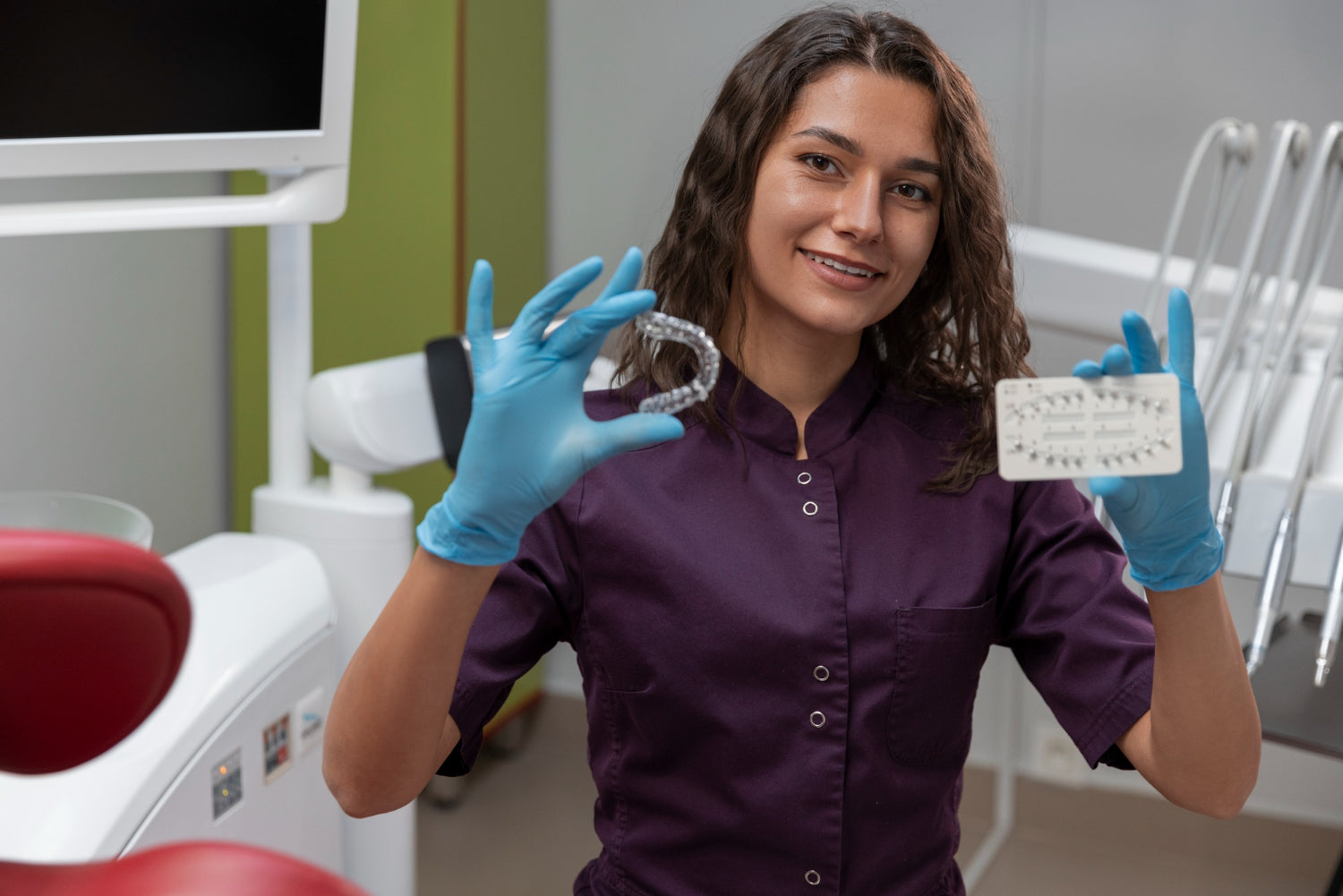
PMMA dental material polymethyl methacrylate is present in almost every dental lab workflow, yet it rarely gets the clinical attention that zirconia and lithium disilicate do. That's largely because PMMA isn't a final restorative material. It's the material that keeps cases moving: temporary crowns during implant integration, full denture bases, diagnostic wax-ups, and same-day provisionals in digital workflows. Without PMMA, most complex restorative cases slow down significantly.
This guide covers why PMMA is so embedded in modern dental lab practice its material properties, the workflows it enables, how milled and 3D-printed PMMA compare, and where it fits alongside permanent materials like zirconia. It's written for dental lab technicians and clinicians who want a technically grounded understanding of a material they use daily but may not have examined closely.
What PMMA is and why it behaves the way it does?
Polymethyl methacrylate is a thermoplastic polymer a long-chain acrylic molecule that forms when methyl methacrylate monomers link under heat or chemical initiation. The result is a material that's transparent in its raw form, lightweight, stiff at room temperature, and relatively easy to machine or mould.
For dental applications, PMMA is compounded with pigments, opacifiers, and UV stabilisers to produce the tooth-coloured or gingival-toned blanks that labs mill from. Its flexural strength in dental grade material falls between 80–120 MPa not enough for permanent crowns under functional load, but more than adequate for temporaries, dentures, and diagnostic restorations where the mechanical demands are lower and adjustability is more important than fracture resistance.
Three properties explain why PMMA became foundational in dental labs and has stayed there despite the emergence of stronger materials:
Machinability
PMMA mills cleanly at high speed with standard carbide burs on the same CAD/CAM equipment used for zirconia blanks and PMMA. No diamond tooling required, no risk of chipping during milling. A temporary crown can be milled, adjusted, and delivered in a single clinical session a workflow that more complex materials don't support.
Adjustability
Unlike sintered ceramic, PMMA can be trimmed, relined, and repaired chairside. This matters in clinical situations that evolve implant temporaries that need adjusting as tissue heals, dentures that need rebasing as ridge anatomy changes, and provisionals that need minor modification at delivery.
Cost
PMMA discs and zirconia blocks price at significantly different points PMMA is substantially less expensive per unit than any permanent restorative ceramic. For temporaries that will be replaced by a permanent restoration after a healing period, the economics of PMMA are straightforwardly correct.
The primary role: implant temporization
The most clinically important application of PMMA in a modern dental lab is implant temporization fabricating the temporary crown or bridge that a patient wears during osseointegration, typically for three to six months.
This application requires more from a temporary material than most labs give it credit for. An implant temporary isn't just a placeholder it shapes the soft tissue emergence profile that the permanent crown will inherit. If the temporary doesn't maintain the correct emergence geometry, the final restoration will seat into a tissue environment that wasn't correctly conditioned, and correcting it requires additional clinical steps.
PMMA's shock-absorbing properties during this period are a genuine clinical advantage. The relatively low stiffness compared to zirconia dental material or ceramic means that early, uncontrolled loading of the integrating implant transmits less force than a stiffer material would. This isn't a primary structural concern in most cases properly designed occlusion is but it contributes to a more forgiving mechanical environment during the vulnerability period of osseointegration.
In a fully digital workflow, the PMMA temporary can be milled on the same machine used for the permanent zirconia restoration same scan, same design file, different material loaded. Labs that run this workflow report that the temporary and permanent restorations arrive at essentially identical fit, which eliminates one of the most common chairside adjustments in traditional crown and bridge work.
Multilayer PMMA: the aesthetic upgrade for temporaries
Standard single-shade PMMA produces adequate aesthetics for most temporary indications. For anterior implant temporaries worn for several months especially in visible aesthetic zones single-shade PMMA can look flat compared to adjacent natural teeth.
Multilayer PMMA discs address this by building a colour gradient into the blank before milling similar in concept to multilayer zirconia discs. The cervical region carries a deeper, more saturated shade; the incisal reg PMMA dental materi ion is lighter and more translucent. A temporary crown milled from a multilayer PMMA disc produces significantly better anterior aesthetics than a single-shade equivalent, without additional chairside characterisation work.
The aidite pmma multilayer disc is a practical choice for labs running anterior implant temporaries and aesthetic provisional cases pre-shaded across VITA classical shades with a natural gradient built into the 12mm disc. It mills on standard open-system CAD/CAM platforms alongside zirconia blanks and other dental lab materials without any additional equipment requirement.
Denture base PMMA: a different application, same material family
Full and partial dentures represent a different PMMA application one where the material serves as a permanent prosthesis rather than a temporary. Here, PMMA's lightweight nature becomes its primary clinical advantage: a full-arch denture in PMMA weighs significantly less than any ceramic or metal equivalent, which directly affects patient comfort and retention.
Milled PMMA denture bases cut from high-density PMMA blanks specifically formulated for denture applications offer better dimensional accuracy and lower porosity than conventionally processed acrylic. Lower porosity means less bacterial infiltration into the denture base over time, which is a genuine hygiene and tissue health advantage for patients wearing the prosthesis long-term.
The Aidite Denture Base PMMA is formulated specifically for full denture workflows a high-density milling disc that produces denture bases with good surface finish, colour stability, and the tissue-matching aesthetics that make denture work clinically acceptable to patients. It covers both upper and lower full denture indications and mills predictably on standard CAD/CAM platforms.
Milled vs. 3D-printed PMMA: which workflow suits your lab
Both subtractive milling and additive 3D printing are now viable routes to PMMA dental restorations, and the choice between them affects both the workflow investment and the clinical outcome.
Milled PMMA cut from a pre-polymerised disc produces a homogeneous material with consistent mechanical properties throughout the restoration. The polymerisation is complete before milling begins, which means there's no post-cure variability in properties. Surface finish from a properly maintained milling system is smooth and requires minimal polishing. For labs already running a zirconia milling workflow, adding PMMA to the material inventory requires only a different blank and compatible burs no additional equipment.
3D-printed PMMA requires a dedicated printer, post-processing equipment (wash and cure unit), and validated printing resins. The equipment investment is meaningful for smaller labs. The advantage is speed and batch production a printer can run overnight and produce multiple temporaries simultaneously, whereas a milling machine produces one unit per cycle. For high-volume temporary workflows or practices that need same-session model and temporary production, the 3D printing route makes operational sense.
The mechanical properties of 3D-printed PMMA resins are generally lower than milled PMMA from industrial-grade blanks, particularly in fatigue resistance and surface hardness. For short-term temporaries this rarely matters clinically. For longer-term provisionals worn for months during implant integration, milled PMMA from high-quality blanks is the more appropriate choice.
PMMA alongside zirconia: how they work together in a lab
In most modern digital dental labs, PMMA and zirconia dental material occupy complementary roles rather than competing ones. Zirconia whether as a zirconium block for single units or a zirconia disc for multi-unit production runs handles permanent crowns, bridges, and implant restorations where strength and longevity are the requirements. PMMA handles everything before the permanent restoration: the provisional, the diagnostic wax-up equivalent, the temporary that shapes tissue during healing.
Labs that integrate both materials in a single digital workflow same scan, same design software, different material at milling report cleaner case handoffs and fewer chairside adjustments at permanent crown delivery. The patient's bite and tissue profile are established by the temporary; the permanent zirconia restoration inherits that environment rather than trying to create it at seating.
For labs building out or rationalising their PMMA and zirconia blanks inventory, sourcing both from a single dental lab material supplier simplifies ordering, technical support, and sintering or milling parameter management. Zirconia Guys carries both Aidite PMMA and zirconia ranges get in touch to discuss which disc and block formats suit your workflow and case mix.


