

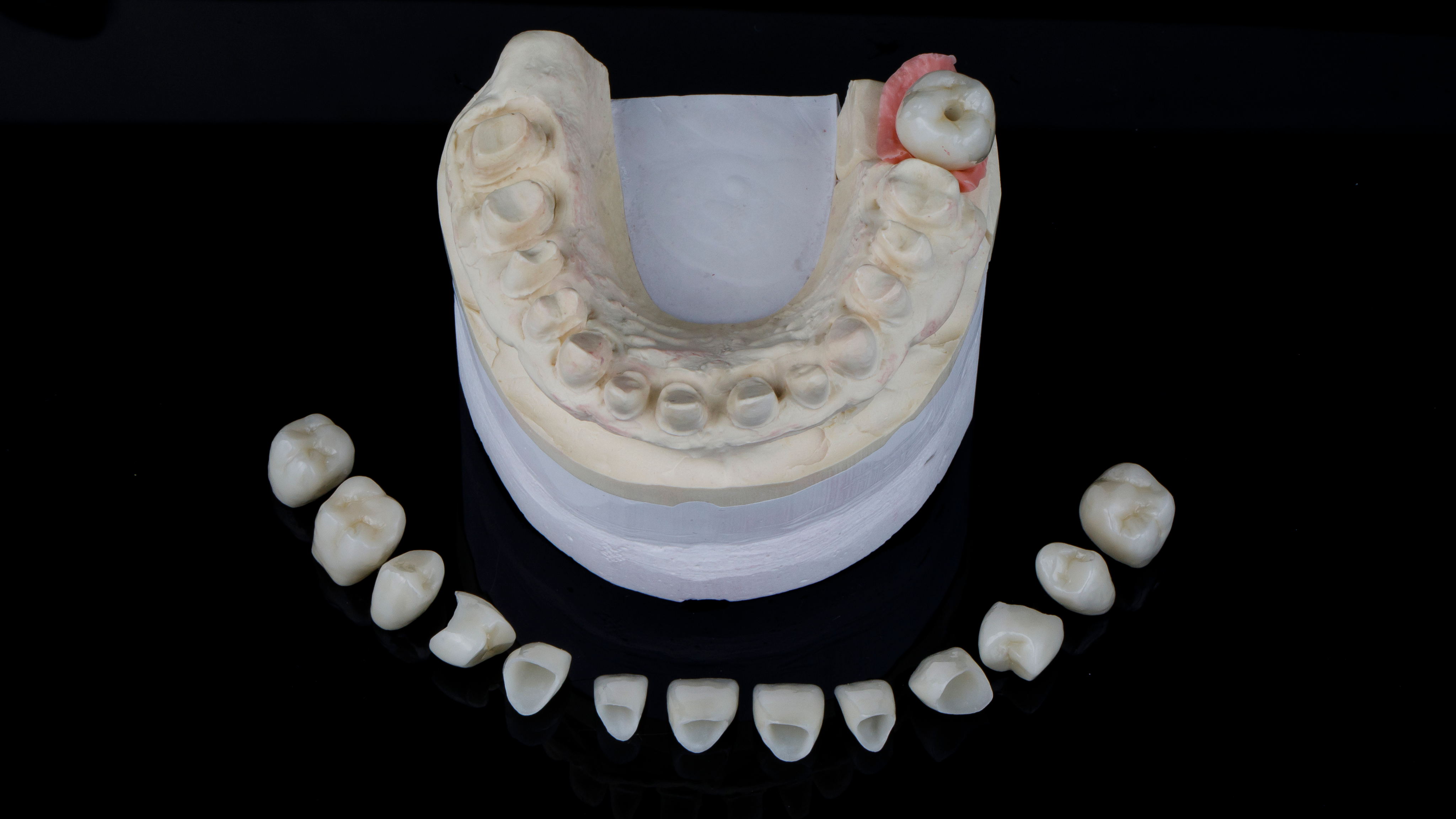
The esthetic zone has long been the most challenging test for any dental restoration material. Patients and clinicians judge anterior restorations by a standard that permits no visible material artifact no flat opacity, no grey margins, no incisal edges that look like porcelain rather than enamel. For most of zirconia's clinical history, that standard was considered beyond what the material could meet without hand-layering feldspathic ceramic over a zirconia substructure. That assumption is now outdated.
Modern zirconia multilayer technology has changed the clinical calculus for esthetic-zone work. Highly translucent multilayer blanks engineered with precise yttria gradients now produce monolithic restorations no layered ceramic, no veneering porcelain that deliver optical outcomes in the anterior zone that were simply not achievable from zirconia a decade ago. The question for dental labs is no longer whether monolithic multilayer zirconia can work in the esthetic zone. The question is how to select the right disc, design the right toolpath, and manage the sintering protocol to extract that performance consistently.
Why Monolithic Zirconia Became the Standard for Esthetic-Zone Cases?
The traditional approach to anterior zirconia restorations was bi-layered: a high-strength 3Y zirconia coping providing structural support, veneered with feldspathic porcelain for optical character. This approach delivered excellent esthetics when executed well but it had two significant clinical liabilities. First, the feldspathic veneer could chip. Veneer fracture is the most commonly reported complication in bi-layered zirconia restorations, with 10-year chipping rates reported in clinical studies at 15–25% for anterior fixed dental prostheses. Second, the layering workflow required significant technician skill and time hand application, multiple firings, and careful contour management on every unit.
Monolithic zirconia eliminates the veneer entirely. The restoration is milled and sintered as a single material no layering interface, no chip risk at that interface, no multi-firing workflow. The structural and workflow advantages were recognized immediately when 3Y monolithic zirconia became practical, and it was adopted rapidly for posterior cases where strength was the primary requirement. The limitation was anterior esthetics: 3Y monolithic zirconia in the anterior zone looked opaque, flat, and obviously artificial under lateral lighting.
The development of 4Y and 5Y formulations and particularly their multilayer implementation resolved this limitation. By engineering a gradient from a dentin-like zone at the cervical to an enamel-like zone at the incisal, dental zirconia manufacturers produced monolithic discs that replicate the optical zonation of natural tooth anatomy across the depth of the crown. Today, monolithic multilayer dental zirconia discs are the default production format for anterior crowns in high-throughput dental labs worldwide.
The Material Science Behind Multilayer Translucency in the Esthetic Zone
Understanding why multilayer zirconia works in the esthetic zone requires understanding the relationship between yttria content, crystal phase, and light behavior in the material.
Zirconium dental ceramic is optically complex in a way that glass-ceramics are not. In 3Y-TZP, the predominantly tetragonal crystal microstructure creates optical scattering — light entering the material is scattered at crystal grain boundaries rather than transmitted through. This scattering is what produces the characteristic opacity of early-generation zirconia. The material absorbed and scattered light rather than transmitting it, making it look flat and bright rather than translucent and layered like natural dentition.
Increasing yttria content to 4Y and 5Y shifts the crystal microstructure toward the cubic phase. Cubic zirconia has lower refractive index anisotropy meaning grain boundaries scatter less light, allowing more transmission. At 5Y yttria content, the material transmits light in a way that begins to approximate natural enamel: some light penetrates, some reflects from within, producing a depth and luminosity that 3Y could never achieve from a single composition.
In a multilayer disc, these optical properties are stratified across the disc thickness:
- Cervical zone (dentin layer): Higher chroma, lower translucency. This zone provides the warm, saturated coloration of natural dentin at the root-third of the crown. In a well-designed multilayer disc, this zone typically uses a 3Y or mixed 3Y/4Y composition strength is retained where the crown preparation margin sits.
- Body zone (transition layer): Balanced chroma and translucency. The intermediate zone provides the natural transition between warm cervical saturation and cooler incisal translucency. This is the layer that determines whether the gradient looks natural or abrupt.
- Incisal zone (enamel layer): Lower chroma, highest translucency. The incisal zone uses 4Y or 5Y composition maximum cubic phase content, maximum light transmission. This is what produces the opalescent, slightly cool incisal character that makes a crown blend with natural dentition under varied lighting conditions.
The clinical performance of a monolithic multilayer crown in the esthetic zone depends entirely on whether this gradient is correctly aligned with the anatomy of the restoration during milling. A correctly oriented disc produces a crown where the enamel-like incisal zone corresponds to the incisal third of the crown. An incorrectly oriented disc produces the inverse or a random relationship between crown anatomy and disc gradient that can only be corrected through heavy staining.
Disc Selection for Esthetic-Zone Monolithic Crowns
Selecting the right disc for anterior monolithic multilayer work involves three decisions: grade, format, and thickness. Each decision has a direct impact on the clinical outcome.
Grade selection (3Y/4Y/5Y)
For single-unit anterior crowns in the esthetic zone, 4Y and 5Y grades are the correct choices. The translucency delivered by 4Y multilayer is sufficient for most anterior cases blending naturally with adjacent natural dentition in the A1–C4 VITA shade range. For patients with highly translucent natural dentition younger patients, cases adjacent to e.max veneers, cases where the adjacent natural teeth show significant incisal translucency 5Y multilayer provides the closest approximation to natural enamel optical behavior.
3Y multilayer, while available, delivers limited translucency in the incisal zone due to its predominantly tetragonal microstructure. It is an acceptable choice for premolar esthetic-zone cases where strength requirement is higher, but for central and lateral incisor work where shade matching to highly translucent adjacent teeth is the priority, 3Y multilayer underperforms relative to 4Y or 5Y.
The tt multilayer zirconia disc format total-translucency multilayer represents the higher end of the 4Y/5Y gradient range, delivering the incisal opalescence that demanding anterior esthetic cases require. Labs that handle both standard and demanding anterior cases benefit from stocking TT multilayer as their primary esthetic-zone disc.
Format selection (white vs. pre-shaded)
White multilayer discs give the technician complete shade control through external staining. Pre-shaded multilayer discs carry VITA-compatible shade gradients built into the material from cervical to incisal. For production-volume anterior work in standard A–D shades, pre-shaded multilayer eliminates the staining step on the majority of cases — significantly reducing bench time per unit.
Thickness selection
For anterior esthetic crowns, 12 mm disc thickness is the standard for most cases. The 12 mm format provides adequate milling depth for full-contour anterior crowns without excessive material waste. For thinner restorations veneers, minimal-prep crowns 10 mm discs may be appropriate depending on the design and the specific mill's capabilities.
Milling Protocol for Monolithic Multilayer Anterior Crowns
The mechanical accuracy of the milling process determines how precisely the disc's gradient architecture maps onto the finished crown. Errors in orientation or toolpath alignment are the most common causes of gradient mismatch and gradient mismatch is the most common reason a monolithic multilayer crown fails to meet the esthetic standard in the anterior zone.
Disc orientation — the single most critical step
Every multilayer disc is directionally coded an engraved directional marking or colored end-cap indicates the gingival axis of the disc. Mounting the disc with the gingival end oriented correctly ensures that the cervical zone of the disc aligns with the cervical margin of the crown, and the incisal zone aligns with the incisal edge.
The st multilayer zirconia disc uses the same directional architecture super-translucency multilayer with a precisely defined cervical-to-incisal gradient that requires correct orientation to deliver its optical design. Verify the orientation marking before the first case from any new batch and again if the disc has been removed from the mill and remounted.
CAD design positioning within the disc
In exocad, 3Shape, or your CAM software, use the blank orientation or layer-mapping tool to align the crown design with the disc's internal zones. The margin should sit in or just above the cervical zone. The incisal edge should extend into the enamel zone. The buccal surface the most optically prominent surface should be positioned to capture the widest range of the gradient from cervical to incisal.
For multi-unit cases, position all units with consistent gingival-axis alignment. Shade drift across units in the same case is most commonly caused by inconsistent disc orientation during nesting one crown correctly aligned, another rotated or positioned in the wrong zone.
Toolpath parameters for multilayer discs
Multilayer zirconia discs vary in hardness across their depth as a function of the changing crystal phase composition. The cervical zone of a 4Y/5Y gradient disc is slightly softer than the incisal zone. An aggressive, uniform toolpath can cause micro-chipping at the layer transitions particularly at the body-to-enamel zone interface where the composition change is most abrupt.
Reduce finishing pass speed by 10–15% compared to standard 3Y toolpath settings. This is not necessary on every mill or with every disc but it is the correct precaution when working with a new disc format for the first time.
Sintering protocol
Esthetic-grade multilayer zirconia is the most sintering-sensitive format in the dental lab. The translucency of 4Y and 5Y material depends on controlled grain growth during the sintering hold phase. Accelerated sintering profiles either fast ramp rates above 5°C/min or shortened hold times at peak temperature produce a coarser microstructure with more grain-boundary scattering, yielding a cloudier, less translucent result.
Follow the manufacturer's published profile exactly: ramp rate ≤5°C/min, peak hold temperature 1480–1550°C (confirm the specific disc specification), hold time as specified. Do not run esthetic-grade multilayer discs on the same accelerated program used for posterior 3Y cases.
Indications and Contraindications for Monolithic Multilayer Esthetic-Zone Crowns
Monolithic multilayer zirconia is not the correct material for every esthetic-zone case. A clear indication framework prevents the clinical errors that result from applying the material to cases it cannot serve.
Strong indications:
- For anterior single-unit implant crowns in the esthetic zone, the tt one multilayer zirconia disc format is specifically engineered for this application a total-translucency multilayer in a 10 mm format that delivers the incisal optical character required to match adjacent natural teeth in the implant restoration context. Implant crowns in the esthetic zone are among the most demanding shade-matching cases in clinical practice, and the optical performance of TT-grade multilayer zirconia makes it the preferred format.
- Single-unit anterior crowns replacing teeth with moderate-to-high natural translucency. Cases where the adjacent natural dentition shows visible incisal translucency under clinical lighting — typical of younger patients, maxillary laterals adjacent to highly translucent centrals, or any case involving shade A1 or lighter.
- Multi-unit anterior cases where shade matching across units is the priority. Pre-shaded multilayer eliminates inter-unit shade variation caused by manual staining differences between technicians or across sessions.
- Premolar crowns in the visible esthetic zone. The first premolar is frequently visible in a full smile particularly in cases where the patient has a broad smile arc. 4Y multilayer in premolar cases delivers the shade matching to adjacent canines and laterals that monolithic 3Y cannot provide without significant staining effort.
Limited indications (evaluate case-by-case):
Anterior 3-unit bridges. Monolithic multilayer zirconia at 4Y grade (600–800 MPa) has sufficient flexural strength for short-span anterior bridges when connector cross-section dimensions are correctly sized. Labs must verify minimum connector area against the manufacturer's published strength data. Do not extrapolate from single-unit strength data bridge connectors have different stress distributions and the connector is where failure occurs.
Contraindications:
- Cases with severely discolored abutment teeth or metal substructures. High-translucency monolithic zirconia transmits light through the crown from the preparation surface. Dark, stained, or metallic abutments will read through a translucent monolithic crown particularly at the cervical third. In these cases, use a less translucent grade or specify an opaque liner as part of the cementation protocol.
- Patients with bruxism. Monolithic multilayer esthetic-grade zirconia at 4Y and 5Y grades has lower flexural strength than 3Y-TZP. For patients with documented parafunctional habits, the standard clinical precaution is to use 3Y or 4Y-grade material in its stronger formulation and supplement with night guard therapy.
- Posterior bridges of 3+ units. This contraindication applies to all esthetic-grade multilayer formats. 5Y and high-translucency 5Y grades do not meet minimum connector strength requirements for multi-unit posterior bridges. 3Y-TZP is the mandatory choice for this indication.
The Lab Workflow Advantage: Why Monolithic Outperforms Bi-Layered in Production
The clinical performance argument for monolithic multilayer zirconia in the esthetic zone is matched by an equally compelling production efficiency argument. Bi-layered ceramic restorations — zirconia copings with feldspathic or pressed ceramic veneers require a fundamentally different and more labor-intensive workflow than monolithic production.
Bi-layered workflow: Design coping → Mill coping → Sinter coping → Layer porcelain (multiple applications and firings) → Contour and adjust → Final glaze. Minimum 3–4 furnace cycles per case. Significant skilled hand time on every unit.
Monolithic multilayer workflow: Design full-contour crown → Mill → Sinter → Glaze (optional stain for custom cases). One or two furnace cycles per case. Minimal hand time for standard pre-shaded cases.
For dental lab materials procurement, this workflow difference has direct cost implications. The consumable cost of feldspathic layering materials porcelain powders, layering liquids, multiple firing cycles — adds meaningful cost per unit to bi-layered production. Monolithic multilayer production reduces consumable cost to the disc, the sintering firing, and a glaze material.
As a dental lab material supplier to US labs, ZirconiaGuys consistently finds that labs transitioning from bi-layered anterior workflows to monolithic multilayer reduce per-case time on standard anterior cases by 40–60%. For a lab producing 20+ anterior cases per week, that reduction compounds into a significant operational improvement across the production year.
Product Spotlight: Upcera Explore Esthetics for Esthetic-Zone Production
For US dental labs standardizing on monolithic multilayer zirconia for anterior production, the explore esthetics zirconia discs by Upcera represent a proven, well-documented format for this application. The Explore Esthetics disc uses Upcera's TT-GT gradient technology four distinct chromatic zones calibrated to VITA Classic and 3D-Master shade guides in a 98 mm disc format compatible with all major open-system mills.
The disc delivers the shade consistency across the full disc that esthetic-zone production demands. Shade drift from center to edge is one of the most common quality failures in multilayer discs from lower-quality manufacturers it forces labs to re-shade-match every case rather than trusting a production standard. Explore Esthetics maintains specification from the first blank to the last in each disc, batch to batch.
The foundation of that performance is correct material selection: the right yttria grade for the case's optical demands, the right disc format for the shade protocol, and the right sintering compliance for the material's optical requirements. Dental lab materials decisions at the disc level determine clinical outcomes at the chair level. In the esthetic zone, that relationship is direct and unforgiving the right disc, correctly processed, delivers; the wrong disc, or the right disc incorrectly handled, does not.


