

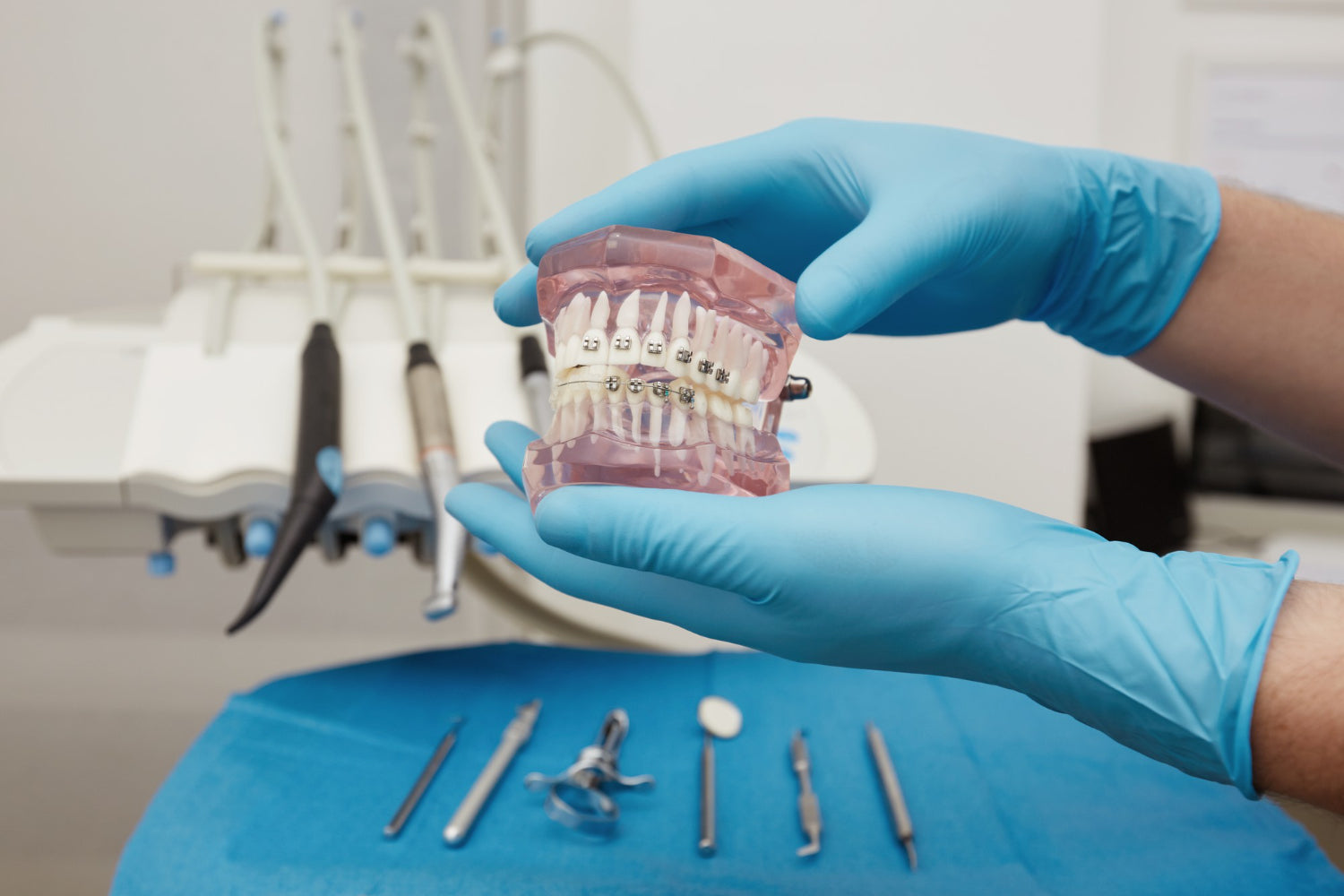
PMMA polymethyl methacrylate is one of the most widely used materials in dental laboratory production. It is the standard for temporary crowns, denture bases, occlusal splints, and long-term provisionals. Yet despite its daily presence in dental labs across the US, the curing process behind PMMA is rarely explained clearly. Most technicians know that conventional acrylic requires mixing and bench curing. Fewer understand how CAD/CAM PMMA discs are cured before they arrive at the lab, why that pre-polymerization process matters clinically, and how the curing method directly determines the material performance of every restoration produced from a PMMA disc.
This guide explains PMMA curing from the chemistry up covering how conventional acrylic is cured, how industrial pre-polymerization differs, why the difference matters for residual monomer content and mechanical performance, and how to select the right PMMA format for each application in a modern CAD/CAM workflow. All seven compulsory keywords are addressed in the relevant clinical contexts throughout.
What Curing Means in the Context of PMMA?
Curing in PMMA means polymerization the chemical process by which liquid methyl methacrylate (MMA) monomer molecules link together into long polymer chains to form solid polymethyl methacrylate. The moment this chain-linking reaction is complete, the material transitions from liquid or dough consistency to rigid solid. The quality, completeness, and conditions of this polymerization reaction are what determine whether the resulting PMMA is dense, strong, and biocompatible or porous, weak, and potentially irritating to oral tissue.
There are three distinct curing mechanisms used in dental PMMA production. Each produces materially different outcomes that directly affect clinical performance.
- Heat-cured (hot-water bath or autoclave curing) — The conventional method used in traditional denture fabrication. Powder and liquid monomer are mixed, packed into a flask against a gypsum mold, and cured at approximately 70–100°C under water bath or pressure conditions. Residual monomer content is typically 2–5%, porosity is moderate, and fit accuracy is operator-dependent.
- Cold-cured (self-cured or chemically activated) — The bench-top method used for chairside repairs and direct provisional fabrication. A chemical activator triggers polymerization at room temperature without external heat. Residual monomer content is higher than heat-cured acrylic — often 5–7% — and mechanical properties are inferior due to lower conversion rate and higher porosity.
- Industrial pre-polymerization (CAD/CAM PMMA discs) — The manufacturing process used for all modern CAD/CAM PMMA disc stock. Monomer is polymerized under high pressure (50–200 bar) and elevated temperature (above 100°C) in industrial autoclaves. The result is residual monomer below 0.5%, near-zero porosity, uniform mechanical properties throughout the disc, and the dimensional stability that accurate CAD/CAM milling requires.
Why the Curing Method Determines Clinical Performance?
The difference between a cold-cured bench provisional and a milled CAD/CAM restoration is not just workflow — it is a fundamental material quality difference rooted in the curing process.
Residual monomer is the clearest clinical consequence. MMA monomer is a known irritant associated with tissue sensitivity, allergic contact reactions, and mucosal inflammation in susceptible patients. Conventional cold-cured PMMA at 5–7% residual monomer represents a meaningful exposure risk for patients with documented acrylic sensitivity. Industrial pre-polymerized PMMA at below 0.5% residual monomer is classified as biocompatible under ISO 20795-1 for denture base polymers — a threshold that bench-cured materials rarely achieve consistently.
Porosity is the second consequence. Bench-mixed acrylic traps air during the mixing and packing process, producing microscopic voids throughout the cured material. These voids are sites for bacterial colonization, stain absorption, and structural weakness. Industrial pre-polymerization under 50–200 bar pressure eliminates void formation entirely the resulting PMMA has near-zero porosity and a homogeneous polymer matrix that resists staining, supports higher polished surface quality, and delivers better mechanical properties throughout the disc.
Dimensional accuracy is the third consequence. Polymerization shrinkage is a direct result of monomer-to-polymer conversion. Bench-cured PMMA shrinks as it polymerizes and that shrinkage varies depending on the powder-to-liquid ratio used, the packing technique, and the curing temperature profile. CAD/CAM PMMA discs complete their polymerization before the lab receives them. There is no residual curing shrinkage to account for in the milling process — the disc dimensions are stable, predictable, and consistent across every unit milled from it.
How PMMA Is Cured for Denture Base Applications?
The pmma denture [→ zirconiaguys.com/products/aidite-denture-base-pmma] base application places the strictest demands on PMMA curing quality of any dental application. The denture base sits in direct contact with oral mucosa for extended periods often 12–16 hours per day. Residual monomer at the tissue interface causes mucosal irritation that patients experience as chronic soreness or sensitivity. A properly cured industrial PMMA denture base eliminates this risk at the material level.
In a CAD/CAM denture workflow, the curing has already occurred before the lab touches the disc. The lab scans the patient model, designs the denture base digitally, mills the base from a pre-polymerized PMMA disc, polishes it, and delivers a dimensionally accurate, biocompatible result. There is no mixing step, no flask packing, no curing oven, and no polymerization shrinkage to manage. The curing quality is built into the disc not dependent on lab conditions or technician technique.
For the denture base to perform correctly in long-term tissue contact, the disc must meet ISO 20795-1 requirements for residual monomer, flexural strength, and surface hardness. Aidite's pre-polymerized PMMA denture base discs consistently meet these thresholds — which is one of the primary reasons they have become the preferred choice among US dental labs that have moved to CAD/CAM denture production.
PMMA Curing for Temporary Crown and Bridge Applications
Temporary crown and bridge provisionals have different curing requirements than denture bases. The tissue contact period is shorter typically two to eight weeks for standard temporaries but the esthetic and dimensional requirements are higher. The temporary must accurately represent the intended shade of the final restoration, maintain its fit over the provisional period without dimensional drift, and polish to a surface quality that patients accept as esthetically appropriate.
This is why aidite denture base pmma should not be used for crown and bridge temporaries. Denture base PMMA is pigmented to simulate gingival tissue pink, red-toned, opaque. For a temporary crown, you need tooth-shade PMMA formulated with dentine-to-incisal gradient or standard tooth shades. The curing chemistry is similar, but the pigmentation, shade calibration, and optical formulation are entirely different.
For crown and bridge temporary applications, the pre-polymerized industrial curing process delivers the same dimensional accuracy and biocompatibility advantages as for denture bases but in a tooth-shade formulation calibrated to VITA shade standards. The pre-polymerized disc eliminates the dimensional variability of bench-mixed provisional materials while delivering a consistent shade result that the technician can rely on from the first blank to the last in a multi-unit case.
A critical practical point: polymerization for CAD/CAM PMMA temporaries is complete before the disc reaches the lab. The lab's post-milling steps polishing, glazing, occlusal adjustment do not involve any additional curing. There is no light-curing step, no chemical activation, and no heat-curing oven required. This is a fundamental workflow simplification over chairside direct provisional materials, which require a curing step at the point of fabrication.
Multilayer PMMA: How Gradient Curing Architecture Works
The multilayer pmma disc format adds a manufacturing complexity to standard single-shade PMMA a gradient of shade and translucency engineered into the disc from cervical to incisal during production. Understanding how this gradient is created and why it holds through milling requires a brief look at the manufacturing process.
Multilayer PMMA discs are produced by sequentially casting and partially curing multiple formulations each with a different pigmentation and translucency profile into the disc mold in distinct layers. The layers are then final-cured together under the same high-pressure, high-temperature industrial conditions used for single-shade discs. The interface between layers is a chemical bond formed during the co-curing step, not a mechanical joint which is why multilayer discs do not delaminate during milling or clinical service.
The result is a disc where the cervical end contains warmer, more saturated, more opaque PMMA that approximates dentin color, while the incisal end contains cooler, less pigmented, more translucent PMMA that approximates enamel. When the digital design is oriented correctly in the disc cervical margin at the cervical end, incisal edge at the incisal end the milled crown exits the mill already expressing the correct shade gradient for the anterior tooth without any staining.
This gradient architecture is what makes multilayer PMMA the most efficient format for anterior provisional production in high-volume labs. The curing quality of the gradient interface is what makes it possible a poorly bonded interlayer would delaminate at the thin incisal edge or at the proximal margin areas where material thickness is lowest.
Selecting the Right PMMA Format Based on Curing and Application
The correct PMMA format selection depends on matching the curing quality, pigmentation, and optical architecture of the disc to the clinical application. Aidite pmma multilayer covers the anterior crown and bridge provisional workflow. Aidite denture base PMMA covers full and partial denture applications. Clear PMMA formulations cover splints, retainers, and clear appliances. Single-shade tooth-color PMMA covers posterior provisional crowns where shade precision is secondary to fit and occlusal accuracy.
For US dental lab materials procurement, the key advantage of sourcing Aidite PMMA from a domestic inventory is the elimination of batch-to-batch variability that can affect shade consistency and curing quality in overseas-sourced generics. As a dedicated dental lab material supplier, ZirconiaGuys stocks the full Aidite PMMA range from US inventory with full batch documentation — including residual monomer certificates and ISO 20795-1 compliance records on request.
Labs that also run zirconia workflows benefit from consolidating material supply. Dental zirconia discs and PMMA discs share the same 98 mm format and open-system mill compatibility meaning the same milling equipment handles both materials. The workflow difference is post-milling: zirconia requires sintering, PMMA requires only polishing. Both start from the same CAD/CAM design file, and both can be ordered from the same US zirconia materials distributor usa inventory to simplify procurement.
PMMA vs. Zirconia: Understanding When Each Material Is the Answer
The curing distinction between PMMA and zirconia is the clearest way to understand why they serve different applications. PMMA is fully cured before the lab receives it the disc is the finished polymer, and milling simply reveals the restoration shape within it. Zirconia blocks are milled in their pre-sintered chalk state and require furnace sintering to densify to final strength and dimensions. Zirconia blocks dental production therefore always includes a sintering step that PMMA production does not.
A zirconia blank milled and delivered without sintering is a fragile pre-sintered form with none of the material's clinical strength. A PMMA disc milled and delivered without any additional processing is a finished, clinically acceptable restoration polishing is the only post-milling step required. This fundamental difference is why PMMA is the temporary material and zirconia dental blanks are the permanent restoration material. The processing requirements match the clinical lifespans fast, simple PMMA production for provisionals; furnace-processed dental zirconia discs for restorations designed to last decades.
The curing process is not a manufacturing footnote it is the foundation of every material property that determines whether PMMA performs correctly in clinical service. Industrial pre-polymerization is what separates CAD/CAM PMMA from bench-mixed acrylic on residual monomer, porosity, dimensional accuracy, and mechanical consistency. Selecting pre-polymerized PMMA from a documented, reliable supply chain is the single highest-leverage procurement decision available to labs building or refining their PMMA workflow.


