

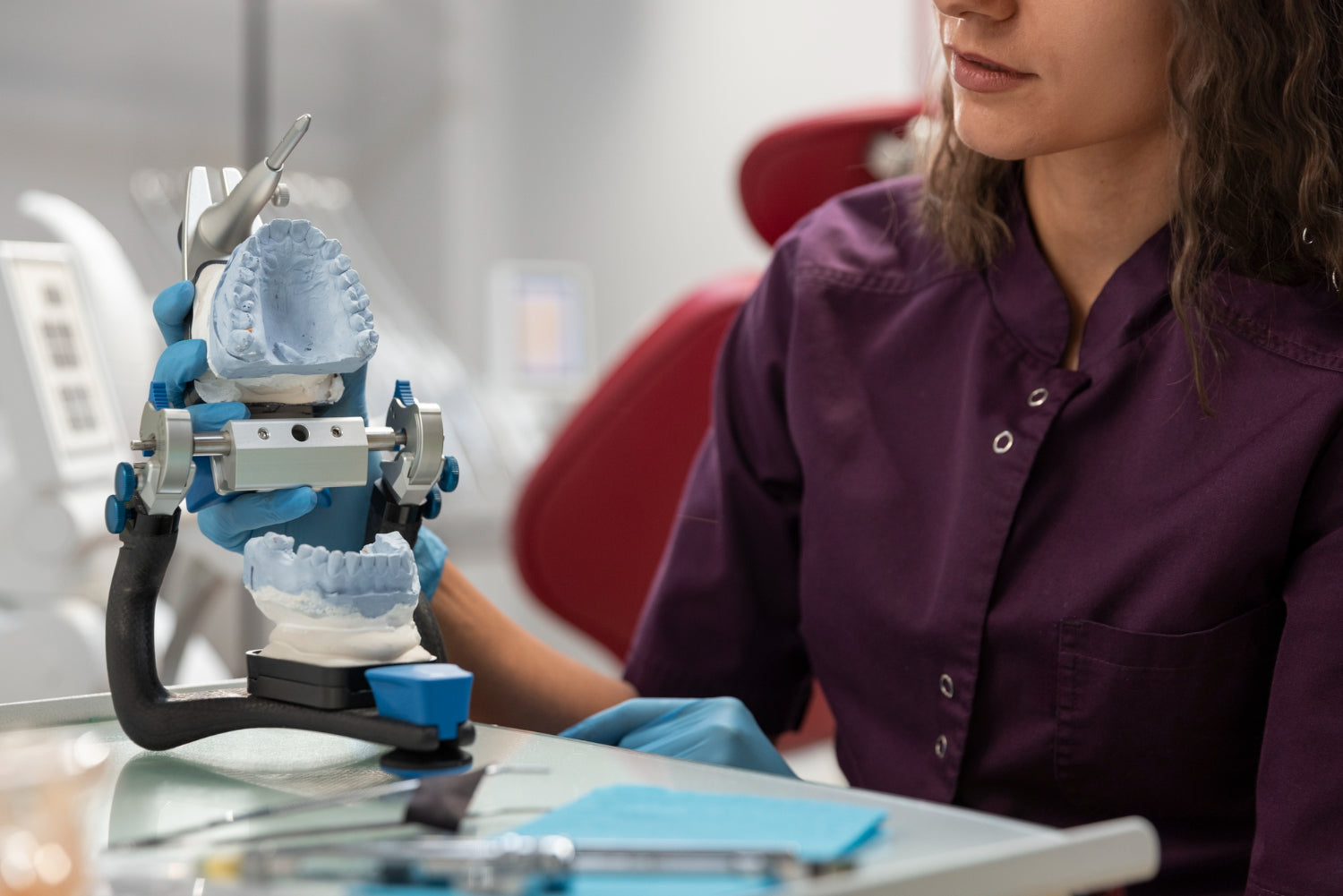
Dental implant surgery has a narrow margin for error. An implant placed two millimeters off-axis can compromise the final prosthetic outcome, damage adjacent root structure, or violate critical anatomical boundaries like the inferior alveolar nerve or maxillary sinus floor. Freehand placement even in experienced hands introduces variability that digital workflows exist specifically to eliminate. The 3D printed surgical guide is the physical mechanism through which that digital precision transfers from the computer screen to the patient's mouth.
This guide explains how surgical guides work, why the material they are printed from determines their clinical effectiveness, and how dental labs can build a reliable guide production workflow using the right resins. For labs that already stock dental zirconia discs, zirconia blocks, and fixed restoration materials, surgical guide resin is a natural workflow extension and one that adds significant clinical value to the services you offer.
What a Surgical Guide Actually Does and Why Accuracy Matters?
A surgical guide is a custom-fabricated template that seats over the patient's remaining teeth, soft tissue, or bone during implant surgery. Metal sleeves embedded in the guide constrain the drill to a predetermined trajectory controlling angulation, depth, and three-dimensional position simultaneously. The surgeon does not judge drill path freehand. The guide does it mechanically.
The accuracy of that constraint determines clinical outcomes directly. Studies on guided versus freehand implant placement consistently show that surgical guides reduce mean angular deviation from planned position by 50–70% and mean apical deviation by 40–60% compared to freehand technique. In practical terms, this means implants land where the prosthetic plan requires them to land not approximately where anatomy and surgical judgment suggested.
For full-arch cases All-on-4, All-on-6, full-arch immediate load this precision is not optional. A misplaced implant in a full-arch case cannot be corrected by adjusting the final prosthesis. The guide is what makes the prosthetically driven treatment plan executable.
The Digital Workflow That Produces a Surgical Guide
Every surgical guide begins with data, not with a physical impression. The workflow has four stages that run entirely in the digital domain before a single gram of resin is printed.
Stage 1 — CBCT and intraoral scan acquisition
The CBCT provides volumetric bone data density, quantity, and the exact three-dimensional position of critical structures. The intraoral scan or scan of the diagnostic cast provides surface anatomy. These two data sets are merged in planning software to create a unified patient model.
Stage 2 — Virtual implant planning
The clinician places virtual implants in planning software (coDiagnostiX, Nobel Clinician, Implant Studio, or equivalent) based on the final prosthetic design. Implant position, angulation, and depth are optimized for prosthetic emergence profile, bone engagement, and clearance from anatomical structures. The plan is reviewed and approved before any physical fabrication begins.
Stage 3 — Guide design
The software generates the guide geometry around the approved implant positions. Metal sleeve positions and orientations are calculated from the virtual plan. The guide body is designed to seat stably on the patient's reference anatomy — tooth-supported, tissue-supported, or bone-supported depending on the clinical scenario.
Stage 4 — 3D printing
The guide STL file is exported to a dental 3D printer. The print is produced in biocompatible surgical guide resin, post-processed, and sterilized for use.
The accuracy of the final guide is determined by two factors: the precision of the planning software and the dimensional accuracy of the printed material. A guide printed in low-accuracy resin will not reliably reproduce the planned sleeve positions regardless of how precisely the digital plan was created.
Why Guide Resin Material Is the Critical Variable?
Not all 3D printing resins are appropriate for surgical guide fabrication. A surgical guide must meet four material requirements that general-purpose 3D printing resins do not reliably satisfy.
Dimensional accuracy
The guide must reproduce planned sleeve positions to within fractions of a millimeter. Resins with high post-cure shrinkage or warping tendency will shift sleeve positions from their designed locations directly degrading the accuracy advantage that guided surgery is supposed to deliver.
Biocompatibility
A surgical guide sits in direct intraoral contact during surgery. ISO 10993 cytotoxicity compliance and class IIa medical device compatibility are the minimum requirements for any resin used in this application. Non-biocompatible resins must never be used in surgical guide fabrication regardless of print accuracy.
Sterilization compatibility
Surgical guides are sterilized before use typically by autoclave or chemical sterilization. Resins must maintain dimensional stability and mechanical integrity through the sterilization process. Resins that warp, discolor, or lose hardness during sterilization are clinically unusable.
Adequate hardness and fracture resistance
The guide must withstand the mechanical forces of drilling without flex or fracture. Soft or brittle resins that deform under drilling pressure allow the drill to deviate from the planned trajectory defeating the purpose of the guide.
For labs sourcing key guide resin for implant surgery, Keystone's Key Guide resin meets all four of these requirements. It is formulated specifically for dental surgical guide fabrication — not adapted from a general 3D printing resin and its dimensional accuracy, biocompatibility certification, and sterilization compatibility make it a clinically reliable choice for surgical guide production.
Selecting the Right Resin: Key Guide vs. Veriguide
Dental labs producing surgical guides in volume will encounter two primary resin options from the leading biocompatible dental 3D printing resin manufacturers. Understanding the distinction between them enables labs to make the correct selection for each guide type.
The surgical guide dental resin from Keystone Key Guide is a high-rigidity, biocompatible formulation designed for fully guided implant surgery with metal sleeves. Its hardness profile ensures that the drill sleeve seats remain mechanically stable under continuous drilling pressure, and its post-cure dimensional accuracy is consistent enough for multi-implant full-arch cases where cumulative positional error must be minimized across all implant positions simultaneously.
For labs that need a transparent guide option allowing visual verification of guide seating and drill position during surgery the dental key guide resin supplier relationship with Keystone also covers their clear formulations optimized for visibility during the surgical procedure.
The whip mix veriguide clear is the transparent surgical guide material specifically engineered for cases where intraoperative visibility is a clinical priority. Its optical clarity enables the surgical team to confirm guide seating against the patient's reference anatomy before drilling begins a meaningful safety advantage in complex cases with limited access. Veriguide Clear meets biocompatibility requirements and maintains its dimensional integrity through standard sterilization protocols.
| Property | Key Guide Resin | Veriguide Clear |
|---|---|---|
| Transparency | Opaque / translucent | Fully clear |
| Primary use | Standard fully-guided surgery | Visibility-priority cases |
| Biocompatibility | ISO 10993 compliant | ISO 10993 compliant |
| Sterilization | Autoclave compatible | Autoclave compatible |
| Dimensional accuracy | High | High |
| Sleeve retention | Excellent | Excellent |
The choice between the two is a clinical decision based on case requirements, not a significant quality differential. Both are purpose-built surgical guide materials that outperform adapted general 3D printing resins on every relevant metric.
Guide Types and Clinical Indications
Surgical guides are classified by their support base the anatomy they seat against during surgery. Each type serves different clinical scenarios and has distinct design requirements.
Tooth-supported guides
Seat against remaining natural teeth and are the most mechanically stable guide type. Tooth structure provides consistent, rigid reference points that resist intraoperative movement. These are the preferred guide type when sufficient dentition remains to provide stable seating.
Tissue-supported guides
Seat against soft tissue in partially or fully edentulous patients. They are more susceptible to positional movement than tooth-supported guides because soft tissue compresses and shifts under pressure. Stabilization screws are often used to secure tissue-supported guides against the bone, and their accuracy is correspondingly lower than tooth-supported designs.
Bone-supported guides
Are used in fully edentulous patients after mucoperiosteal flap reflection. They seat directly on exposed bone, providing stable reference anatomy. Bone-supported guides require a flap procedure eliminating the flapless surgery option — but deliver reliable accuracy in fully edentulous cases.
Dual-use guides
Incorporate both implant placement guidance and prosthetic reference — allowing the final restoration design to be verified against implant positions intraoperatively. These are standard in All-on-4 and full-arch immediate load protocols.
What Labs Need to Build a Surgical Guide Workflow?
For dental labs adding surgical guide production to an existing digital workflow, the equipment requirements are modest compared to the fixed restoration milling setup. The primary investments are a dental 3D printer compatible with biocompatible resins, a post-cure light unit calibrated for the specific resin chemistry, and a cleaning station for IPA washing of printed parts.
Labs that already function as a zirconia materials distributor usa stocking zirconia blocks, zirconia blank inventory, and zirconia dental blanks for fixed restoration production have the digital infrastructure in place. The scanning workflow, digital design capability, and quality control processes that apply to zirconia blocks dental restoration production transfer directly to surgical guide production. The addition of a 3D printer and guide resin extends the lab's service range without requiring a fundamentally different production model.
The key workflow addition specific to surgical guide production is CBCT data handling and implant planning software access either through the referring clinician's digital plan or through an in-house planning subscription. Labs that can receive approved STL files from the clinician's planning software and go directly to print are positioned for high-volume guide production with minimal case planning overhead.
The 3D printed surgical guide is the link between digital implant planning and accurate clinical execution. Its value is not theoretical the accuracy improvement over freehand technique is consistent, measurable, and clinically significant across case types and complexity levels. For dental labs, surgical guide production is a natural extension of the digital workflow already in place for fixed zirconia restorations, and the material investment required to begin is modest compared to the clinical value delivered.
The resin you print with determines the accuracy of the guide you deliver. Sourcing biocompatible, purpose-built surgical guide resins from a reliable US supplier is not a secondary consideration it is the foundational material decision in a surgical guide production workflow.


